


The Rescue That Stopped Taking the Dog Away
For decades, saving a dog meant removing it. One woman in South Los Angeles bet that the opposite was true, that the fastest way to help a dog is to help the person holding the leash. That bet quietly rewrote how American rescue works.

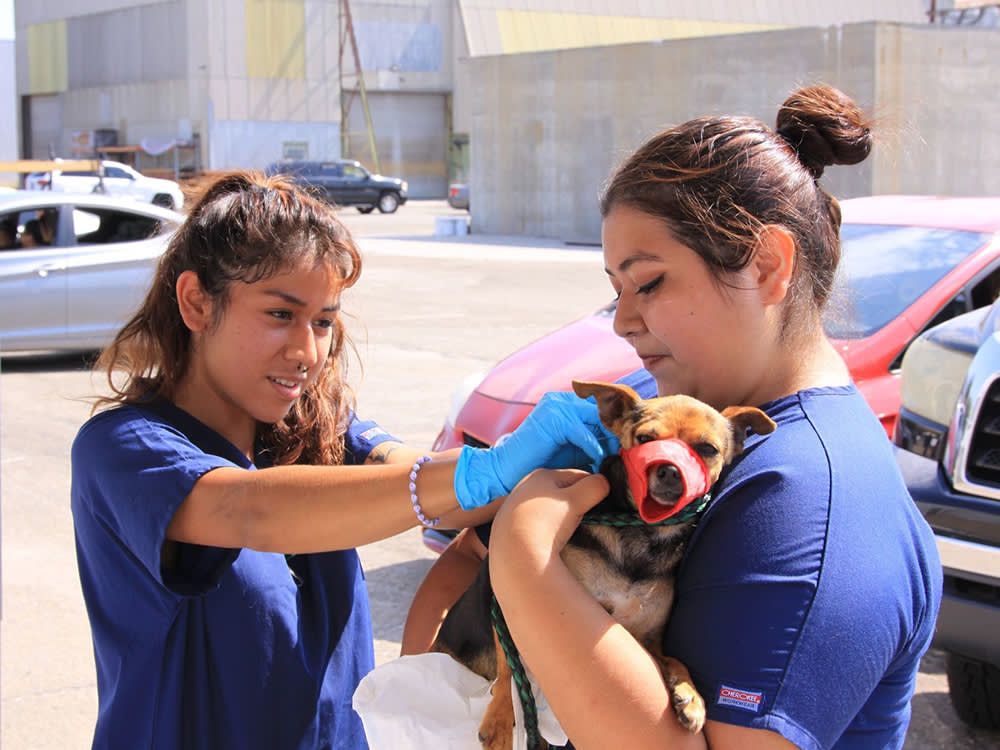
Picture the moment a family calls a rescue to give up their dog. The standard script is grim and familiar: the dog is surrendered, the family is judged, everyone moves on. Now picture a rescue that answers that call with a different question entirely, not “when can you drop him off,” but “what would it take for you to keep him?”
That single reframing is one of the most consequential ideas in modern animal welfare, and it came out of the roughest blocks of South Los Angeles, from a soft-spoken former furniture-factory manager named Lori Weise. She co-founded Downtown Dog Rescue, and the organization she built started from a premise the rest of the field spent years catching up to: that a dog and the person who loves it are usually better off together, and that the humane move is to make staying together possible.
The question that flipped the script
Most rescue is built around removal. A dog in a bad situation gets pulled out and rehomed, and that instinct comes from a good place. But Weise kept running into a wall it could not solve. The people calling to surrender their dogs, overwhelmingly low-income, often one emergency from losing everything, did not want to give them up. They were cornered by a landlord’s pet deposit, an unaffordable vet bill, a licensing fee, a housing rule. The dog was not the problem. The barrier around the dog was.
So when someone calls Downtown Dog Rescue meaning to relinquish their pet, the first thing volunteers ask is what it would take for the dog to stay. The answers, a few hundred dollars, a ride to a clinic, help with a deposit, help navigating a rule, turned out to be far cheaper and far kinder than intake, and they kept families whole. That practice grew into the organization’s Shelter Intervention Program, and it became the thing DDR is known for.
From Skid Row to a movement
The work started small and hard in 1996, when Weise and her co-founder, Richard Tuttlemondo, both managers at the Modernica furniture factory downtown, resolved to act on the suffering dogs crowding the streets around them. A plan to spay and release females led them into nearby Skid Row, a dense stretch of blocks where thousands of people were living in desperate conditions. They went in expecting to capture strays and discovered something that changed everything: many of the dogs were not strays at all. They had owners, people who happened to be homeless.
Winning over the dogs, it turned out, meant first winning over the people. Their first real link to that community was a New Orleans-born man named Benny Josephs and his older Pit Bull, Iron Head, a dog Josephs had come across bearing a burn scar on his head and gone on to share a cardboard shelter with, bunk-bed style. As Weise learned the realities of that world, the shape of the problem came into focus. A dog could not be licensed without an owner’s address. Homeless shelters and subsidized housing would not take pets. Disease ran through the encampments. Some dogs were abused, some kept only to help with panhandling.
Their first instinct, to remove the dogs from all that, ran into the same truth again: there were too many, most were considered unadoptable, and the people did not want to lose them. Pulling dogs away from the homeless owners who had been caring for them did not sit right. So they inverted the plan and brought the services to the people instead. They delivered food, ferried dogs to the vet, built kennels behind the factory, and solved the licensing trap by using their business address to license more than 300 dogs themselves. Over time, as a successful spay-and-neuter push thinned the Skid Row dog population, the work turned toward low-income owners living across Watts, Compton, and South Central.
Learning the dogs no one else would take
The dogs that came with this territory were not easy. Most were Bully breeds shaped by street survival, a few were trained fighters, and none of them were predictable, which is exactly why the shelters that would have taken them were also likely to euthanize them. Aggression ranks among the top reasons dogs are given up in Los Angeles, and DDR was deliberately working at that hardest edge.
A turning point came in 2003 with a blue Pit Bull, aptly named Blue, who went from calm to explosive the instant he met the founders’ own dog, tearing a hole in a military-grade kennel and leaving Weise wondering whether it was time to quit. A friend sent her instead to Brandon Fouche of Canine Communications, whose facility in South Central was full of Bully breeds coexisting peacefully. His approach treated these dogs as pack animals who crave order and can be taught to gauge and manage their own aggression, and two weeks later Blue was running with the group. Weise brought more dogs to Fouche, and then he handed one back to her and told her to do it herself. She ran a stubborn potbellied Pit named Lulu through a two-week socialization boot camp, and it worked. That success became a template, and she began building programs no one had tried before.
Those programs did not look like anyone else’s. They looked like hip-hop flyers distributed on gang turf urging people to get their dogs fixed, and like block-party-style spay and neuter events staged right in the middle of Watts and Compton, the first big one held in 2002 despite everyone predicting disaster. To make it work in neighborhoods wary of outsiders, Weise leaned on local volunteers, “street soldiers” who knew the blocks, and on paying people for help and information rather than lecturing them. Her stance was that the outsider is the one who needs the education, and that respect, not reform, is what brings down the wall between a rescue and a community.
The housing fight that set families free
The deepest barrier was housing, and it took one of DDR’s own people to crack it. Jo Barker, who lived in South Central, fell into homelessness in 2003 and spent three years moving between shelters and motels, able to keep only two of her four dogs. Out of that experience she taught herself the law, and unearthed the leverage that mattered: under the Fair Housing Act, a person’s dog can qualify as an assistance animal, which means it is permitted in federally subsidized housing that otherwise bans pets. The sticking point was getting landlords and agencies to honor it. After months of conflict, and with the Los Angeles Homeless Services Authority brought in to mediate, an agreement finally held. Residents would no longer have to choose between their dogs and a roof.
That is the whole philosophy in miniature. Barker’s own street dog, Boxer, carries a patch of coloring on his shoulders shaped, she likes to point out, like angel wings, and he learned trust and stability in one of the city’s toughest neighborhoods rather than in a kennel or a grave.
What’s new since this was written
The idea that started as a scrappy workaround has become an institution. Downtown Dog Rescue’s Shelter Intervention Program, formally launched in April 2013, has kept more than 5,000 pets out of the shelter system by resolving the specific barrier standing between an owner and their animal. It has expanded far beyond DDR’s original blocks, operating at Los Angeles city shelters including South LA, East Valley, and North Central, and at county facilities such as Carson, Baldwin Park, and Downey, and it has been widely copied by shelters and rescues across the country as a model for keeping pets and people together.
Weise’s work has also drawn a wider spotlight. She has been profiled by national outlets and is the subject of the 2024 book Rethinking Rescue: Dog Lady and the Story of America’s Forgotten People and Pets by journalist Carol Mithers, which traces how her insistence on serving people, and not just pulling dogs, reshaped the way the humane movement thinks about who deserves the love of a dog. The through-line, from a cardboard shelter on Skid Row to a national program, is the same stubborn bet she started with: help the person, and you save the dog.
References
- Mithers, Carol. Rethinking Rescue: Dog Lady and the Story of America’s Forgotten People and Pets. Counterpoint Press, 2024. counterpointpress.com
- Downtown Dog Rescue. “Shelter Intervention Program.” downtowndogrescue.org
- “Lori Weise, Founder, Downtown Dog Rescue.” PBS NewsHour, Brief but Spectacular. pbs.org
- U.S. Department of Housing and Urban Development. “Assistance Animals and the Fair Housing Act.” hud.gov
Leila Torres leads our Living coverage, from home life and travel to the products and rescue stories that come with sharing a life with animals. She edits and writes across the section, with a soft spot for pieces about the bond between people and their pets.
Meet our experts ↗Keep reading
 LivingA Former Ringling Clown Is Rewriting the Pit Bull's Reputation, One Hoop at a TimeMarcus Webb · 5 min
 LivingShelters Didn't Refill Because Adopters Vanished. Three Faucets Were Left RunningLeila Torres · 6 min
 LivingThe Prison Puppy Program Has One Rule Ghislaine Maxwell Can't Get AroundNina Vasquez · 4 min
 LivingA Cairo Puppy Lost All Four Paws. Then Women Across the World Went to Work.Nina Vasquez · 6 min
 Living55 Dogs, One Business License: The Arizona Case That Exposes a Rescue LoopholeJames Okafor · 5 min
 LivingA Man Cried About His Dog on Live TV. A Shelter's Inbox Exploded.Sara Lim · 5 min