


Mango Is Safe for Your Dog. The Skin Might Not Be Safe for You
Mango flesh is a great dog treat, but the skin carries urushiol, the same irritant as poison ivy, and your dog can ferry it straight to you. A vet on serving mango and the quirk nobody mentions.

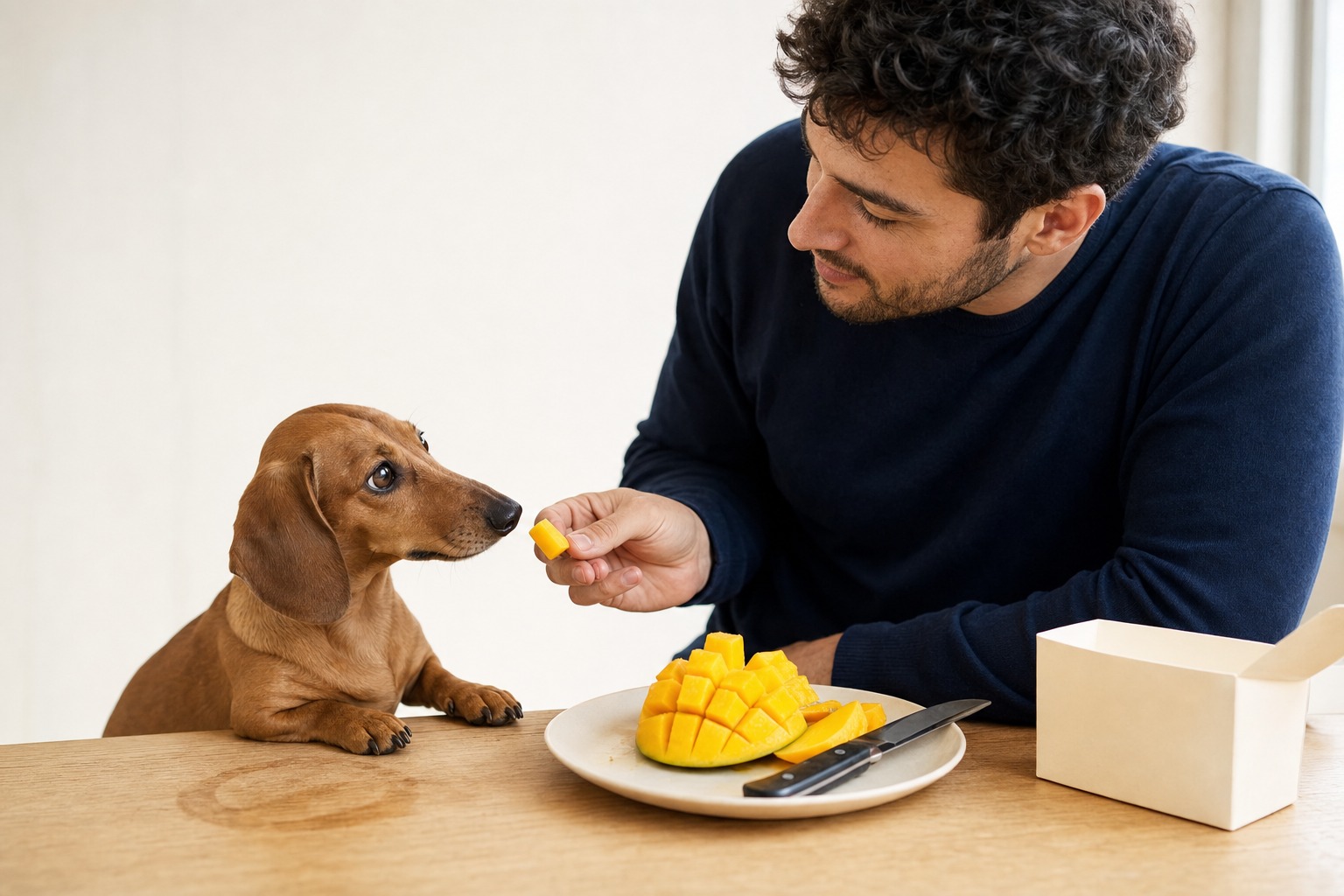
Mango lands on every “fruits dogs can eat” list, gets a cheerful yes, and moves on. That is mostly right and slightly incomplete, because mango has a quirk none of those lists mention: its skin is chemically related to poison ivy, and while your dog probably will not break out, you might. So the interesting mango question is not really “can my dog eat it,” it is “what do I do with the parts my dog should not eat,” and the answer touches your own skin, not just theirs. Here is the full picture, flesh and peel and pit.
The flesh: a genuinely good treat
Start with the easy part. Ripe mango flesh (Mangifera indica) is a nutritious snack for most dogs. It brings vitamin C for immune support and healing, vitamin A for vision and immune function, folate for red blood cell formation, polyphenol antioxidants that mop up cell-damaging free radicals, and fiber plus water for the gut. Dogs tend to love the sweetness, and in small amounts it is a pleasant, vitamin-carrying treat.
The catch on the flesh is sugar. Mango is sweet enough that it is a poor fit for diabetic dogs, who often cannot handle the load, and for dogs on strict calorie-controlled diets. For those dogs, the right move is not “a little mango,” it is a lower-sugar snack entirely, green beans, a few blueberries, a bite of cucumber. For everyone else, mango stays in the occasional-treat lane.
The skin: the part that can come back to bite you
This is the twist. Mango skin is technically edible, but it earns a skip for two separate reasons, and the second one is about you.
First, it is tough and hard to digest, and larger pieces can lodge in the esophagus or intestines, the same mechanical risk that makes so many fruit parts off-limits.
Second, and more surprising, mango skin contains urushiol, the oily irritant responsible for poison ivy and poison oak rashes. Mango belongs to the same plant family as poison ivy, so this is not a coincidence. Here is the counterintuitive part: dogs rarely develop the itchy, blistering dermatitis that urushiol causes in people, because their fur shields their skin. But that same fur can carry the oil. A dog who mouths mango skin, or brushes through poison ivy on a walk, is more likely to transfer urushiol to your hands and arms than to break out themselves.
Mango is one of those treats dogs go a little wild for, which is exactly why prep discipline matters. The flesh is wonderful in small amounts. The pit and skin are what send dogs to the emergency vet, so they come off first, and I tell owners to wash their hands after handling the peel, because that is the part that can transfer to you.
So handle the peel like you would any poison-ivy-adjacent material: get it off the mango, into the trash, and wash your hands. Do not let your dog chew the discarded skin.
The pit: a hard no
Never let your dog have a mango pit. It is large, hard, and slow to break down, which makes it a choking hazard and a prime candidate for gastrointestinal obstruction, watch for vomiting, appetite loss, belly pain, and lethargy if one is swallowed. It also contains small amounts of cyanide compounds. A single pit is unlikely to poison a dog, but between the blockage risk and the chemistry, there is simply no reason to allow it. Cut around it, discard it out of reach, and move on.
How to serve it, start to finish
- Choose a ripe mango and wash the outside.
- Peel it completely, discard the skin in a sealed bin, and wash your hands after handling the peel.
- Cut the flesh off the pit and discard the pit where your dog cannot reach it.
- Chop the flesh into bite-sized pieces sized to your dog.
- Keep it to a small, occasional serving under the 10 percent treat budget, and on a hot day, freeze a few cubes for a cooling treat.
- If your dog is diabetic or on a weight-loss plan, skip mango and pick a lower-sugar snack.
Dried mango, by the way, is not a shortcut. It concentrates the sugar and may carry added preservatives, so fresh flesh is the better call.
The bottom line
Mango is a safe, nutritious treat for most dogs, and the “yes” you have read elsewhere holds up, for the flesh. The parts to respect are the pit, which is a real obstruction and cyanide hazard, and the skin, which is both hard to digest and coated in the same irritant as poison ivy. Peel it, pit it, wash your hands, keep it small and occasional, and steer diabetic dogs toward something less sweet. Do that and mango is exactly the easy summer treat its reputation promises, minus the part that could give you a rash.
References
- ASPCA. “Toxic and Non-Toxic Plants List.” https://www.aspca.org/pet-care/animal-poison-control/toxic-and-non-toxic-plants.
- Kim, H., et al. “Nutritional Composition and Bioactive Compounds in Three Different Parts of Mango Fruit.” International Journal of Environmental Research and Public Health. https://pmc.ncbi.nlm.nih.gov/articles/PMC7345606/.
- American Academy of Dermatology. “Poison Ivy, Oak, and Sumac: What Causes the Rash.” https://www.aad.org/public/everyday-care/itchy-skin/poison-ivy/treat-rash.
Common questions
Can dogs eat mango skin?
Best to skip it. Mango skin is hard to digest and can lodge in the throat or gut, and it contains urushiol, the same oily irritant found in poison ivy. Your dog may not react to it, but the residue can transfer to you.
Is the mango pit dangerous?
Yes. The pit is a choking and intestinal-obstruction hazard and contains small amounts of cyanide compounds. Always remove it before serving.
Which dogs should not have mango?
Diabetic dogs and dogs on strict weight-loss plans should skip mango because of its sugar. For those dogs, reach for a lower-sugar option like green beans or a few blueberries.
Not a substitute for your vet. Our guidance is educational. For urgent symptoms, contact a vet or emergency clinic right away. Editorial standards
Dr. Nair is a veterinarian focused on diet and feeding. She covers everyday nutrition, treats, and the many "can they eat this?" questions owners ask, grounding each answer in what is actually safe and sensible for dogs and cats.
Meet our experts ↗Keep reading
 FoodSalmon Is Great for Your Dog. Raw Salmon Can Kill Them.Dr. Ravi Mehta · 7 min
 FoodCranberries Won't Cure Your Dog's UTI. The Science Is Blunt About It.Dr. Nina Kohl · 6 min
 FoodThe Avocado Panic Is Half Wrong. Here's the Half That's Real.Dr. Ravi Mehta · 7 min
 FoodShrimp for Dogs: The Cooking Rule Protects You BothDr. Lena Park · 7 min
 FoodOne Lick of Cool Whip Won't Hurt Your Dog. The Habit Will.Dr. Amara Solis · 6 min
 FoodKale Is a 'Superfood.' For Dogs, It Comes With a Catch.Dr. Priya Nair · 5 min