


Cranberries Won't Cure Your Dog's UTI. The Science Is Blunt About It.
Cranberries are a safe, healthy dog treat, but the belief that they prevent or treat urinary infections doesn't hold up. A vet walks through what a 2026 review found, and how to actually feed them.

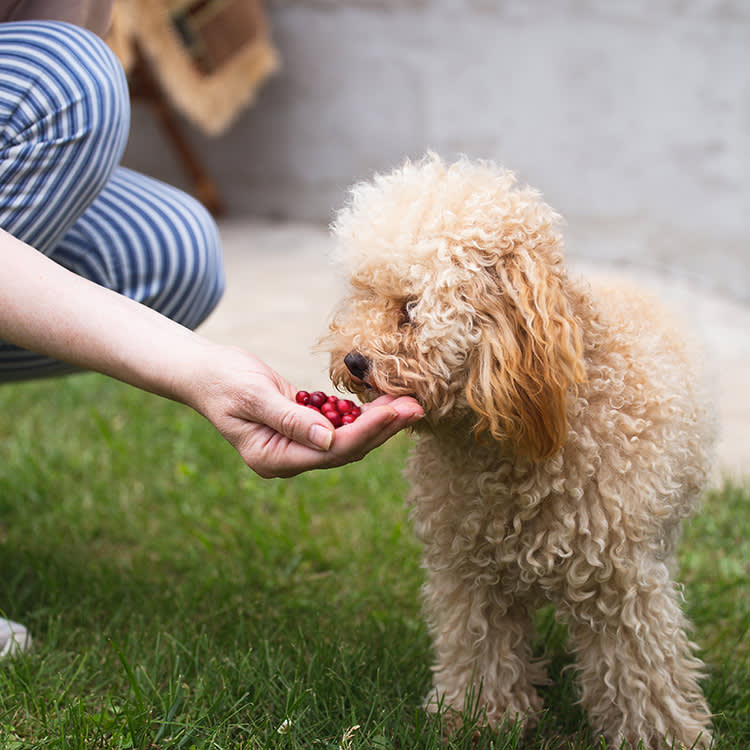
Cranberries have a reputation that precedes them: the urinary-tract fruit, the natural UTI fix, the thing you reach for so nobody has to go to the doctor. That reputation has migrated to dogs, and it’s why a lot of people feed cranberries or buy cranberry supplements, to head off or treat their dog’s urinary infections. Here’s the uncomfortable part, delivered straight: the science doesn’t back that up. Cranberries are a perfectly good treat for a dog. As a UTI remedy, the evidence is thin to the point of blunt, and a 2026 review of the research says so plainly.
That’s the thing worth getting right, because a myth about medicine is more dangerous than a myth about a snack. So let’s separate the two: cranberries the treat, which are fine, from cranberries the cure, which aren’t.
The UTI claim, and what the evidence actually shows
The theory has a real mechanism behind it, which is why it’s so sticky. Compounds in cranberries can, in a test tube, reduce the ability of bacteria like E. coli to stick to the cells lining the urinary tract. Less adhesion, the logic goes, means fewer infections. It’s a tidy story, and in a lab dish there’s something to it.
The trouble is that dogs are not test tubes, and the studies in actual animals don’t deliver on the promise. A 2016 trial in the American Journal of Veterinary Research gave dogs with recurrent UTIs either an antibiotic or cranberry extract for six months; the cranberry group actually had a numerically higher infection rate than placebo, though the difference wasn’t statistically significant. And a 2026 systematic review, the most comprehensive look yet, pulled together the available studies, three of them, covering 122 animals, and found that none reported a statistically significant or even numerical benefit from cranberry for preventing or treating urinary tract infections. The reviewers rated the certainty of evidence as low to very low and concluded the data simply can’t support cranberry as a treatment or preventive.
In plainer terms: the lab result never translated into a real benefit for real dogs. Cranberries may keep bacteria from sticking on a slide, but there’s no good reason to believe cranberry supplements do anything meaningful for a dog’s urinary health.
The cranberry-for-UTIs idea is one I have to gently correct a lot. I understand why, it sounds natural and it’s what people do for themselves. But a urinary infection in a dog is a real medical problem that needs a real diagnosis and usually antibiotics, and the research on cranberry just isn’t there. My worry is a dog sitting in discomfort while an owner waits for berries to work. Feed cranberries because your dog likes them. Don’t feed them instead of a vet visit.
This is the reframe that matters. If your dog is straining to urinate, going more often, having accidents, or you see blood, that’s a vet visit, not a cranberry. Untreated urinary infections can climb to the kidneys and turn serious. The berry is not a substitute for care.
As a treat, though, they’re genuinely fine
With the medical myth set aside, cranberries are a nice little snack, and here the news is good. Plain cranberries aren’t toxic to dogs, and they bring a respectable nutritional profile: low in calories, low in sugar, and high in antioxidants.
The antioxidants, anthocyanins, ursolic acid, quercetin, are studied for helping reduce inflammation and support the immune system. Cranberries also offer fiber, which aids digestion and helps a dog feel full, and vitamins C, A, and K. It’s a legitimately healthy, low-calorie treat, exactly the kind of thing you can offer a dog that could use a snack without a sugar load. Just feed it as what it is, a treat, not a therapy.
How to feed them without trouble
Keep two things in mind: plain, and portioned.
Plain. Give only plain cranberries, no added sugar, no flavorings. Raw or cooked are both fine. The versions to avoid are the sweetened ones: cranberry sauce (unless it’s homemade with nothing but cranberries), dried cranberries, which concentrate the sugar, and especially cranberry juice, which is high in sugar. Steer clear of sugar-free cranberry products too, because “sugar-free” can mean xylitol, a sweetener that’s severely toxic to dogs. Cranberry-containing cookies or cakes are also out, not for the cranberries but for the butter, milk, and sugar around them.
Portioned. Serving size scales with the dog. As a rough guide, a small dog can handle one to two cranberries at a time, a medium dog five or six, and a large or giant breed eight to ten, as an occasional treat a few times a week. Whole cranberries can be a choking size for small dogs, so wash and chop them for the little ones. If it’s your dog’s first time, offer a small bite and watch, then increase gradually if all is well. Too many cranberries, thanks to their sugar and acid, can bring on diarrhea, vomiting, stomach pain, or loss of appetite, and if digestive upset lasts more than a day or two, call your vet. As with any treat, keep cranberries under roughly 10 percent of daily calories on top of a complete and balanced diet.
A quick word on cranberry supplements, since they’re marketed hard for canine urinary health: given the evidence above, don’t count on them to do what the label implies. If you’re considering one for any reason, talk to your vet first rather than assuming it’s helping.
What’s new since this was written
The headline update is exactly the 2026 systematic review discussed above. It represents the current best synthesis of the evidence, and it lands firmly against cranberry as a urinary treatment or preventive in dogs and cats, while noting how few and how small the existing studies are. If you’ve been feeding cranberry supplements on the old assumption that they protect your dog’s bladder, this is the research that should change your mind, or at least prompt a conversation with your vet about what actually works.
The other steady development is the widening reach of xylitol in sugar-free products, now often labeled “birch sugar.” It doesn’t touch fresh cranberries, which stay safe, but it sharpens the same rule that runs through every fruit-for-dogs question: the whole, plain food is fine, and the danger hides in the sweetened, “sugar-free,” processed versions. Read the label on anything cranberry-flavored before it goes near your dog.
The bottom line
Cranberries are a safe, low-calorie, antioxidant-rich treat for dogs, feed them plain, raw or cooked, in size-appropriate amounts, and skip the sauce, juice, dried, and sugar-free versions. What they are not is a UTI remedy. The best available evidence, capped by a 2026 review, finds no real benefit from cranberry for preventing or treating urinary infections in dogs, so if your dog has urinary symptoms, the answer is a trip to the vet, not a handful of berries. Enjoy them as a snack; don’t ask them to be medicine.
References
- Weese, J.S., et al. “Effectiveness of Cranberry Supplementation for Prevention and Treatment of Infectious Urinary Tract Disease in Dogs and Cats: A Systematic Review.” Journal of Veterinary Pharmacology and Therapeutics, 2026. PMC12968518
- Chou, H.-I., et al. “Effects of cranberry extract on prevention of urinary tract infection in dogs and on adhesion of Escherichia coli to Madin-Darby canine kidney cells.” American Journal of Veterinary Research, vol. 77, no. 4, 2016. AVMA Journals
- Health Benefits of Cranberries — WebMD
- Xylitol and Your Dog: Danger, Symptoms and Treatment — U.S. Food & Drug Administration
Common questions
Do cranberries prevent or cure UTIs in dogs?
The evidence says no. A 2026 systematic review of the available studies in dogs and cats found no clear benefit from cranberry supplements for preventing or treating urinary tract infections. If your dog has a UTI, it needs a vet, not cranberries.
How many cranberries can a dog have?
It depends on size: roughly one to two for a small dog, five or six for a medium one, and eight to ten for a large dog, as an occasional treat a few times a week. Too many can cause stomach upset.
Is cranberry juice safe for dogs?
Not recommended. Cranberry juice is high in sugar, and sugar-free versions may contain xylitol, which is toxic to dogs. Stick to plain raw or cooked cranberries instead.
Not a substitute for your vet. Our guidance is educational. For urgent symptoms, contact a vet or emergency clinic right away. Editorial standards
Dr. Kohl is a board-certified veterinary dentist with a particular interest in preventive oral care. She reviews all dental health content at The Pet Times and contributes practical guides on home dental routines, professional cleaning, and oral disease prevention.
Meet our experts ↗Keep reading
 FoodYogurt Isn't a Health Food for Your Dog. It's a Brilliant Delivery DeviceDr. Priya Nair · 6 min
 Food"Dogs Are Basically Wolves" Is How Raw Chicken Gets Fed. Here's the Catch.Dr. Lena Park · 7 min
 FoodBaked Sourdough Is a Fine Dog Snack. Raw Dough Is a 911 Call.Dr. Amara Solis · 6 min
 FoodPapaya for Dogs: The Enzyme Is the Point, and Also the CatchDr. Priya Nair · 6 min
 FoodCantaloupe Is Great for Dogs. The Rind Is the Part That Isn'tDr. Nina Kohl · 5 min
 FoodThe Real Problem With Ritz Crackers Isn't the Salt. It's the Whole RecipeDr. Priya Nair · 5 min