


Scientists Pitted Kittens Against Puppies at Math. The Kittens Won.
A study found that seven-week-old kittens can already tell more from less, a skill puppies don't nail until later. The reason traces all the way back to how cats evolved to hunt.

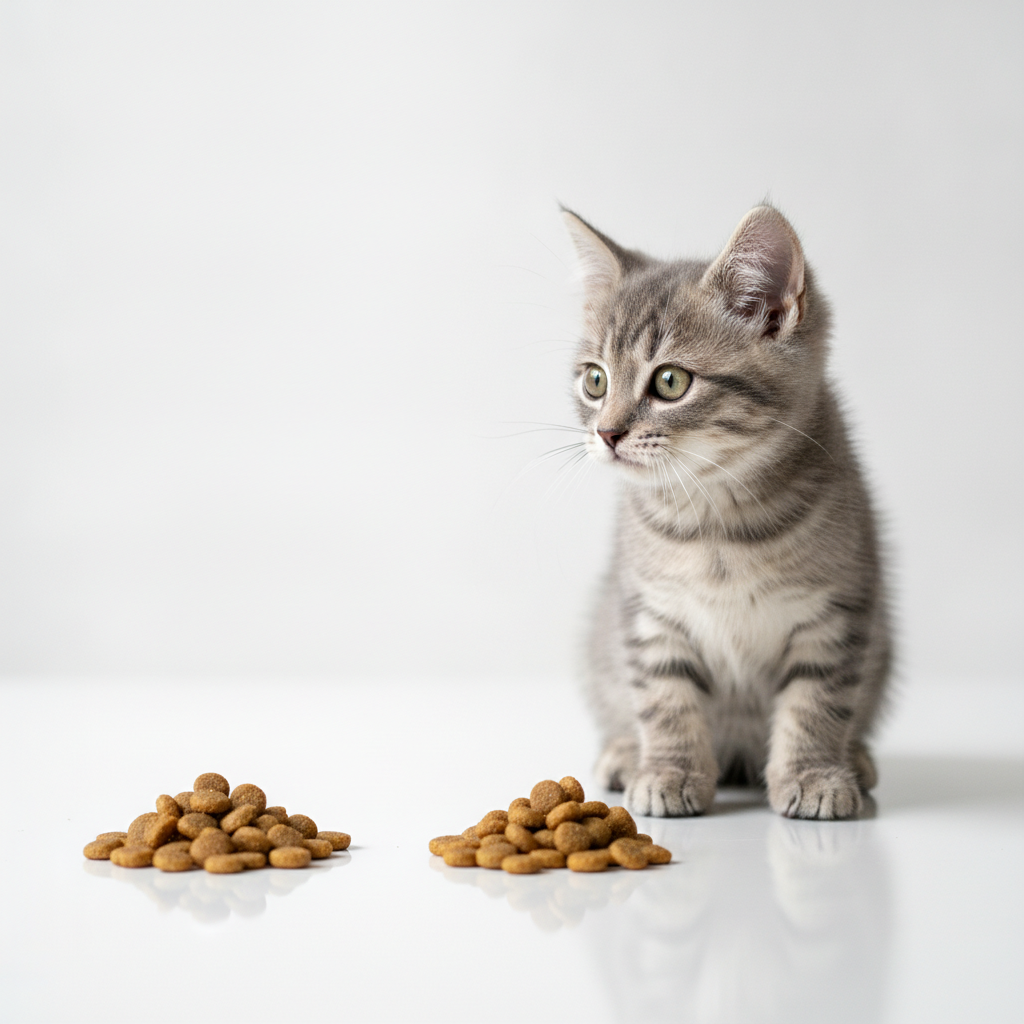
Your cat will never balance your checkbook. But it turns out that even as a tiny kitten, they were quietly doing a kind of math, and doing it better than a puppy of the same age. That’s the headline from a study on feline number sense, and the reason behind it is more interesting than the party trick itself.
The skill in question is called quantity discrimination: the ability to tell different amounts apart. It’s not counting, exactly, but it’s foundational, and it makes evolutionary sense for almost any animal. More food is good. Fewer predators is good. Being able to eyeball which pile is bigger has obvious survival value.
There’s a consistent quirk to how it works, though, and it applies to cats, people, and every other species tested. The easier the comparison, the more reliable the choice. Telling one item from ten is simple; telling eight from ten is genuinely hard. Performance tracks the ratio between the two amounts, not the raw gap.
It’s tempting to file this under cute trivia, but it tells us something real. A kitten arrives already tracking more versus less, which is exactly why enrichment built around choices, foraging spots, puzzle feeders, little food games, lands so naturally for them.
How you test a kitten’s math
A 2023 study in the journal Animal Cognition asked whether this number sense is present in very young kittens, testing seven-week-olds across two experiments. The short answer: yes, even pre-weaning kittens can handle rudimentary quantity tasks.
In the first experiment, 26 kittens chose between two trays holding different numbers of food pieces, with the amounts ranging from a close three-versus-four all the way to an easy one-versus-nine. Each kitten ran a dozen trials at different ratios. Twenty-five of the 26 picked the larger quantity more often than random guessing would predict; only one didn’t. There was no difference between male and female kittens. And they were reliable specifically when the ratio between the two amounts dropped below 0.4, the easier, more lopsided comparisons.
The second experiment tested size instead of number. Twenty-four kittens chose between a large and a small piece of food, molded into flat circles, with size ratios spanning 0.2 to 0.8. Eighteen kittens favored the bigger piece, five leaned toward the smaller, and one split evenly. Again, they were consistent only when the area ratio fell below 0.5, and again sex made no difference.
What guided their choices was purely the ratio, not the numerical difference and not the total amount of food on offer. One wrinkle: when a single piece was about five times larger than its partner, kittens actually preferred the smaller one, a bias seen in adult cats too, possibly a leftover instinct to favor prey that isn’t intimidatingly large.
Why kittens edge out puppies
Puppies can do quantity discrimination as well, they’re just slower to develop it. Where a seven-week-old kitten reliably picks four items over one, an eight-week-old puppy can’t, per a 2020 study; puppies manage the skill only on the easier spreads, like one versus six or one versus eight. As adults, cats and dogs end up more evenly matched, which means the real story is about timing: the ability simply comes online earlier in cats.
The likely explanation is written into their family histories. Cats descend from solitary hunters who had to make their own quantitative calls early in life, no pack to lean on. Dogs descend from more social, group-living ancestors, and puppies stay dependent on others longer. An early-blooming number sense is what you’d expect from an animal built to fend for itself sooner.
Why it matters beyond the fun fact
The developmental angle is the genuinely useful part. Finding this ability already near adult-level at seven weeks suggests it isn’t a slowly learned trick but something close to innate, wired in because it mattered to survival. It also slots into a growing body of research on how animals represent quantity, a field that keeps finding surprisingly sophisticated number sense across species. For the person living with a cat, the practical read is simple: your kitten came pre-loaded to make “which is more” decisions, so leaning into food puzzles and foraging games works with their instincts rather than against them.
References
- Szenczi, P., Martínez-Byer, S., Chacha, J., Hudson, R., & Bánszegi, O. “Quantity discrimination by kittens of the domestic cat (Felis silvestris catus).” Animal Cognition, 2023. doi.org/10.1007/s10071-023-01784-z
- Prato-Previde, E., et al. “Quantity discrimination in domestic dogs (Canis lupus familiaris).” Behavioural Processes, 2020. doi.org/10.1016/j.beproc.2020.104239
Dr. Chen is a small-animal veterinarian who leads health and safety coverage at The Pet Times. She writes and reviews the bulk of our illness, condition, and safety content, translating clinical guidance into clear, practical advice owners can act on at home.
Meet our experts ↗Keep reading
 TrainingYour Cat Holds a Picture of You in Their Head, Even When You Leave the RoomDr. Mara Chen · 4 min
 TrainingStop Watching Who's Winning. The Real Tell in a Cat Fight Is Who Trades PlacesNina Vasquez · 5 min
 TrainingYour Cat Isn't Aloof. Science Counted 276 Faces to Prove ItDr. Amara Solis · 6 min
 TrainingBreed Barely Predicts Your Cat's Personality. Here's the ProofDr. Ravi Mehta · 6 min
 LivingYour Kid Isn't Scaring the Cat on Purpose. Here's the Fix.Dr. Nina Kohl · 6 min
 TrainingCats Copy Each Other's Faces. AI Caught Them Doing It.Dr. Nina Kohl · 4 min