


The Goodbye Ritual You Think Is Sweet Is Stressing Your Cat Out
A calm cat while you travel isn't about the sitter, it's about the setup you leave behind. A cat behaviorist on the routine, enrichment, and one habit you should drop entirely.

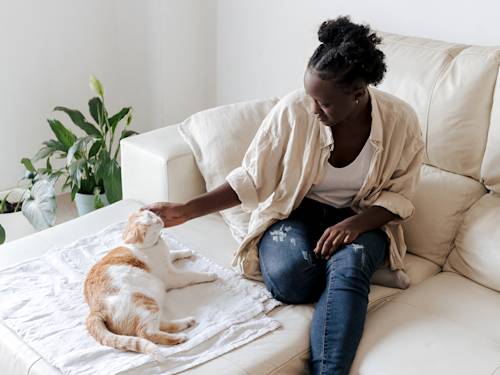
Everyone worries about the wrong half of leaving a cat behind. We obsess over the sitter, the app, the daily check-ins, all the human logistics. Meanwhile the thing that actually determines whether your cat spends your trip relaxed or wound tight is the environment you leave them in, and one small habit most owners think is loving. Get the setup right and your cat barely registers that you are gone. Here is how to build it.
Home beats anywhere else
The single biggest lever is location, and it favors staying put.
Cats are deeply territorial, and their sense of safety is tied to their own space more than to any particular person. A new environment, even a nice boarding facility, asks a cat to feel safe somewhere unfamiliar, and many cats simply cannot. Keeping them home, with someone coming to them, removes the biggest source of stress before you even start.
Cats also hide stress well, and it does not stay purely emotional. Feline stress can surface as real physical problems, from litter box trouble to stress-linked cystitis, which is one more reason to keep the environment as unchanged as possible. If home care is at all an option, choose it over boarding.
Guard the routine like it matters, because it does
Cats run on prediction. The more your cat’s day stays identical while you are gone, the less your absence stands out.
Keep feeding times exactly where they normally are. A timed automatic feeder is a genuinely useful tool here, not because it replaces a sitter but because it anchors the day: set it for the usual hour and your cat will start waiting for it in their usual spot, absorbed in their own rhythm rather than the fact that you are not around. The goal is a day that looks and feels like every other day.
Fill the silence and the hours
Two kinds of emptiness bother a home-alone cat: quiet and boredom. Address both.
For the quiet, leave some low background noise going. A radio or TV on softly takes the edge off an empty house, and there are cat-specific playlists and videos made for exactly this. One honest caveat from behaviorists who suggest it: some cats will bat at or chase a TV, so if yours treats the screen as prey, skip the video and stick to audio.
For the boredom, add enrichment before you go. More toys, extra scratchers, vertical space to climb, a few good hiding spots, an extra cozy bed. A rotating handful of foraging or puzzle feeders gives a bored cat a job. The idea is to make the environment more interesting while you are away, not less, so there is something to do besides wait.
The goodbye habit to drop
Now the counterintuitive part. The tender, drawn-out goodbye, the extra treats, the “be a good kitty” send-off, feels like kindness. It is closer to the opposite. Making a big emotional production of leaving turns your departure into a marked, dramatic event, which is exactly what you do not want a cat to register.
Keep your exits low-key and unceremonious. No fussing, no farewell treats, no lingering. Do the same when you get back: a calm, ordinary arrival rather than a big reunion. And take some comfort in feline biology here, because cats sleep a great deal of the day, and a cat who is dozing when you slip out may not clock your leaving at all. Let your absence be a quiet blank in their day rather than a cliffhanger. When they wake up, you can lavish them with all the attention they will tolerate, which, being a cat, will be exactly as much as they decide and not one pet more.
References
- Ohio State University Indoor Pet Initiative. “Enriching Your Cat’s Environment.” https://indoorpet.osu.edu/cats
- International Cat Care. “Preventing and reducing stress in cats.” https://icatcare.org/advice/
- Cornell Feline Health Center. “Feline Behavior Problems: House Soiling.” https://www.vet.cornell.edu/departments-centers-and-institutes/cornell-feline-health-center/health-information/feline-health-topics/feline-behavior-problems-house-soiling
Dr. Kohl is a board-certified veterinary dentist with a particular interest in preventive oral care. She reviews all dental health content at The Pet Times and contributes practical guides on home dental routines, professional cleaning, and oral disease prevention.
Meet our experts ↗Keep reading
 LivingThe One Question That Sorts a Good Cattery From a Bad OneNina Vasquez · 6 min
 LivingThe Cat Lover's New York Is Really a Map of Cats Who Need HomesJordan Ellis · 7 min
 LivingHis Cat Vanished in Yellowstone. Two Months Later, a Chip Pinged 900 Miles Away.Dr. Lena Park · 5 min
 Health & WellnessYour Cat Skips the Vet Because of the Car, Not the BillDr. Mara Chen · 6 min
 LivingOne Cat, Three Flights, Zero Consent: How Mittens Became a Frequent FlyerJordan Ellis · 4 min
 LivingA Full Bowl Isn't Cat Care. Hire the Sitter Who Notices.Leila Torres · 6 min