


His Cat Vanished in Yellowstone. Two Months Later, a Chip Pinged 900 Miles Away.
Rayne Beau walked from Wyoming to Northern California and lost 40 percent of his body weight doing it. The reason his story has an ending is a scanner, not a miracle.

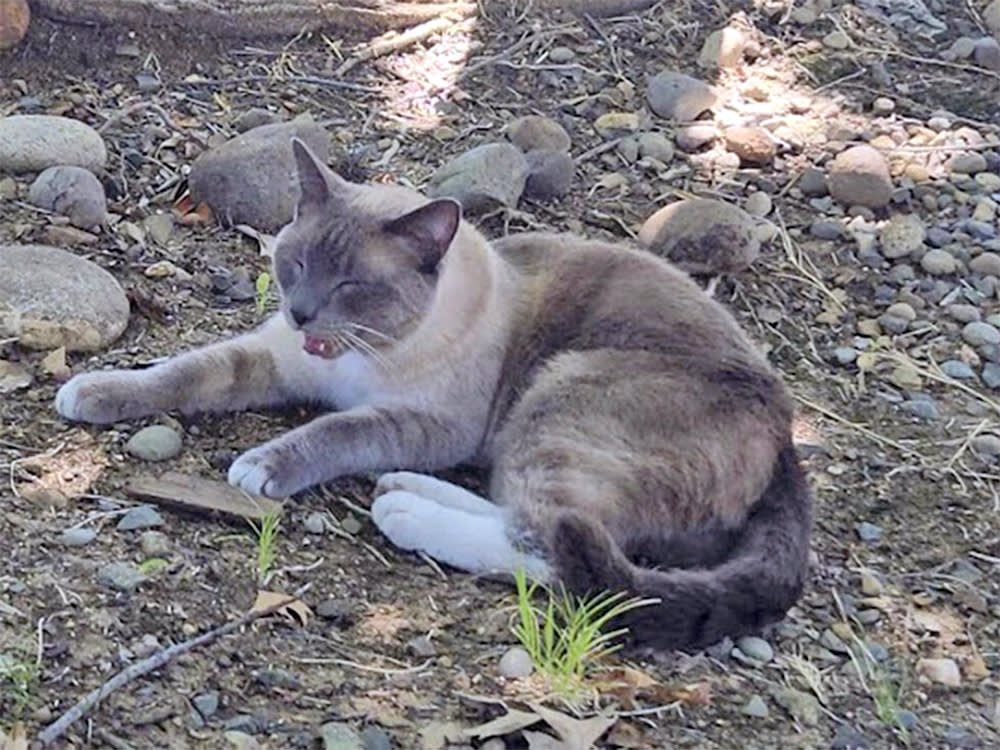
The part everyone repeats is the mileage. A cat went missing in Yellowstone and turned up 900 miles away in Northern California, roughly two months later, having apparently walked most of it himself.
The part that actually saved him was a microchip the size of a grain of rice, and a phone number that still worked.
What happened
On June 8, Benny and Susanne Anguiano were camping in Yellowstone National Park with their two cats when something in the woods spooked one of them. Rayne Beau, a grey cat whose name is pronounced “Rainbow,” bolted.
They searched for four days. They put out his favorite treats and his toys, which is what you do, and which usually works, and this time did not. Eventually they had to drive home to Salinas, California, without him.
Susanne told the Associated Press that she never entirely let go of the idea he would find his way back. Somewhere in the Nevada desert on the drive home, she saw a double rainbow through the windshield and photographed it, and read it as a promise about a cat named Rainbow.
The call came from a scanner
In August, a microchip company contacted the Anguianos. Rayne Beau was at the SPCA in Roseville, California, north of Sacramento, about 900 miles from the last place they had seen him.
A woman had found him near her home and had been putting out food and water until she managed to trap him on August 3. She brought him to the SPCA. Somebody there ran a scanner over the back of his neck, and a number came up, and that number was attached to a working phone. The next day, he went home.
He was not in good shape. Susanne’s account is grim: his paws were badly beaten up, he had lost 40 percent of his body weight, and his protein levels were low enough to say plainly that nobody had been feeding him. He had not been taken in and cared for by anyone along the way. He walked it.
The number that makes this story ordinary
Here is what turns a miracle into a procedure. Microchipped cats who arrive at a shelter as strays are reunited with their families about 38.5 percent of the time. Unchipped stray cats go home 1.8 percent of the time.
That is the finding from a landmark study of 7,704 microchipped animals across 53 shelters, published in the Journal of the American Veterinary Medical Association. A microchip does not make your cat findable. It makes your cat returnable, which is a different and much more powerful thing, because the finding usually happens anyway and then dead-ends.
And now the number that should genuinely worry you. In that same study, when a chipped animal could not be returned, the single biggest reason was not a failed scan or a broken chip. It was a phone number in the registry that was wrong or disconnected: 35.4 percent of failures. Another 24.3 percent were owners who never returned the shelter’s calls or letters. Nearly 10 percent of chips were never registered at all.
Which means the most common way a microchip fails is not technological. It is administrative. Somebody moved, changed carriers, and never logged in.
The chip is the easy part, and people think it is the whole part. If you have not opened your registry account since the day of the implant, your cat is functionally unchipped. It takes four minutes to fix, and it is the four minutes that decides whether anyone can call you.
What the Anguianos changed
Both of their cats now wear AirTags. Rayne Beau also got a global GPS tracker, which is the reasonable overcorrection of a family that has been through this.
They are also scaling back the camping, at least for a while. Benny described the aftermath of losing him as an ugly feeling, and said they would practice at home first, camping in the driveway, so Rayne Beau can get used to it in a place where bolting means running to the back door.
That instinct is right, and it generalizes. A cat who has never left the house is not ready for a national park. A campsite is a wall of unfamiliar smells and sounds with no safe room to retreat to, and a startled cat’s plan is not to hide under the picnic table. It is to run in a straight line until the fear stops.
The four-minute version
If you take one thing from a cat who walked 900 miles:
- Get the chip. It costs less than a bag of premium food and it is the only ID that cannot fall off.
- Register it, in your name, with a phone number you actually answer. An unregistered chip is a serial number pointing nowhere.
- Update it when you move or change your number. This is the step that fails, more than any other single thing.
- Add a tracker if you travel with your cat, but treat it as a supplement, not a replacement. A GPS tag can slip off a harness. The chip stays.
Rayne Beau got extraordinarily lucky and paid for it with 40 percent of his body weight. The ordinary version of his story is a scanner, a phone call, and a cat home the same afternoon.
References
- Search and reunification methods and microchip return rates in stray dogs and cats — Lord et al., Journal of the American Veterinary Medical Association (via The Ohio State University)
- Microchips Result In High Rate Of Return Of Shelter Animals To Owners — Faunalytics
- Rethink the microchip and boost your return-to-owner rate — University of Florida Shelter Medicine Program
Dr. Park is a board-certified emergency and critical care specialist. She reviews our health and safety content for clinical accuracy and contributes guides on recognising urgent conditions. Her focus is helping owners act quickly and correctly when it matters most.
Meet our experts ↗Keep reading
 Health & WellnessYour Cat Skips the Vet Because of the Car, Not the BillDr. Mara Chen · 6 min
 LivingThe One Question That Sorts a Good Cattery From a Bad OneNina Vasquez · 6 min
 LivingYour Cat Will Yowl for 3,000 Miles. Fix the Box, Not the Noise.Dr. Lena Park · 8 min
 LivingThe Cat Lover's New York Is Really a Map of Cats Who Need HomesJordan Ellis · 7 min
 LivingA Full Bowl Isn't Cat Care. Hire the Sitter Who Notices.Leila Torres · 6 min
 LivingTikTok Makes Flying With a Cat Look Easy. Here's the Part It Skips.Leila Torres · 10 min