


TikTok Makes Flying With a Cat Look Easy. Here's the Part It Skips.
The viral cats-in-Paris videos leave out the stress, the paperwork, and the honest first question: should your cat be on a plane at all? A real guide to flying with a cat, including the part where the answer is 'leave them home.'

Affiliate disclosure. This article contains affiliate links. We may earn a small commission if you buy through a link, at no extra cost to you. How we handle recommendations.
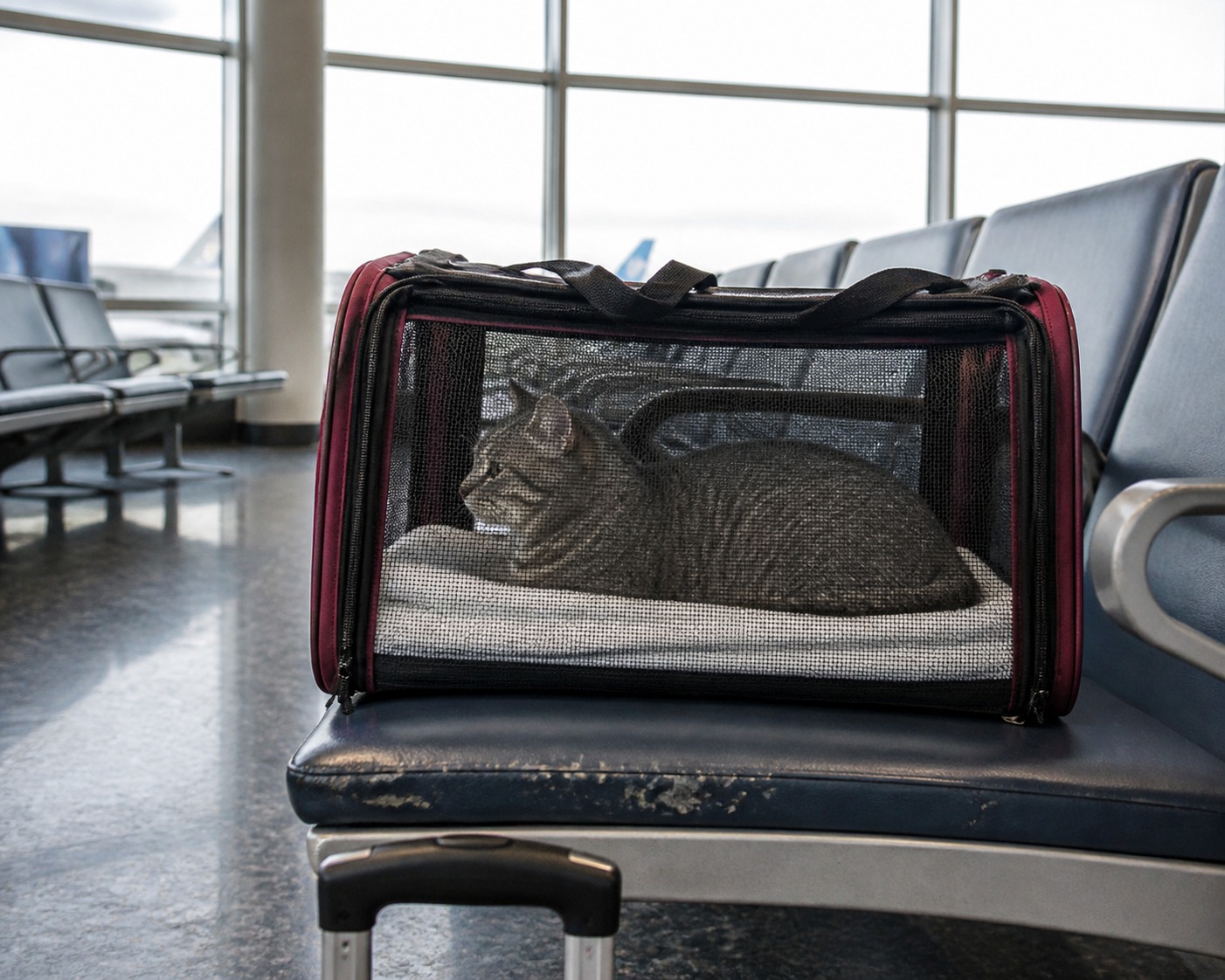
Your feed is full of them: cats in tiny sweaters padding down the aisle to Paris, lounging carrier-free on a lap at 35,000 feet, serving looks in matching stripes with their humans. It looks effortless, aesthetic, and honestly kind of magical. Nothing racks up views like a cat on a plane.
What those videos don’t show is everything that makes flying with a cat hard, and the one question a good guide has to ask before any of the logistics: should your cat be on that plane at all? For a lot of cats, the most loving answer is no. This is the honest version, starting there and then, if you truly must fly, walking through how to do it as safely and calmly as possible.
First, the question TikTok won’t ask: should you?
Strip away the content and you are left with a simple welfare question. If you are relocating and there is no alternative, flying with your cat is a genuine necessity and you make the best of it. But if this is a vacation and your cat hates the carrier or hates leaving home, forcing them onto a plane is a hard thing to justify. It will be stressful for them in a way it simply isn’t for a dog who lives for the car ride. The kinder option is often a trusted cat sitter and a cat who gets to stay in the one place on earth they feel safe.
If the worry is that you’ll miss them, technology has you covered better than a plane ticket does. A treat-tossing pet camera like the Furbo lets you check in, talk to your cat, and even fling them a snack from another time zone. That is a far lighter footprint on your cat’s nervous system than a day of airports.
“Cats are territorial in a way that makes travel genuinely taxing for them, not just annoying,” says Dr. Lena Park. “A stressed cat can stop eating, hold their urine, or spiral into a state that turns a vacation into an emergency vet visit in an unfamiliar city. Before you book, ask honestly whether this trip is for your cat or for you. If it’s for you, they are almost always better off home with a sitter.”
If you must fly, know that the rules are a moving target
You can fly with a cat in the cabin on most major U.S. carriers, but the specifics vary by airline and destination and can change without much warning. Domestically, American, Delta, and United all allow small cats to ride in the cabin, stowed in a carrier tucked beneath the seat ahead of you. For international travel, some carriers, Lufthansa, KLM, Swiss, Air France, and Turkish Airlines among them, have a reputation for being especially accommodating to feline travelers, though whether your cat is allowed in the cabin can hinge on the breed and the destination country’s import rules.
Whichever airline you pick, do your homework before you book the ticket, not after. Five things to pin down:
- How many pets the cabin allows. Many flights cap in-cabin pets, sometimes at just a handful. If that limit is already reached, you are out of luck even if you paid, and even if you bought your cat a seat. Reserve your pet’s spot the moment you book.
- The weight limit. These often apply to the cat and carrier combined, a detail people discover at the counter when they’re already over.
- Carrier specs. Most airlines want a soft-sided carrier with a sturdy, removable base that stows below the seat, though the exact allowed dimensions differ. A handful will let a marginally bigger bag ride on your lap; most won’t.
- Entry requirements. International trips mean paperwork, typically an up-to-date rabies vaccination, a working microchip, and a health certificate, and airlines will want to see it before you board. Requirements are country-specific, so check the destination’s rules early.
- Fees, and the ESA caveat. Pet fees may be payable in advance or at the airport; keep a printed record either way. And do not assume an “emotional support animal” label gets you out of the fee. Airlines are not required to waive charges for ESAs, so declare your pet in advance and don’t argue with the gate agent about it.
Preparing for the trip
Book as far ahead as you can, both to secure a cabin spot and to give yourself time for documents. Keep every airline-specific form as an original, physical copy, digital screenshots are not always accepted. Once booked, confirm your cat’s reservation, then reconfirm a few days before departure; showing up to find the booking didn’t stick is one of the most avoidable disasters.
If you need a new carrier, buy it early and turn it into a familiar object rather than a trap. Leave it out on the floor for days so your cat can investigate it on their own terms, and take a few short practice trips, to the vet, around the block, to the store, so the carrier isn’t only ever the prelude to something scary. For a noise-sensitive cat, you can try gradually desensitizing them to the sounds of a plane, but this is delicate work, and it is worth getting a professional’s help early rather than accidentally making the fear worse.
Schedule a vet visit in the days before you fly. The vet may have to endorse a travel form, so bring the physical copy and fill in as much as you can beforehand. This is also the appointment to ask about travel-specific medication and about the right way to withhold food and water before the flight, follow your vet’s guidance here rather than the internet’s.
Then gather the essentials:
- Pee pads. One for the carrier on the way out, one for the way back, plus spares.
- A harness and leash. For any moment your cat is out of the carrier. A harness is far harder to slip than a collar, and a loose cat in an airport is a nightmare.
- Collapsible bowls and food. Bring food even if you don’t expect to need it, because delays turn a five-hour trip into a twenty-five-hour one with no warning. If you pack wet food, keep containers under 3.4 ounces in a clear quart bag or security will toss them.
- Medications. Only vet-approved ones, and test any travel med at home first to rule out a bad reaction mid-flight.
- Comfort items. A favorite toy, and a small soft item that smells like you, a sock, a washcloth, can steady a nervous cat. A little catnip doesn’t hurt if your cat enjoys it.
- A light blanket or shawl. Lay it across the carrier so your cat gets some cover and fewer things to startle at.
Getting through security
At the checkpoint you will likely have to lift your cat out so the emptied carrier can ride the X-ray belt on its own. This is the highest-risk moment of the whole trip. Harness and leash your cat before you open the carrier, no matter how mellow they seem, because a spooked cat bolting through a crowded terminal is exactly the scenario to prevent. You can ask to be taken to a private screening room to do this, which is safer, but understand it can add real time, so arrive early if that’s your plan.
In-flight etiquette
Despite what the videos suggest, most airlines keep cats zipped inside the carrier for the entire flight. You can ask a flight attendant, but if they say no, that’s the answer, ignoring it can get you banned from future flights. Even if you get a yes, check with your seatmates first, they paid for a calm flight, not a cat encounter, and not everyone wants one. And any time your cat is out, keep the harness on and the leash firmly in hand. A plane is a new, loud, frightening place, and a cat you thought you knew can react in ways you don’t expect. Retrieving one from under a stranger’s seat is not how you want to spend the descent.
Layovers
Some airports have pet relief rooms, but they tend to be dog-dominated and can overwhelm a cat. A self-contained family restroom is often a calmer option for a quick break, just don’t camp there for the whole layover; other travelers need it, and your cat may not even relax in it. Wherever you are, expect strangers to approach and ask to meet your cat. Get comfortable saying no on your cat’s behalf, and drape the carrier if the attention is too much for either of you.
The honest bottom line
The choice is yours, but go in clear-eyed: for most cats, a plane trip is neither easy nor fun, no matter how serene it looks on your screen. Even doing everything right, your cat may be miserable, and a cat pushed past their stress threshold can end up genuinely ill, leaving you hunting for an emergency vet far from home instead of enjoying your trip. When you can, the kindest move is to leave them where they feel safe. They’ll be sad to watch you pack. They’ll be overjoyed when you walk back through the door.
What’s new since this was written
Flying with a pet has gotten noticeably more expensive, and the numbers are worth checking before you commit. As of 2026, American, Delta, and United all charge roughly $150 each way for an in-cabin pet on domestic routes, with Delta charging about $200 each way internationally, and Delta raised its cabin pet fee sharply (a jump of more than 50 percent) earlier in the year. Carrier allowances have converged around 18 by 11 by 11 inches for soft-sided bags. A few airline-specific quirks matter: Delta will not carry pets on flights to Hawaii and enforces temperature embargoes that block pet travel when it’s too hot or too cold, and Delta requires you to call reservations to add a pet after booking, while American lets you add one through its app and pay at the counter. Always confirm the current fee, carrier size, and cabin limit directly with your airline, because these are exactly the rules that keep shifting.
References
- Delta Air Lines. “Pet Travel Overview.” delta.com.
- American Airlines. “Traveling with pets.” aa.com.
- United Airlines. “Traveling with pets.” united.com.
- USDA APHIS Pet Travel. “Take your pet from the U.S. to a foreign country.” aphis.usda.gov.
Leila Torres leads our Living coverage, from home life and travel to the products and rescue stories that come with sharing a life with animals. She edits and writes across the section, with a soft spot for pieces about the bond between people and their pets.
Meet our experts ↗Keep reading
 LivingOne Cat, Three Flights, Zero Consent: How Mittens Became a Frequent FlyerJordan Ellis · 4 min
 Product PicksThey Live in a Van With Two Cats. This Is the Gear That Survives ItNina Vasquez · 7 min
 LivingA Cat Roamed a Plane for Hours. The Funny Part Hides a Real Travel MistakeJordan Ellis · 5 min
 TrainingYour Cat Isn't Trying to Come With You. It's the Best Box in the House.Dr. Lena Park · 7 min
 LivingThe Goodbye Ritual You Think Is Sweet Is Stressing Your Cat OutDr. Nina Kohl · 5 min
 LivingThe One Question That Sorts a Good Cattery From a Bad OneNina Vasquez · 6 min