


A Cat Roamed a Plane for Hours. The Funny Part Hides a Real Travel Mistake
A viral TikTok of a mystery cat touring an airplane aisle is delightful, until you notice the exact avoidable error that set it loose, and the flying-with-cats safety advice most owners get backwards.
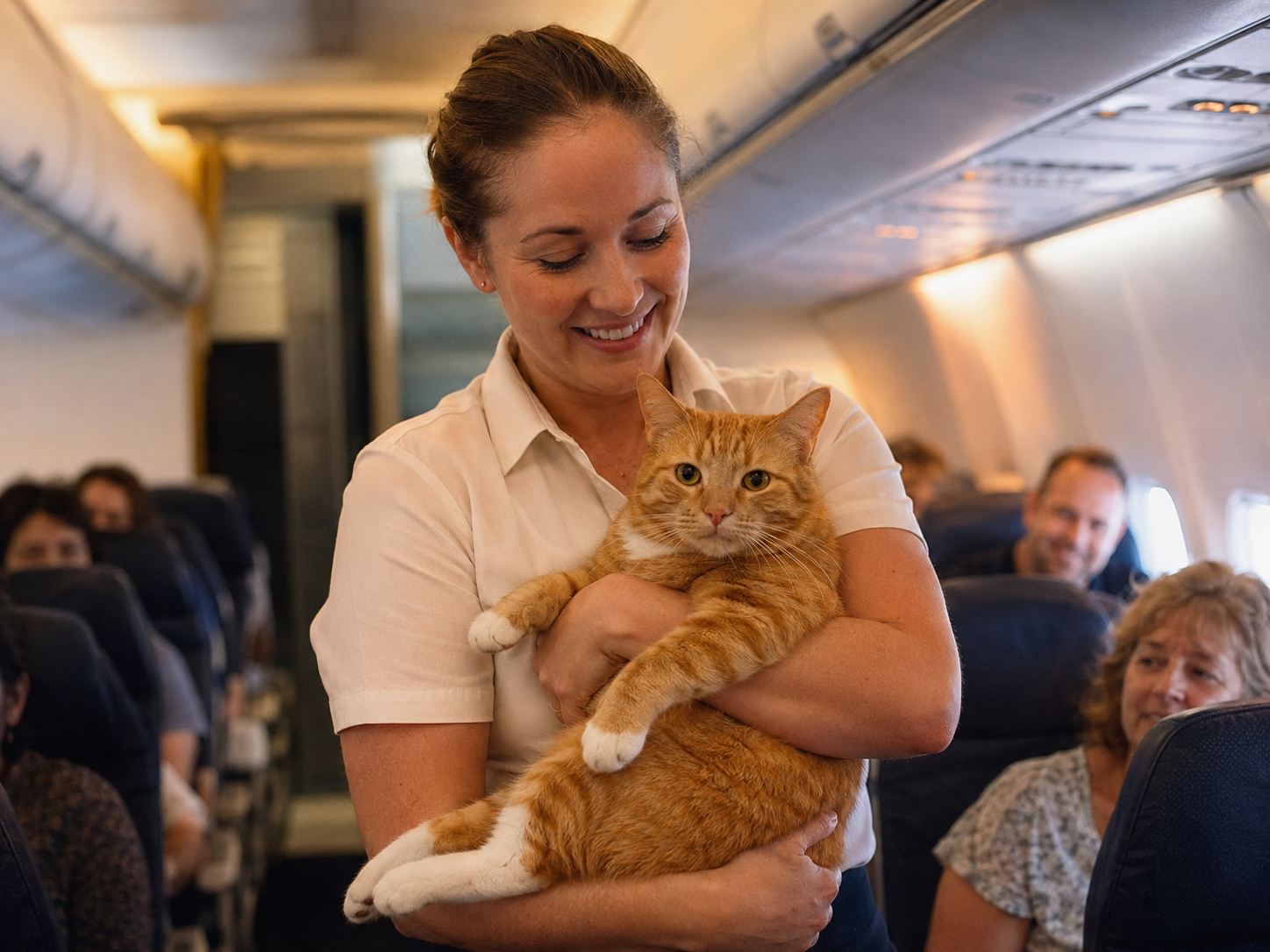
The video is genuinely charming: a flight attendant walking the aisle cradling an unbothered cat, asking a planeful of strangers, “Whose cat is this?” and getting only raised phones in reply. It went viral because it is funny. But underneath the comedy is a single, specific, entirely avoidable mistake, and the way most people would try to prevent it is itself a mistake. So this piece uses the world’s most likeable in-flight escape to get at what actually matters when you fly with a cat.
What happened
On a recent flight out of New York, a cat slipped free and began touring the cabin. A TikTok user filmed a flight attendant carrying the remarkably mellow cat up the aisle while a second attendant announced over the intercom, “So we’re still looking for the owner of this cat.” No one answered. Per the video’s caption, the cat was loose and unclaimed for hours. A third attendant eventually lifted the cat overhead and asked the whole cabin, “Whose cat is this?” to a chorus of raised phones.
The crew handled it with real grace. One attendant, who goes by Jay on TikTok, turned up in the comments (“This flight was a first for sure”) and, after being praised for the careful handling, mentioned they used to work at a vet clinic and want a cat of their own “so bad.” A kind stranger with no connection to the cat simply kept it safe until the mystery resolved.
The one mistake that set it loose
Here is the resolution, and the actual lesson. The owner had been asleep the entire time, missing every announcement about her runaway pet. According to a Yahoo News report, she admitted she had unzipped the carrier just enough to let the cat poke its head out.
That is the whole failure mode, and it is worth stating bluntly because it is so common: a carrier is only as secure as it is fully closed. The cracked-zipper “just a little air” gesture is understandable and kind, and it is exactly how a restless cat in a novel, stimulating environment ends up in the aisle. Cats can wriggle out of a surprisingly small opening. On a plane, where you may fall asleep and cannot easily chase a loose animal, that small opening is all it takes.
How a cat is even allowed on a plane loose
There is no single federal law governing pets in airline cabins. Each airline sets its own policy. Most require pets to travel in carriers that meet the federal rules for carry-on baggage, stowed under the seat. Some airlines do not require service animals to ride in carriers, but those animals generally must be leashed, harnessed, or tethered, and every animal must be registered with the airline before the flight. In other words, a pet cat is supposed to stay in its closed carrier for the duration. Getting from a zipped carrier to the aisle takes an assist, and in this case the assist was an unzipped flap.
The advice most owners get backwards
Now the part the original clip does not touch, and the reason this article exists. When a cat is anxious about flying, the instinct, and the request vets hear constantly, is “can you give me something to knock him out.” For air travel specifically, the answer from the veterinary establishment is a firm no to old-style sedation.
The American Veterinary Medical Association advises against giving pets tranquilizers or sedatives for air travel unless a vet deems it medically necessary. Sedation at altitude carries documented risks: it can depress breathing and heart function in an animal already stressed, impair a cat’s ability to regulate its body temperature, and, crucially, cause a groggy cat to lose its balance and get injured sliding around the carrier. Flat-faced breeds face the highest danger, because a sedative that relaxes the airway muscles raises the risk of obstruction, and there is less margin for error in the air.
Owners come in wanting a sedative for the flight, and for air travel that is usually the wrong tool. The modern approach is an anti-anxiety medication like gabapentin, which many vets now use because it eases anxiety without the deep sedation and without the cardiovascular effects of true tranquilizers. But that is a conversation to have with your own vet well before travel day, including a trial dose at home so you know how your cat reacts, never a first-time dose at the gate.
The actual pre-flight checklist
Skip the sedative debate at the airport and set your cat up properly in advance:
Get a genuinely secure carrier and keep every zipper fully closed for the entire flight. If you want to give your cat air, that is what the ventilation panels are for, not an open flap. A small carrier zip-tie or lock clip through the pulls is cheap insurance against a curious paw.
Acclimate the carrier for weeks, not hours. Leave it open at home with treats and bedding inside so it reads as a safe den rather than a trap sprung on travel morning.
Talk to your vet about anxiety, and if medication makes sense, use an anxiolytic like gabapentin as directed, trialed at home first, rather than a sedative.
And stay awake, or at least keep the carrier fully secured if you might doze off. The owner in the video did nothing malicious. She simply combined a cracked zipper with a nap, and that was enough.
The bottom line
The plane-cat video is a feel-good clip with a crew that deserves the praise it got. But the takeaway is not “cats are escape artists, isn’t that cute.” It is that a partially opened carrier is the specific trigger, a fully closed one is the fix, and the popular backup plan, sedating your cat for the flight, is the thing vets most want you to reconsider. Fly with the zipper closed, the carrier familiar, and a vet-approved plan for anxiety, and your cat stays a passenger instead of an act.
Frequently asked questions
Should I sedate my cat before a flight? Generally no. The AVMA advises against tranquilizers and sedatives for pets flying unless medically necessary, due to breathing, heart, temperature-regulation, and balance risks at altitude. Ask your vet about an anxiolytic such as gabapentin instead, and trial any medication at home first.
How did the cat get loose on the plane? Its owner had unzipped the carrier partway to let the cat poke its head out, then fell asleep. The cat slipped through the opening and roamed the cabin for hours.
What are the rules for cats in airplane cabins? There is no single federal law; each airline sets its own policy. Most require pets in a closed carrier that fits under the seat and meets carry-on size rules, with the pet registered before the flight.
References
- “Traveling with Your Dog or Cat.” American Veterinary Medical Association. https://www.avma.org/resources-tools/pet-owners/petcare/animal-travel-certificates-regulations-requirements/traveling-your-dog-cat
- Jahn, Katrin, and Theresa DePorter. “Feline Stress Management During Air Travel: A Multimodal Approach.” Journal of Feline Medicine and Surgery, 2023. https://journals.sagepub.com/doi/10.1177/1098612X221145521
- “Traveling with Pets.” Federal Aviation Administration. https://www.faa.gov/travelers/fly_pets/cabin_pets
Jordan Ellis is a certified professional dog trainer with a decade of experience working with rescue organisations and private clients. They specialise in anxiety, reactivity, and positive reinforcement methods, and review all training and behaviour content at The Pet Times.
Meet our experts ↗Keep reading
 LivingThe Goodbye Ritual You Think Is Sweet Is Stressing Your Cat OutDr. Nina Kohl · 5 min
 LivingThe One Question That Sorts a Good Cattery From a Bad OneNina Vasquez · 6 min
 LivingYour Cat Will Yowl for 3,000 Miles. Fix the Box, Not the Noise.Dr. Lena Park · 8 min
 LivingHis Cat Vanished in Yellowstone. Two Months Later, a Chip Pinged 900 Miles Away.Dr. Lena Park · 5 min
 LivingThe Cat Lover's New York Is Really a Map of Cats Who Need HomesJordan Ellis · 7 min
 Product PicksThey Live in a Van With Two Cats. This Is the Gear That Survives ItNina Vasquez · 7 min