


Your Cat Isn't Trying to Come With You. It's the Best Box in the House.
The suitcase is not a protest and it is not a plea. It is a warm, walled, human-scented hiding box that appeared in your living room, and understanding that is the difference between a sweet story and a soiled bag.

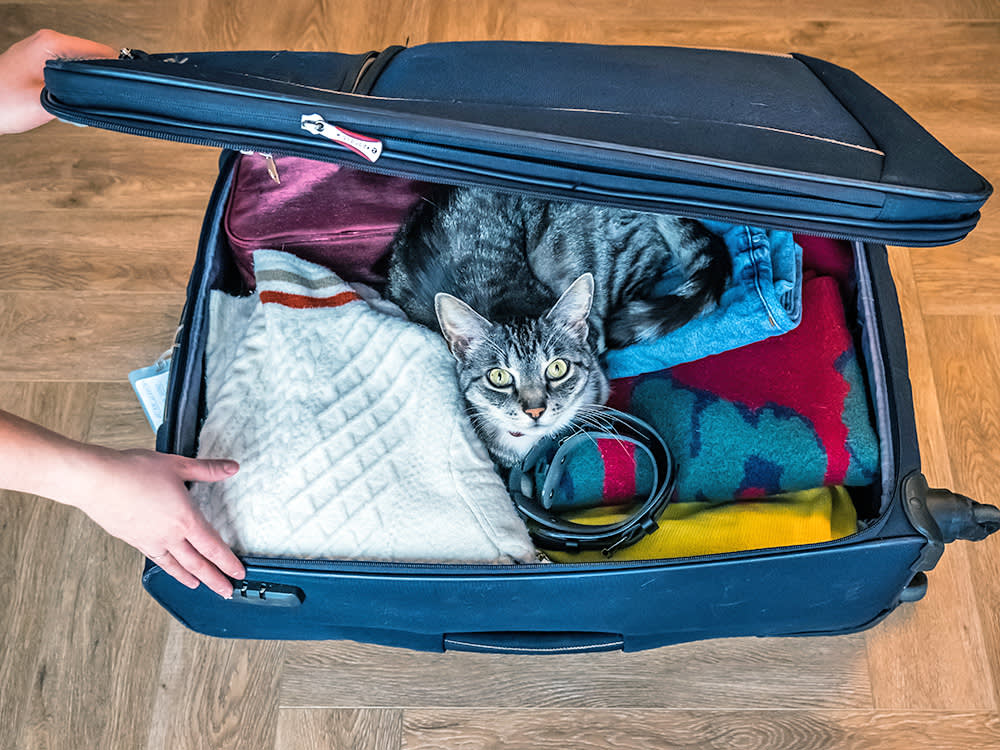
The suitcase comes out and the cat is in it. Not near it. In it, deep in the clothes, radiating the calm of an animal who has solved something.
There are two stories people tell about this, and both of them are flattering to us. The first: she knows I’m leaving and she’s trying to stop me. The second: she wants to come with me. Both cast your cat as a small heartbroken romantic with a working understanding of air travel.
The likelier explanation is less sentimental and considerably more useful. A suitcase is the best box that has ever appeared in your living room. It has walls. It holds warmth. It is lined with soft things that smell overwhelmingly of you. From a cat’s point of view, you have not packed for a trip. You have installed a superior piece of furniture.
That reframe matters, because it changes what you do about the parts of this behavior that are actually a problem.
Why a box is not a joke
Cats’ obsession with boxes is treated as an internet punchline, but it has been measured, and it holds up.
In a study of newly arrived cats at a Dutch animal shelter, researchers gave some cats a hiding box and withheld it from others. The cats with a box showed lower stress scores and lower cortisol, and they acclimated to the shelter faster. A box is not a novelty item for a cat. It is a coping tool, and enclosure is the mechanism: solid sides mean fewer directions from which something can arrive.
Now look at your suitcase through that lens. Rigid walls on all four sides. A soft, deep, insulating floor. Elevated slightly off the ground. And, critically, packed full of fabric carrying the strongest concentration of your scent in the house, because worn clothes hold more of you than laundered ones do.
It is a hiding box with your smell built into the padding. Of course she is in it.
The pressure of the sides may be doing work too. Cats are drawn to spaces that hold them, which is likely a carry-over from what it felt like to sleep pressed against a mother and a heap of siblings. A half-packed suitcase is one of the few objects in a home that recreates that.
People want the suitcase to be a message, and I understand why, it is a better story. But most of the time your cat is not commenting on your travel plans. They are taking advantage of a very good box that you left open on the floor.
So do they know you’re leaving?
Some of them, yes, and this is where the sentimental story has a kernel of truth in it.
Cats are exceptional at pattern detection, and the suitcase is a reliable predictor. It appears, the routine changes, you vanish, a different human shows up to feed them. A cat who has been through that cycle a few times can absolutely learn that the bag means the disruption.
What they cannot do is understand the disruption. There is no version of a cat’s mind that contains “she is going to a conference in Denver and will return Sunday.” There is only: the thing that comes before you disappear is happening again.
That gap is the whole problem. Anxiety with no explanation attached has to go somewhere, and in cats it usually comes out as behavior.
Which brings us to the peeing
For a lot of people the suitcase question is not really about sitting in it. It is about what they found in it.
Peeing in or on a suitcase feels like the most legible act of spite in the animal kingdom. It is not. Cats are not vindictive, and the machinery for a revenge plot, holding a grudge across time, modeling how you will feel when you find it, is not in there.
What is in there is scent. Urine and feces are not just waste to a cat; they are among the primary channels through which cats communicate presence, identity, and territory. And there is a specific version of this behavior aimed at objects that leave and come back: cats layer their own scent onto the things that travel between the home and the outside world, which has the effect of tying those objects, and you, back into the shared group smell.
Read that way, the wet suitcase is closer to a plea than an insult. Your cat is anxious about a thing they cannot understand, and they are using the only tool they have to make it smell like it belongs to them.
Which is not to say you have to accept it.
What actually works
The instinct is to protect the suitcase. The better move is to defuse it, and then to fix the thing the suitcase is a symptom of.
Kill the novelty. A suitcase that only appears before a departure is a loaded object. A suitcase that lives out in the corner all year is furniture. Leave a bag out permanently, or bring the travel bag out days early and simply let it sit. Many cats stop reacting to it entirely once it stops predicting anything. If your cat has a marking history, this alone often solves it.
Give them a better box in the same room. If you want the suitcase left alone while you pack, close it when you step away and put an open cardboard box, ideally with a worn t-shirt in it, right beside where you are working. You are not denying the need. You are redirecting it, which is the only approach that reliably works with cats.
Fix the trip, not the bag. If the marking or the yowling is real, the suitcase is not the problem. Your absence is. Look at what actually changes for your cat while you are gone. A person who arrives, tips food into a bowl, and leaves is providing calories, not company. Ask your sitter to add a play session. See if a friend can stay over. Leave worn clothing out on the bed on purpose. If your partner or roommate is the one covering, ask them to deliberately over-invest in attention and enrichment while you are away rather than assuming the cat is fine because the cat is quiet.
Rule out the medical first. Any new inappropriate urination deserves a vet visit before it gets filed as behavioral, because urinary tract disease and stress-related cystitis present exactly this way, and stress makes the medical version more likely, not less. If your cat only pees in the suitcase, that is behavioral. If your cat has started peeing in several places, call your vet.
What’s new since this was written
The most useful shift in the last decade is that the “cats don’t care whether you’re home” story has quietly collapsed under its own evidence, and the suitcase behavior is a small piece of the wreckage.
Cats form genuine attachments to their people, and cats show measurable stress responses to changes in their environment and routine. That reframes what you are looking at when the bag comes out: not a quirk, and not an accusation, but an animal detecting an incoming disruption to the only stable arrangement they have and trying to do something about it with an extremely limited toolkit.
The enrichment research points the same direction. A hiding box lowers cortisol. Predictability lowers stress. Both of those facts are actionable in a way that “my cat is sad I’m leaving” is not. So put a box out, keep the routine as intact as you can while you are away, and let her sleep in the suitcase. She has picked the best seat in the house and she is not wrong.
References
- Vinke, C. M., Godijn, L. M., & van der Leij, W. J. R. (2014). Will a hiding box provide stress reduction for shelter cats? Applied Animal Behaviour Science.
- van der Leij, W. J. R., Selman, L. D. A. M., Vernooij, J. C. M., & Vinke, C. M. (2019). The effect of a hiding box on stress levels and body weight in Dutch shelter cats; a randomized controlled trial. PLOS ONE.
- Vitale, K. R., Behnke, A. C., & Udell, M. A. R. (2019). Attachment bonds between domestic cats and humans. Current Biology.
- Buffington, C. A. T., et al. (2006). Clinical evaluation of multimodal environmental modification (MEMO) in the management of cats with idiopathic cystitis. Journal of Feline Medicine and Surgery.
Common questions
Does my cat know I'm leaving when the suitcase comes out?
Many cats do learn the association, because the suitcase reliably precedes a change in routine. What they cannot do is understand where you are going or why, which is exactly why the anxiety shows up as behavior rather than sulking.
Why does my cat pee in my suitcase?
Almost never spite. Cats deposit scent on the objects that come and go from a home as a way of layering their smell onto yours. It is a communication attempt, and it is usually one about anxiety.
How do I stop my cat from sitting in the suitcase?
Take away its novelty. A suitcase that lives out in the room permanently stops being an event. If you only want it protected while packing, zip it shut when you step away and give your cat a better box in the same room.
Dr. Park is a board-certified emergency and critical care specialist. She reviews our health and safety content for clinical accuracy and contributes guides on recognising urgent conditions. Her focus is helping owners act quickly and correctly when it matters most.
Meet our experts ↗Keep reading
 LivingHis Cat Vanished in Yellowstone. Two Months Later, a Chip Pinged 900 Miles Away.Dr. Lena Park · 5 min
 LivingYour Cat Will Yowl for 3,000 Miles. Fix the Box, Not the Noise.Dr. Lena Park · 8 min
 LivingThe Cat Lover's New York Is Really a Map of Cats Who Need HomesJordan Ellis · 7 min
 Product PicksFor a Cat, the Wrong Harness Isn't Gear. It's an Escape Hatch.Marcus Webb · 7 min
 Product PicksThey Live in a Van With Two Cats. This Is the Gear That Survives ItNina Vasquez · 7 min
 Health & WellnessYour Cat Skips the Vet Because of the Car, Not the BillDr. Mara Chen · 6 min