


The Dog You Didn't Choose: How Titan Adopted Arabelle Sicardi
Beauty writer Arabelle Sicardi never picked Titan. On paper, the six-pound Min Pin–Chihuahua mix belongs to their partner. In practice, he became Sicardi's anchor, writing companion, and proof that a dog can choose you.

Affiliate disclosure. This article contains affiliate links. We may earn a small commission if you buy through a link, at no extra cost to you. How we handle recommendations.
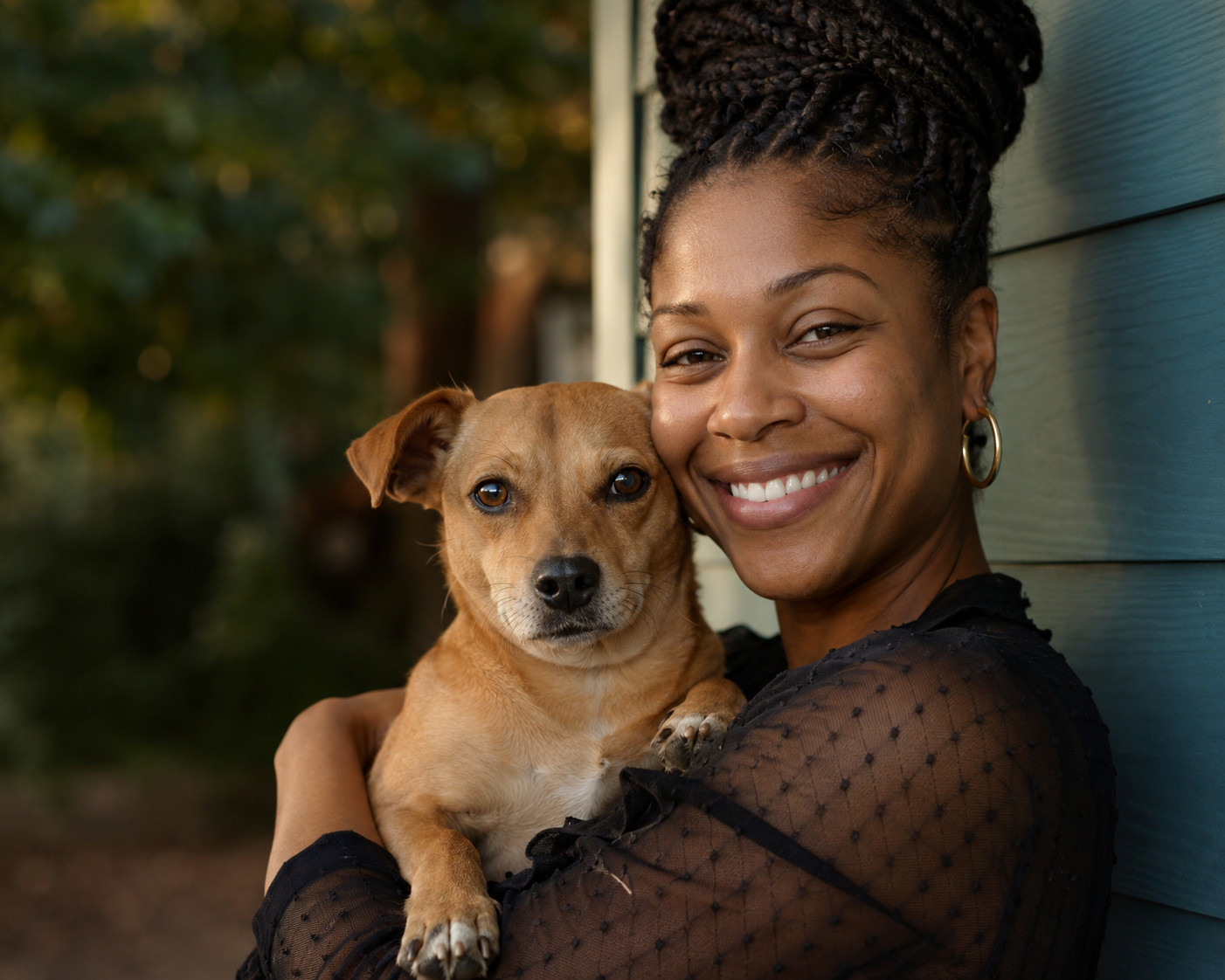
Arabelle Sicardi did not choose Titan. On paper, the six-pound Min Pin–Chihuahua mix belongs to their partner, who named him Titanium back when he was small enough to fit in a sock and dark enough to look like a lump of coal. But somewhere along the way, Titan made his own decision, and it wasn’t the one the paperwork describes. He picked Sicardi.
Anyone who has ever inherited a pet “for” someone else knows this plot. The dog you didn’t pick out, didn’t name, didn’t plan for, quietly becomes the one who organizes your days and anchors you on the worst of them. For Sicardi, a beauty writer who has spent more than a decade arguing that beauty is really about care, Titan turned out to be the clearest possible demonstration of that thesis, wrapped in a body smaller than a house cat and partial, of all things, to jazz.
Care as a higher power
To understand why Titan matters so much to Sicardi, you have to understand what Sicardi means by care. “Care to me is my higher power,” they say. Across a decade of writing for Allure, Elle, and The Cut, and in their newsletter You’ve Got Lipstick on Your Chin, Sicardi has pushed against the beauty industry’s rigid standards while insisting the work itself is an act of care, “how I see care work in the world and how I relate and give care to other people.” Beauty, in their telling, is less about products than about how we tend to one another.
That conviction runs through their forthcoming nonfiction book, The House of Beauty, and their 2019 children’s book, Queer Heroes: Meet 53 LGBTQ Heroes From Past and Present, which introduced young readers to queer figures from history. Sicardi describes a multigenerational readership, people who “grew up with them on Tumblr” alongside kids who only know them through the heroes they wrote about. The throughline, again, is care given outward. Titan is where it comes back.
The dog who reassigned himself
The bond didn’t announce itself; Sicardi’s partner noticed it first. Titan, who had never behaved that way with anyone else the partner had dated, started circling Sicardi, following them room to room, ignoring everyone else in favor of staying close. “He started recognizing me as mommy and he would run to me whenever he could,” Sicardi says. He walks beside them off-leash, claims their lap whenever they sit, and refuses to sleep unless they’re near.
Sicardi is clear-eyed about the household hierarchy. Their partner is “daddy,” the one Titan runs to when frightened and snuggles in the morning. But the rest of the time, Titan is a Velcro dog bonded to Sicardi specifically, a little creature with, by their description, “big dog energy” who barks at every postal worker, distrusts men, and has firm opinions about everything. “I don’t like men either,” Sicardi says they tell him. “It’s totally fine if you create space between us and men.”
There’s a cat in this family too, sort of. Pringle, a domineering, “bowling-ball”-shaped cat who “dominates the neighborhood,” lives with Sicardi’s parents in New Jersey after declining the LA lifestyle (Pringle, by Sicardi’s account, finds even an Uber an indignity). Sicardi describes the difference between the two animals precisely: Pringle is an independent creature who happened to choose them, while Titan “feeds off my energy and is in the same mood when I’m in the same mood.” One is a roommate. The other is a mirror.
An anchor on the hard days
The reason this matters beyond cuteness is what Titan does for Sicardi’s mental health. A self-described introvert and homebody who could happily go weeks without seeing another person, Sicardi names Titan as the reason they leave the house during depressive episodes. “The only reason I go outside is to take care of him, play ball with him, and make him happy,” they say. The obligation is the point: caring for a creature who loves you unconditionally pulls you into the daylight, “ideally in the sun, because that makes me feel better too.”
He’s also Sicardi’s writing partner. Titan has sat in their lap through nearly the entire drafting of their latest book, kept them company through middle-of-the-night revisions, and, as Sicardi puts it, “listened to me read my entire book out loud, so he knows it as well as I do.” The relationship isn’t deferential in either direction. “He’s not scared of me because he knows I’ll never hurt him,” they say. “We’ll argue, he’ll bicker with me, and then we’ll snuggle. I think he thinks I’m part of his pack and I’m not his boss.” For a small dog with a big name, that turns out to be exactly the right arrangement.
Why the jazz thing isn’t just a cute quirk
And then there’s the music. Titan, his people have learned, calms down to jazz and bossa nova specifically. When he’s barking or being left with a sitter, that’s the soundtrack that settles him. It’s easy to file under doting-pet-parent whimsy. The research suggests he may be onto something.
In a study by the Scottish SPCA and the University of Glasgow, researchers played kenneled dogs five genres, classical, Motown, pop, reggae, and soft rock, while tracking heart rate, heart-rate variability, salivary cortisol, and behavior. Dogs were measurably calmer on reggae and soft rock: lower heart rates, higher heart-rate variability (a marker of reduced stress), and more time lying down and resting instead of pacing and barking. Classical helped at first but faded over the week as the dogs habituated to it.
Two findings explain Titan. First, music with a steady, relaxed rhythm and lower intensity, which describes a lot of jazz and bossa nova, sits in the same calming zone as the reggae and soft rock the dogs preferred. Second, individual dogs had individual tastes, just like people. So the lesson isn’t “play your dog jazz.” It’s that a consistent, low-arousal soundtrack can genuinely lower a dog’s stress, and the right genre is whatever your particular dog settles to. The Scottish SPCA was convinced enough to install sound systems in its shelters. Sicardi got there first, one barking fit at a time.
The heart outside the body
Sicardi has had dogs before, but not like this. The earlier ones came when they were young, and the connection, they say, was never this deep. “Titan is my best friend, truly my best friend,” they say, before landing on the line that captures the whole strange gift of a dog who chose you. “When you’re with somebody you love so much that you’re like, oh, my heart is outside of my body right now. It’s so weird that this person just has my heart. And that’s scary, it’s just this little six-pound dog.”
That’s the thing about the dog you didn’t choose. You don’t get to decide how much of you they’ll carry around. You just find out, one ordinary day, that a sock-sized animal who likes bossa nova is holding your heart for you, and walking it carefully through the world.
If you’re navigating depression yourself, know that an animal’s companionship is a real support but not a substitute for care; reaching out to a mental health professional alongside it is a strength, not a failure.
References
- Bowman, A., et al. “The Effect of Different Genres of Music on the Stress Levels of Kennelled Dogs.” Physiology & Behavior, vol. 171, 2017, www.sciencedirect.com/science/article/abs/pii/S0031938416306977.
- “The Effect of Different Genres of Music on the Stress Levels of Kennelled Dogs.” University of Glasgow / Scottish SPCA, eprints.gla.ac.uk/135846.
- Sicardi, Arabelle. Queer Heroes: Meet 53 LGBTQ Heroes From Past and Present. Wide Eyed Editions, 2019.
Common questions
Can a dog bond more with someone other than its official owner?
Yes. Dogs form their strongest attachments based on who provides consistent care and emotional attunement, not on whose name is on the adoption paperwork. A dog can live in a household and clearly designate one person as its anchor, exactly what happened with Titan and Arabelle Sicardi.
Does music really calm dogs?
Research supports it. A Scottish SPCA and University of Glasgow study found dogs were measurably calmer, with lower heart rates and less pacing, when played certain genres, especially reggae and soft rock. Individual dogs had individual preferences, so the calming genre is the one your specific dog settles to.
What kind of dog is a Min Pin–Chihuahua mix?
A small companion dog, often under ten pounds, that tends to bond intensely to one person, alert-bark readily, and show outsized confidence for its size, the 'big dog energy in a small body' Sicardi describes in Titan.
Leila Torres leads our Living coverage, from home life and travel to the products and rescue stories that come with sharing a life with animals. She edits and writes across the section, with a soft spot for pieces about the bond between people and their pets.
Meet our experts ↗Keep reading
 TrainingYour Dog Isn't Catching Your Sadness. They're Catching Something TrickierDr. Priya Nair · 7 min
 LivingThe 'Love Hormone' Loop With Your Dog Is Real. The Famous Part Keeps Falling Apart.Dr. Mara Chen · 9 min
 LivingGrowing Up With a Dog May Guard Your Gut, Researchers FoundDr. Ravi Mehta · 4 min
 TrainingYour Dog Tolerates Your Hugs. That's Not the Same as Liking Them.Dr. Ravi Mehta · 7 min
 LivingShe Registered Her Dog to Vote to Prove It Was Easy. It Was.Jordan Ellis · 4 min
 TrainingYour Dog Doesn't Know What 'Family' Means. They Know Exactly Who's in Their Group.Dr. Nina Kohl · 5 min