


The 'Love Hormone' Loop With Your Dog Is Real. The Famous Part Keeps Falling Apart.
Yes, gazing at your dog raises oxytocin in both of you. No, that doesn't prove dogs invented the feeling through domestication. Here's what the last decade of research actually supports, and where the headline outran the evidence.

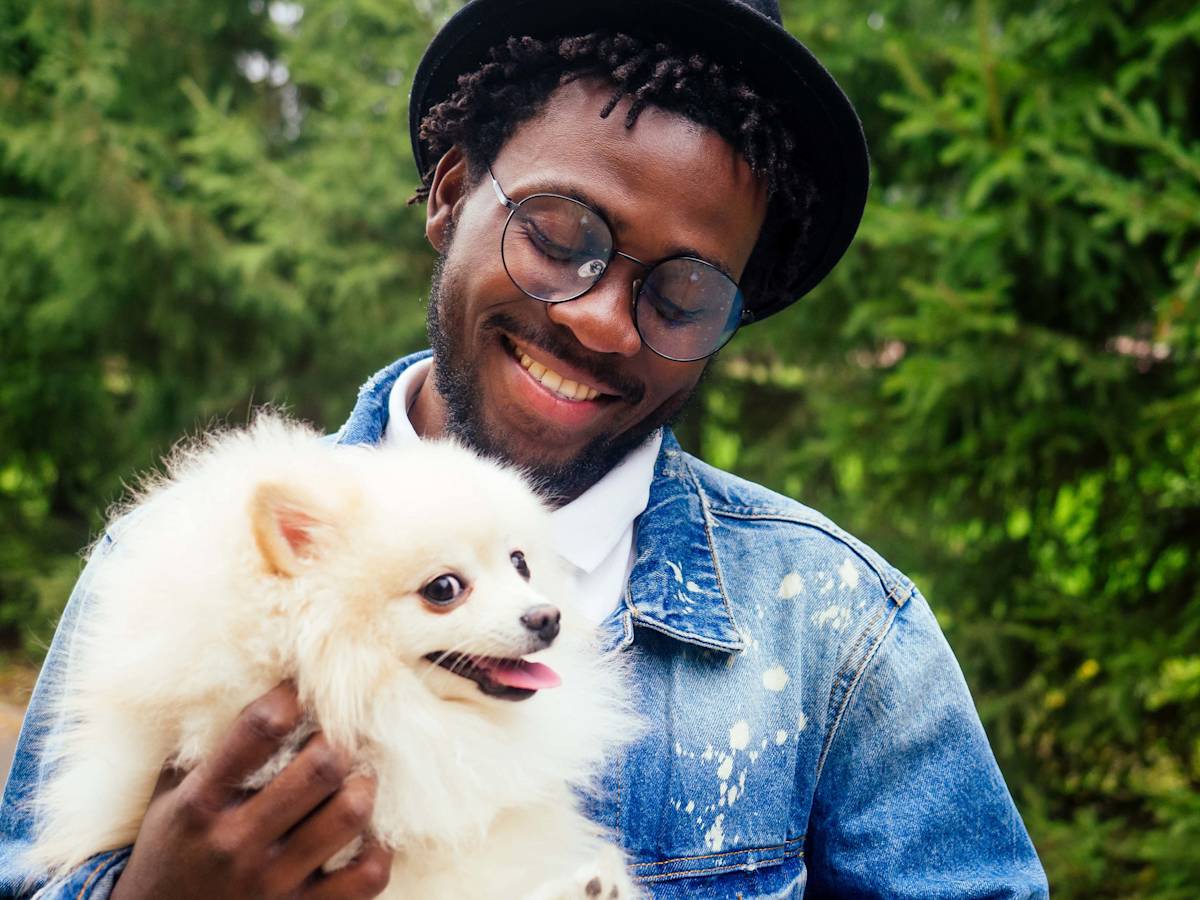
The story you have heard goes like this. Look into your dog’s eyes, and both of your brains flood with oxytocin, the same hormone that binds a mother to a newborn. Dogs do this. Wolves don’t. Which means dogs evolved, over thousands of years of living with us, to hijack a bonding circuit that was never meant for them.
It is a gorgeous story. Half of it is well supported. The other half, the half that made it famous, has been quietly falling apart for a decade, and almost nobody has updated the headline.
That’s worth knowing, not because the science ruins anything, but because the real finding is more interesting than the myth. Your dog is not running a domestication exploit on your endocrine system. Something simpler and stranger is going on.
What oxytocin actually does
Start with people, because that’s where the research began.
Take two groups, one single and one three months into a romantic relationship, and the coupled group shows measurably more oxytocin. More telling: among those couples, the ones carrying more of it at the three-month mark were the ones still together three months after that. The hormone tracks the bond, not just the mood.
In parenting, the loop is tighter. Mothers who gaze at their babies show higher oxytocin. Higher oxytocin drives more caregiving behavior, which raises oxytocin in the baby, which makes the baby more attentive and attached, which pulls more caregiving out of the mother. It runs in a circle and feeds itself. Touch pushes levels up in both; take the touch away and levels drop in both.
The animal work underneath this is worth a moment, because it shows the hormone is not just correlated with care, it is necessary for it. Baby mice cry when separated from their mothers, and mothers go to them. Female mice without pups usually don’t bother. But that response has to be learned, and oxytocin is what makes the learning possible. It rewires a region of the left auditory cortex, an area that turns out to contain both oxytocin-producing neurons and a dense population of oxytocin receptors. Block that region’s activity with a drug and a mother mouse stops responding to her own crying pups. Inject oxytocin into an inexperienced female who has been ignoring the cries, and she starts responding.
That is a real mechanism, not a vibe. And petting a dog raises oxytocin in the human and in the dog. Which is where the story about your dog begins.
Why cuteness is a chemical trap
There’s a reason a puppy is physically difficult to walk away from.
A proportionally large head, big eyes set wide apart, chubby cheeks, a small nose and mouth: that cluster of features shows up in the young of most mammals, and it triggers an oxytocin release in the adult looking at them. Oxytocin creates the feeling of love. The feeling of love creates the urge to care for the thing you love. Cuteness is not decorative. It is a caregiving switch, and it is wired to fire whether the infant in question is yours, someone else’s, or a different species entirely.
Dogs, by luck or by our own selective breeding, sit right in the strike zone of that switch. You are not imagining that a dog’s face does something to you. You are describing an evolved reflex working exactly as designed.
The study that started the myth
In 2015, a team led by Takefumi Nagasawa published in Science what is still the most-cited finding in this whole area. Dog-human pairs were observed interacting for 30 minutes. The dogs who gazed longest at their people were in the pairs where both parties showed the biggest oxytocin increases. Then the researchers went further, giving dogs oxytocin through the nose. Female dogs who got it gazed at their people longer than female dogs given a saline control. Male dogs, oddly, did not respond the same way, and nobody has fully explained why. The humans, who received nothing, showed oxytocin increases anyway after interacting with the treated females.
Then came the claim that made headlines: the researchers reported that hand-raised wolves did not show this loop. Dogs did, wolves didn’t, therefore the loop is a product of domestication. Dogs, the story went, co-opted a bonding system built for human parents and children.
Biologists were legitimately excited, because it suggested a shared physiological mechanism underneath romantic bonds, parental bonds, and interspecies ones. Dog owners were delighted for the obvious reason.
Both groups moved on before the follow-ups came in.
What happened when people tried to replicate it
The reciprocal loop, the part where your oxytocin and your dog’s rise together during affectionate interaction, has held up reasonably well. It is not bulletproof, but the weight of evidence supports it.
The domestication claim has not held up. Across the studies published since 2015, roughly nine have found partial co-modulation of oxytocin between dogs and their people, and at least four have found none at all, including work published as recently as 2024. That is not the signature of a robust, universal effect. It’s the signature of an effect that is real but conditional, and we don’t yet know what the conditions are.
Worse for the domestication story: when researchers went back and re-analyzed Nagasawa’s own data, splitting the results by the sex of the human rather than the species of the animal, the picture flipped. Oxytocin rose in the female owners of both dogs and wolves. It was flat or slightly negative in the male owners of both. Which means the dog-versus-wolf difference the world took away from that paper may have been an owner-sex difference wearing a costume.
And in 2022, a team reported partial evidence of a similar oxytocin effect between cats and their people. Cats were not domesticated on the wolf-to-dog timeline, were not bred for cooperative work with humans, and did not, as far as anyone can tell, evolve to hold eye contact with us. If the loop shows up in cats too, then “dogs evolved this to bond with us” stops being the obvious explanation.
“The bond is real. What people got wrong is the origin story, not the feeling,” says Dr. Nina Kohl. “It’s entirely possible that oxytocin does this across a lot of mammal pairings, and that what dogs actually evolved is not a special hormone trick but a willingness to sit still and look at us long enough for an ordinary one to fire.”
A caveat about eye contact that matters more than the science
One practical warning, because this research gets misapplied constantly.
Eye contact between a dog and a human is context-dependent, and the context does most of the work. A soft, mutual look between a dog and the person they trust is a tender exchange. A hard, held stare directed at a stranger’s dog, or at a frightened one, is a threat display in almost every language a dog speaks. It reads as a challenge. Dogs have bitten people over it.
So no, the takeaway from an oxytocin study is not to make deep eye contact with the anxious rescue at the end of the block. Read the dog in front of you first, then the paper.
Where oxytocin does something you can actually use
Two findings here are practically useful, and one of them cuts against the “feel-good hormone” branding.
The useful one: oxytocin makes dogs better at reading us. In a 2015 object-choice experiment, dogs given oxytocin were significantly better than saline-treated dogs at following human social cues to find hidden food, both when the human gazed at the location and when they pointed at it. The hormone didn’t make the dogs smarter. It made them more receptive to social information coming from a person.
The uncomfortable one: oxytocin also intensifies memories of negative social interactions. It appears to sharpen attention toward social information generally, which means it can deepen a bad experience as reliably as a good one. This is not a hormone that makes everything nicer. It’s a hormone that turns up the volume on whatever social channel is already playing.
Not every dog runs the same chemistry
The idea that oxytocin is a universal dog-love dial fails on contact with actual breeds.
A 2016 study dosed two breeds that sit at opposite ends of the cooperative-versus-independent spectrum, the Border Collie and the Siberian Husky, and then measured how their social behavior shifted. The Collies responded strongly. The Huskies barely responded at all. You cannot dose an independent dog into being a velcro dog. They process the hormone differently.
The genetics point the same way. A 2017 study looked at variations in oxytocin receptor genes and found that in German Shepherds, which version of the gene an individual dog carried was an excellent predictor of how willing that dog was to greet an unfamiliar person. A weaker version of the same trend showed up in Border Collies. In Siberian Huskies, the pattern didn’t hold at all.
And in another 2017 study, researchers compared oxytocin levels in dogs bred for assistance work, a population selected for more than 40 years on friendliness, calm temperament, and the absence of aggression, against ordinary pet dogs. The assistance dogs had higher baseline oxytocin. Which suggests that when we spent four decades breeding for temperament, one of the things we were unknowingly selecting on was the hormone itself, and that oxytocin levels may sit upstream of how likely a dog is to behave aggressively.
What newer research adds
A 2026 review in Neuroscience & Biobehavioral Reviews pulled together everything published on oxytocin, gaze, and the dog-human partnership since the original study, and its conclusion is a good summary of where we stand.
The basic loop survives. When you and your dog interact affectionately, oxytocin does appear to move in both of you, more often than not, though not in every study and not in every pair. That is a real and reasonably supported finding.
The famous part does not survive. The claim that this loop is unique to dogs, absent in wolves, and therefore a product of domestication is, at best, unresolved. The wolf comparison is now confounded by owner sex, cats appear to do something similar, and the replication record is mixed.
None of this should change how you feel about your dog. It should change what you say at parties. Something measurable really does pass between the two of you when you sit together, and the lab can see it. What the lab cannot yet show you is the part of the story you liked best: that your dog’s ancestors built this on purpose, for you.
References
- Nagasawa, M., et al. “Oxytocin-gaze positive loop and the coevolution of human-dog bonds.” Science, 2015;348(6232):333-336. Link
- “The effects of oxytocin on social behavior and eye gaze: Insights from dog-human partnership.” Neuroscience & Biobehavioral Reviews, 2026. Link
- Wynne, C.D.L. “Commentary: Oxytocin-gaze positive loop and the coevolution of human-dog bonds.” Frontiers in Psychology, 2016. Link
- Oliva, J.L., Rault, J.-L., Appleton, B., Lill, A. “Oxytocin enhances the appropriate use of human social cues by the domestic dog (Canis familiaris) in an object choice task.” Animal Cognition, 2015;18(3):767-775. Link
- Kovács, K., et al. “Differential effects of oxytocin on social sensitivity in two distinct breeds of dogs (Canis familiaris).” Psychoneuroendocrinology, 2016;74:212-220. Link
- Kis, A., et al. “Oxytocin and opioid receptor gene polymorphisms associated with greeting behavior in dogs.” Frontiers in Psychology, 2017. Link
- MacLean, E.L., Gesquiere, L.R., Gee, N., Levy, K., Martin, W.L., Carter, C.S. “Endogenous oxytocin, vasopressin, and aggression in domestic dogs.” Frontiers in Psychology, 2017;8:1613. Link
- Marlin, B.J., Mitre, M., D’amour, J.A., Chao, M.V., Froemke, R.C. “Oxytocin enables maternal behaviour by balancing cortical inhibition.” Nature, 2015;520(7548):499-504. Link
Dr. Chen is a small-animal veterinarian who leads health and safety coverage at The Pet Times. She writes and reviews the bulk of our illness, condition, and safety content, translating clinical guidance into clear, practical advice owners can act on at home.
Meet our experts ↗Keep reading
 TrainingYour Dog Isn't Ignoring You. You're Talking Too Fast.Tom Hadley · 5 min
 LivingThe ADA Has No Breed List. Your Landlord's Insurance Does.Dr. Priya Nair · 6 min
 LivingYour Dog Isn't Upset When You Argue. They're Trying to Stop You.Jordan Ellis · 6 min
 LivingScientists Ranked Which Dogs 'Smile' Most. Your Beagle Is Not Winning.Dr. Nina Kohl · 5 min
 LivingIs Your Dog Really Jealous, or Just Afraid of Missing Out? The Science Is Messier Than the Headlines.Dr. Nina Kohl · 5 min
 Training'Gentle Parenting' Your Dog Isn't Permissive. That's the Part People Get Wrong.Dr. Nina Kohl · 9 min