


Scientists Ranked Which Dogs 'Smile' Most. Your Beagle Is Not Winning.
A new study filmed 210 dogs to map their 'play face.' Poodles and Shepherds beam. Beagles and Akitas keep it subtle. Here's what that does, and doesn't, say about how happy your dog is.

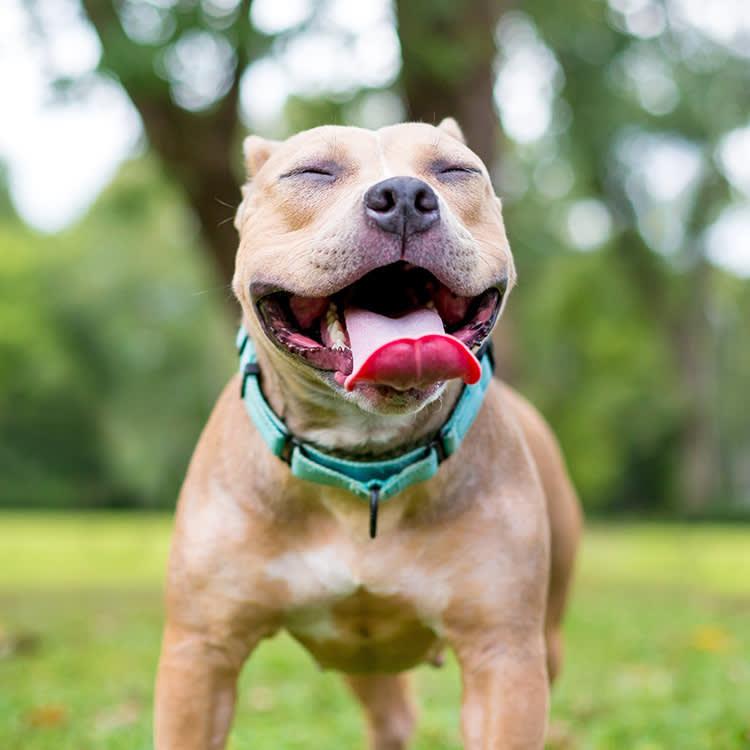
You have probably decided, based on nothing but their face, that your dog is either a permanent optimist or a tiny furry pessimist. A new study suggests you’re partly reading the breed, not the mood. Some dogs are simply built to broadcast a big open-mouthed grin. Others feel exactly the same joy and barely show it.
The research, published in the journal Behaviour and led by Dr. Veronica Maglieri, set out to measure something dog owners guess at every day: which breeds look the happiest, and which wear a permanent poker face.
What the researchers actually did
The team filmed 210 dogs across 29 breeds and combed through 925 separate facial expressions. The dogs were recorded in three states, relaxed, playful, and panting with an open mouth, so the researchers could isolate one specific expression: the “play face.”
If you’ve watched dogs at a park, you already know the play face even if you’ve never named it. It’s the loose, open-mouthed, almost-laughing look a dog makes when it’s inviting a romp. Scientists call it the Relaxed Open Mouth, or ROM. The researchers catalogued which facial muscles each breed moved to produce it, and how far.
The beamers and the stoics
The gap between breeds turned out to be wide. At the expressive end, breeds like Poodles and German Shepherds throw the full, exaggerated version of the play face, the kind that reads as an outright grin. Basset Hounds, Czechoslovakian Wolfdogs, Rottweilers, and Pit Bulls landed in that same high-expression group, recruiting more facial muscles and pushing their expressions further, so that a play face on these dogs can look a lot like laughing.
At the other end sit the stoics. Beagles, Shih Tzus, Newfoundlands, Bull Terriers, and Akitas make a far more minimal, understated version of the same expression. Same feeling, quieter face.
There was a genuine surprise in the flat-faced breeds. The researchers expected Pugs and Bulldogs to be nearly unreadable, since their squashed facial structure limits how much they can move. Instead, the few movements they can make, subtle lip-corner pulls and mouth stretches, happen to land as a permanent little smile. Anyone who’s seen a Pug with its tongue lolling out gets the idea.
Why this is more than a fun ranking
The clever part isn’t the leaderboard, it’s the method. Dr. Maglieri used the muscle data to build a branching, tree-like chart (a dendrogram) that groups breeds, and even compares them to wolves, not by shared ancestry but by how similarly they move their faces. Instead of asking which breed descends from which, the study asked which breeds move their muscles alike. The two questions produce different family trees.
That reframing hints at something bigger about how we bred dogs. In shaping breeds for looks, humans may have also, accidentally, tuned how expressive their faces are, and possibly how easily different breeds can read one another’s intentions at the park.
The play face itself isn’t a dog invention, either. It shows up across carnivores, wolves included, as an ancient signal that means “I’m playing, not fighting.” It’s part of how dogs tell each other, and us, that a wrestling match is friendly.
So is your poker-faced dog unhappy?
No, and this is the part to hold onto. A subtle face is not a sad face.
It’s easy to look at a Poodle grinning ear to ear and assume it’s happier than the Newfoundland lying quietly next to it, but that’s a trick of the anatomy. Some breeds just have a louder face. If you want to know how your own dog feels, watch the whole body, the tail, the ears, the looseness in how they move, not just the mouth.
In other words, if your Beagle or your Akita always looks a little unimpressed, don’t take it personally. They’re probably just as content as the goofiest Poodle in the room. They’re only being quieter about it.
References
- Facial expressivity and the “play face” across dog breeds, Behaviour (Brill)
- Tell-tale signals: faces reveal playful and aggressive mood in wolves, Animal Behaviour (ScienceDirect)
- Intra and interspecific audience effect on domestic dogs’ behavioural displays and facial expressions, Scientific Reports
Dr. Kohl is a board-certified veterinary dentist with a particular interest in preventive oral care. She reviews all dental health content at The Pet Times and contributes practical guides on home dental routines, professional cleaning, and oral disease prevention.
Meet our experts ↗Keep reading
 TrainingYour Dog Isn't Trolling You. They're Playing, or Trying to Tell You Something.Dr. Nina Kohl · 7 min
 LivingYou're Not Soft for Loving Your Dog This Much. You're Wired for It.Dr. Mara Chen · 6 min
 Training5 Reasons Your Dog Follows You Into the Bathroom (One Is Worth Watching)Dr. Nina Kohl · 6 min
 LivingYou Can't Make Your Partner's Dog Like You. So Ignore It.Dr. Ravi Mehta · 5 min
 LivingThe ADA Has No Breed List. Your Landlord's Insurance Does.Dr. Priya Nair · 6 min
 LivingNetflix's Dog Documentary Is Great. The Title Is a Lie.Dr. Nina Kohl · 7 min