


Which Paw Your Cat Leads With Is a Readout of Its Personality
Paw preference in cats isn't a party trick. It maps to which side of the brain runs the show, and that lines up with how bold, how anxious, and how playful your cat tends to be. Here's how to test it, and what the answer means.

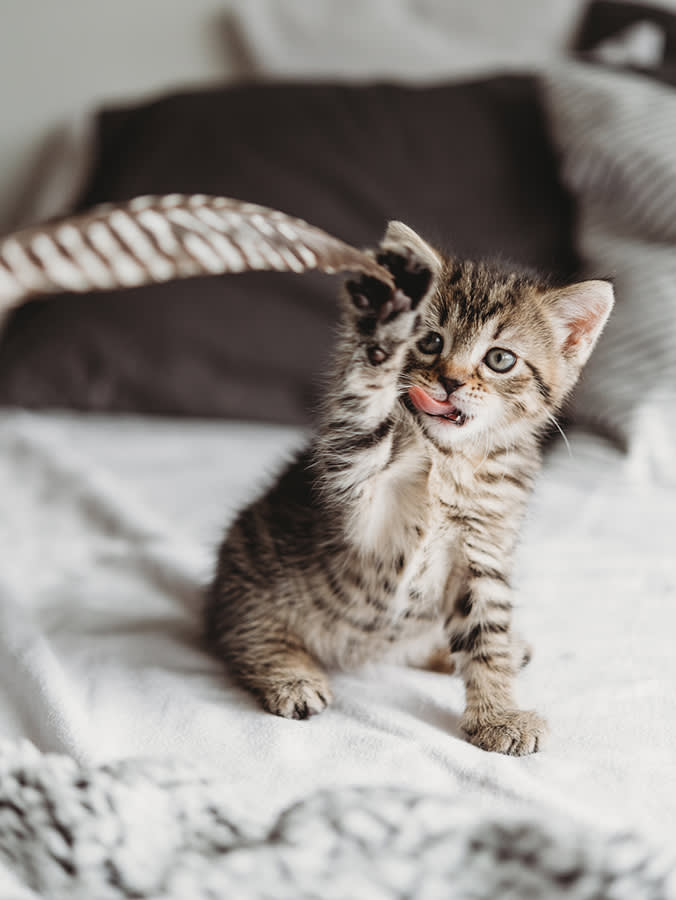
We treat “which hand do you write with” as a throwaway fact about a person. In cats, the equivalent question turns out to be a small window into the animal’s mind. Whether your cat reaches for a toy with the left paw or the right is not a cute quirk; it reflects which half of their brain tends to be in charge, and that lines up in measurable ways with how bold, how anxious, and how playful your cat is. This piece is about what paw preference reveals, why cats are so much more evenly split than people, and how to run the simple test yourself.
Cats aren’t lopsided the way we are
Start with the number that makes cats interesting here. People are overwhelmingly one-sided: about nine in ten of us favor the right hand. Cats refuse to line up that way. Their paw preference lands close to an even three-way split, with roughly a third favoring the left, a third the right, and a third showing no steady preference at all. So unlike the human near-monopoly on right-handedness, a cat’s leading paw is genuinely up for grabs, which is part of what makes it worth reading.
What the leading paw hints about temperament
The direction a cat leans turns out to travel with personality. Cats that favor the left paw tend to run more fearful and quicker to aggression; cats that favor the right tend to be the more playful ones, ahead of both the lefties and the no-preference group. Sex nudges the odds too, with females skewing toward the right paw and males toward the left, a tilt that holds across study groups without forecasting any one cat. None of it is fate for an individual, but across a population the pattern is steady enough to mean something.
I love this topic because it turns a small observation into real insight about a cat. When an owner tells me their cat is a strong lefty and also skittish and quick to swat, those two facts are not a coincidence, they fit together. Watching which paw a cat favors is one of the easiest ways to start reading their emotional wiring without any special equipment.
Why the paw tracks the brain
The link is not mystical; it is anatomy. Scientists call the tendency to lean on one side of the body lateralization, and it was long shelved as a human specialty, until researchers kept turning it up everywhere else, in parrots and songbirds, dolphins and toads, mice and monkeys, and of course dogs and cats. The reason it maps to emotion is that the two hemispheres split the work. Routine, safe, familiar business, along with upbeat states like contentment and excitement, runs mostly through the left hemisphere; novelty, alarm, and the urge to flee, plus darker feelings like fear, ride on the right. Because each hemisphere drives the opposite side of the body, the paw a cat reaches with quietly reports which hemisphere tends to take the wheel. That is why the choice is not trivial: it is an outward tell for inner wiring.
Even the strength of the preference says something
It is not only which paw, but how committed the cat is to it. How strongly a cat favors one side ranges widely, the same way some people can do almost anything with their off hand while others treat it as dead weight. That strength carries information. A cat with a firm, consistent preference, either paw, tends to be steadier, warmer, more biddable, and friendlier, and also tends to be handier with their paws, a better problem-solver, and faster to react.
Cats with no preference are the interesting flip side. The technical term is “ambilateral,” the feline cousin of “ambidextrous,” and these cats are more vulnerable to stress and more likely to show aggression than clearly left- or right-pawed cats. There is a striking human parallel: ambidextrous people are more susceptible to anxiety and to conditions like PTSD. A cat who genuinely uses both paws equally is not the most balanced cat in the room; if anything, they may be the most easily rattled.
How to run the test at home
You can gauge your cat’s paw preference with the same approach researchers use, and it costs nothing but patience. The trick is to pick one repeatable first move and log it over and over. Good candidates: the paw that leads as your cat steps into the litter box, the paw that reaches down first at the top of a staircase, or the paw they dip into a jar or container to hook out a treat. The catch is repetition. A single trial is noise; to know whether your cat has a real preference, and how strong it is, you need to run the same test about 50 times and look at the pattern. Do that, and you will not just learn whether your cat is a lefty, a righty, or neither, you will have a genuine clue about their confidence, their reactivity, and how their particular brain is put together.
What newer research adds
The three-way split and the sex difference have held up as the science has grown. A meta-analysis pooling multiple paw-preference studies in cats and dogs confirmed that individual animals reliably favor a paw even while the population stays close to evenly divided, and that females and males lean in opposite directions. More recent work has started teasing out breed as another layer, with signs that different cat breeds differ in how reactive and how strongly lateralized they are, which fits the broader idea that paw preference and emotional style are linked.
The practical upshot for an owner has not changed: your cat’s leading paw is a small, free, at-home readout of temperament, best measured over many trials rather than one lucky reach. It will not diagnose anything, but it is a real thread connecting how your cat moves to how your cat feels.
The bottom line
A cat’s paw preference is a genuine signal, not a gimmick. It reflects which brain hemisphere dominates, which in turn tracks with boldness, anxiety, and playfulness, and unlike people, cats split almost evenly between lefties, righties, and the ambilateral middle. Run the fifty-trial test if you are curious, and read the result as one honest clue among many about the cat who lives in your home.
References
- McDowell, Louise J., Deborah L. Wells, and Peter G. Hepper. “Lateralization of Spontaneous Behaviours in the Domestic Cat, Felis silvestris.” Animal Behaviour, vol. 135, 2018. https://www.sciencedirect.com/science/article/abs/pii/S0003347217303640
- Ocklenburg, Sebastian, et al. “Paw Preferences in Cats and Dogs: Meta-Analysis.” Laterality, 2019. https://pubmed.ncbi.nlm.nih.gov/30741091/
- Wells, Deborah L., et al. “Laterality as a Tool for Assessing Breed Differences in Emotional Reactivity in the Domestic Cat.” Animals, vol. 9, no. 9, 2019. https://www.ncbi.nlm.nih.gov/pmc/articles/PMC6770185/
Common questions
Do cats have a dominant paw?
Many do. Research suggests cats split roughly into thirds: about a third favor the left paw, a third the right, and a third show no consistent preference. The split is far more even than in humans, where about 90 percent are right-handed.
Does a cat's paw preference mean anything?
It appears to. Paw preference reflects which brain hemisphere is more dominant, and that tracks with temperament. Left-pawed cats tend to be more fearful and reactive, right-pawed cats more playful, and cats with no preference are more prone to stress.
Is paw preference linked to a cat's sex?
Studies point that way. Female cats are more likely to be right-pawed and males more likely to be left-pawed, though it is a tendency across groups, not a rule for any individual cat.
How do I test my cat's paw preference?
Watch which paw they use first for a task, stepping into the litter box, taking the first step down stairs, or reaching into a container for a treat, and repeat it about 50 times. One or two trials won't tell you anything; the pattern only shows up over many tries.
Dr. Chen is a small-animal veterinarian who leads health and safety coverage at The Pet Times. She writes and reviews the bulk of our illness, condition, and safety content, translating clinical guidance into clear, practical advice owners can act on at home.
Meet our experts ↗Keep reading
 TrainingThe One Piece of Cat Body Language You Can Speak, Not Just ReadDr. Mara Chen · 5 min
 TrainingYour Cat Isn't Plotting Revenge. They Already Forgot.Dr. Nina Kohl · 5 min
 TrainingThe Study Says Your Cat Is a Psychopath. Read the Questions.Dr. Ravi Mehta · 6 min
 TrainingStop Watching Who's Winning. The Real Tell in a Cat Fight Is Who Trades PlacesNina Vasquez · 5 min
 TrainingMale vs. Female Is the Wrong Question About Cat Affection. Here's the Right OneLeila Torres · 7 min
 LivingYour Cat's 5 A.M. Screaming, Translated (and Why It Really Happens)Tom Hadley · 4 min