


The One Piece of Cat Body Language You Can Speak, Not Just Read
Almost everything you learn about cat communication is about decoding your cat. The slow blink is the rare signal that runs the other way, and you can use it as a live consent check.

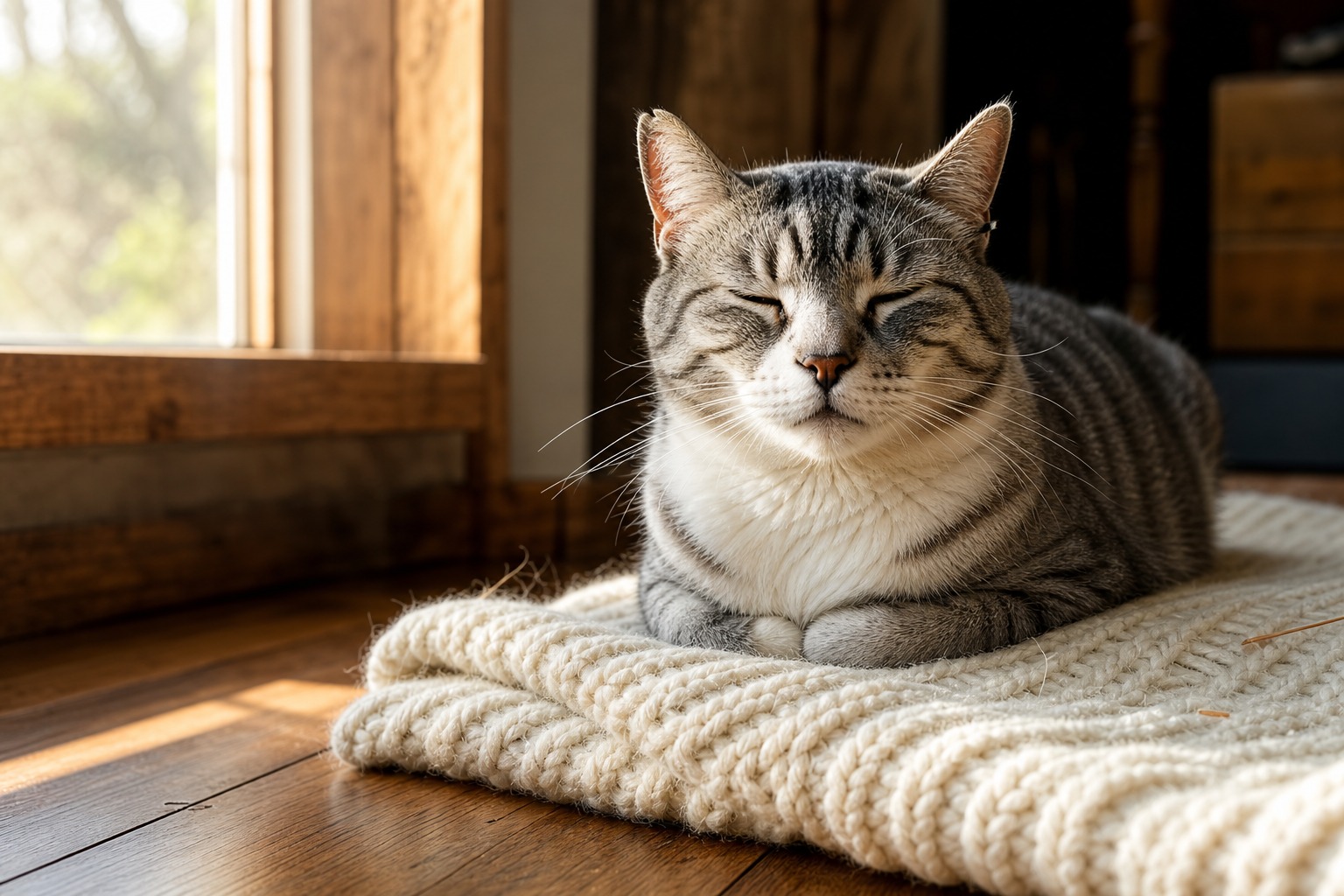
Almost every piece of cat advice you will ever read is about listening. Read the tail. Read the ears. Read the whiskers, the posture, the pupils. Cats are treated as a language we are forever trying to translate in one direction, from them to us. The slow blink is the exception that everyone underrates: it is the one signal that runs the other way. It is a thing you can say, in your cat’s own vocabulary, and get an answer back. That makes it less a party trick and more the closest thing we have to a two-way conversation with a species that does not otherwise take our calls.
How to actually say it
Because this is a skill and not a fact, start with the doing. The move has three beats, and the timing is what separates a real slow blink from a human staring contest, which cats read as a threat.
- Get near your cat without looming. Sit or crouch, a comfortable arm’s length away, body angled slightly off to the side rather than squared up and head-on.
- Soften your face and let your eyes narrow, the way they do when you are genuinely relaxed and half-smiling. This is the “cat smile,” and it is distinct from a wink, which uses one eye.
- Let your eyes drift closed for a beat or two, then open them slowly. Do not snap them shut and back open. The whole thing should look lazy.
Then wait and watch. Many cats will blink back, and once they do you can trade blinks back and forth like a slow, wordless exchange. It works on cats you have never met, not only your own, which is the part that surprises people.
Why it works as a consent check, not just a hello
Here is the reframe that makes the slow blink genuinely useful rather than merely cute. A hard, unbroken stare is confrontational in cat social life, a low-grade challenge. The slow blink is the opposite move: by deliberately breaking your own gaze and closing your eyes, you are announcing that you are not a threat and not about to do anything sudden. You are lowering the temperature on purpose.
That means the slow blink is also a question. Offer one, and the cat’s response tells you where you stand right now, this second. A blink back is a yes, an opening. A cat who holds a flat stare, turns away, or leaves is telling you the door is closed for the moment. Used that way, the blink becomes a quiet permission slip you can check before you reach out, instead of a guess.
I teach the slow blink less as an affection trick and more as a way to ask the cat’s permission. Offer the blink, watch what comes back, and let that decide whether you close the distance. It turns a lot of scratched hands into calm greetings, because you stopped assuming and started asking.
The evidence behind it
The reason any of this is more than folklore is a study titled “The role of cat eye narrowing movements in cat-human communication,” published in the Nature journal Scientific Reports. It was the first experiment to show that people can shift a cat’s behavior by narrowing their eyes at it, and the eye-narrowing motion has real parallels to the genuine human smile, the “Duchenne” smile where the warmth reaches the eyes.
The team ran two experiments, both in the cats’ own homes and recorded on video. The first involved 21 cats from 14 households: coached owners who slow blinked at their settled cat, sitting about a meter away, got more slow blinks back than when they simply sat in the room without the signal. The second brought in 24 more cats and swapped the owner for a stranger, who either slow blinked or held a neutral, no-eye-contact face before offering a flat, palm-up hand. Cats blinked back more at the stranger’s slow blink, and, tellingly, were more likely to approach that outstretched hand after a blink than after a neutral face. Put together, the two experiments show slow blinking is a real channel of positive communication, and that it works even between a cat and a person who have never met.
The part that turns a bond trick into a welfare tool
What lifts the slow blink out of “nice to know” is a separate line of research on shelter cats, and it is the piece the original story missed. A 2020 study in Animals found that cats who slow-blinked more in response to a human were adopted faster from a rescue setting. A signal that started as a soft way to say hello turns out to have real stakes: a cat who can trade blinks reads as approachable to a stranger walking the aisles, and approachable cats go home sooner. For a shelter, teaching staff and visitors to slow blink is a cheap, no-risk intervention that may nudge a nervous cat toward a family.
That reframes the whole habit. The slow blink is not only about deepening the bond with the cat you already have. It is a genuinely useful tool for the cat who does not have a person yet, and a gentle way to read stress in a vet clinic or a foster room where you cannot afford to guess wrong.
The honest caveats
The researchers were careful, and so should we be. The original experiments ran in naturalistic homes rather than a controlled lab, and the team itself said a lab replication would be worth doing. The finding has held up well in the years since and become one of the more reliably cited results in cat behavior, but “held up” is not “settled beyond question.” And the slow blink is a greeting and a check-in, not a magic override. It will not fix a cat who is in pain, resource-guarding, or genuinely frightened, and it is no substitute for giving a cat space when the blink comes back as a no.
Within those limits, though, it costs nothing and risks nothing. You have a small, science-backed way to open a conversation in a language your cat actually speaks, and to hear, in real time, whether they want to have it.
References
- Humphrey, T., Proops, L., Forman, J., Spooner, R., & McComb, K. “The role of cat eye narrowing movements in cat-human communication.” Scientific Reports, 2020. doi.org/10.1038/s41598-020-73426-0
- Humphrey, T., Stringer, F., Proops, L., & McComb, K. “Slow Blink Eye Closure in Shelter Cats Is Related to Quicker Adoption.” Animals, 2020. doi.org/10.3390/ani10122256
Dr. Chen is a small-animal veterinarian who leads health and safety coverage at The Pet Times. She writes and reviews the bulk of our illness, condition, and safety content, translating clinical guidance into clear, practical advice owners can act on at home.
Meet our experts ↗Keep reading
 Health & WellnessYour Cat Isn't Being Spiteful. Almost Every 'Bad Cat' Behavior Is Anxiety.Dr. Priya Nair · 9 min
 LivingYour Cat Isn't Trying to Cuddle. They're Doing Math.Dr. Nina Kohl · 6 min
 TrainingYou Can Tell When Your Cat Is Happy. That's the Problem.Dr. Priya Nair · 7 min
 TrainingYour Cat Is Trying to Bury Something. The Question Is What.Dr. Lena Park · 8 min
 TrainingWhy a Cat Will Nurse a Duckling, and Why You Should Still Watch CloselyDr. Amara Solis · 6 min
 TrainingYour Cat Isn't Being Weird. Your Bowl IsDr. Ravi Mehta · 8 min