


Your Cat Traded Away Color and Sharpness to See in the Dark
Cats don't have magic night vision. They made a deal: they gave up the rich color and fine detail you take for granted to buy low-light sight you'll never have. Here's the trade, and why it ends in 3 a.m. zoomies.

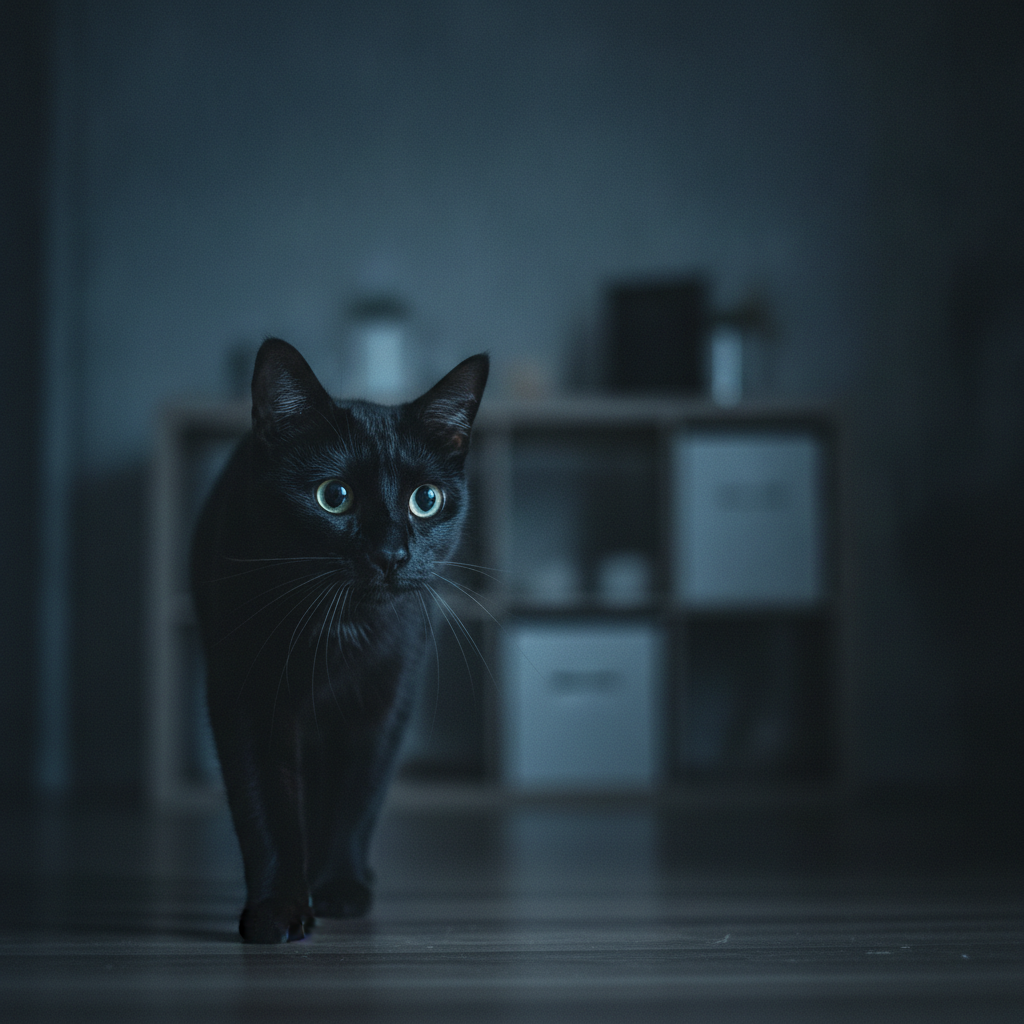
The 3 a.m. thunder of paws, the cat caroming off furniture in a pitch-dark hallway without clipping a single corner, it reads like a superpower. It isn’t. It’s the visible payoff of a bargain your cat’s ancestors struck millions of years ago, and like every bargain, it cost something. Cats didn’t simply add night vision on top of normal sight. They sold off pieces of the daytime vision you rely on, your color, your sharpness, to pay for seeing in the gloom. Understand the trade and the glowing eyes, the midnight zoomies, and the way your cat ignores a still toy until it twitches all snap into focus.
The eye is mostly the same. The wiring is the deal.
A cat’s eye isn’t structurally exotic: curved cornea, big lens, pupil, iris, same basic parts as yours. The difference is in what the retina is stocked with, and that’s where the trade lives.
The retina carries two kinds of light-detecting cells. Rods are exquisitely sensitive to light and motion and do the work of night vision and peripheral detection. Cones handle daylight and color. You are cone-rich, which is why your world is saturated with color and fine detail. Your cat went the other way, loading up on rods at a ratio of roughly 25 rods to every cone, versus about 20 to 1 in people. Every extra rod is a vote for low-light sensitivity and against color.
Those extra rods are exactly why a cat buries us after dark. But there’s no free lunch in an eye. The same swap that makes them brilliant in dim light is what costs them the color and the crisp detail we have. They’re not seeing a better version of our world at night, they’re seeing a different world, optimized for a different job.
The three things your cat gave up
Spell the trade out and the whole animal makes sense.
It gave up color. With far fewer cones, cats see a muted palette, mostly blues and yellows, similar to a dog. The vivid reds and greens of your world are largely lost on them.
It gave up fine detail. Cats are best described as mid-sighted. They see something sharply only within about 20 feet, where humans see most clearly at 100 to 200 feet. Your cat’s world goes soft at a distance that yours stays crisp.
It traded still-object clarity for motion. Those rods aren’t just light buckets, they’re motion detectors. Cats track fast movement with a precision we can’t match, which is why a motionless feather wand is invisible-boring and a twitching one is irresistible.
In exchange for all that, the cat bought something we’ll never have: useful sight in light levels six to eight times dimmer than the minimum we need.
The hardware that makes the low-light half possible
Three features cash in on the rod-heavy retina.
A built-in light amplifier. Behind the retina sits a reflective layer, the tapetum lucidum, that bounces light the eye missed back through for a second pass. The result: a cat’s eye can use more than half the available light in a room. It’s also why your cat’s eyes flash in headlights, that’s the leftover light escaping.
Pupils that open wider and faster. A cat’s pupils dilate into full, wide circles to flood the eye with light in dim conditions, and they adjust faster than ours. In bright light, those same pupils clamp down to slits to sharpen focus.
A rod count built for twilight. Which leads to the detail people get wrong about cats.
Cats aren’t nocturnal, and that explains the schedule
Here’s the myth worth retiring: cats are not nocturnal. They’re crepuscular, most active at dawn and dusk. That’s not trivia, it’s the reason the whole visual system is tuned the way it is. Dawn and dusk are exactly when a cat’s natural prey is on the move, and exactly the light levels where excellent dim-light vision pays off. Your cat’s eyes are dawn-and-dusk instruments, and the 3 a.m. zoomies are those instruments running the program they were built for, even in a well-fed house cat who’s never hunted for a meal.
How your cat stacks up against the dog, and against you
Both cats and dogs out-see humans in the dark, but cats take it. Dogs carry more rods than we do; cats carry more than dogs, which is what lets them work in light as much as six to eight times dimmer than we’d need. Against a human, it isn’t close. Our smaller pupils, sparser rods, and missing tapetum leave us cracking shins on the coffee table during a midnight kitchen run. Animals with true night vision go further still, bigger eyes, wider pupils, even denser rods, but in the everyday gap between “lights on” and “pitch black,” your cat wins every time.
Why the trade was worth it
A cat’s dim-light vision isn’t for terrorizing your ankles, though it’s handy for that. It’s the inheritance of an ambush predator that needed to spot and track prey in near-darkness. The rods that gather scarce light are the same rods that detect the faintest motion, so the trade bought a cat the two things a twilight hunter needs most, light and movement, by spending the two things it needed least, color and far-distance detail. From the cat’s point of view, it got the better end of the deal.
What recent research adds
The newest work is less about the mechanics of the eye and more about how cats fold vision into a richly multisensory read of the world, and of you. A 2025 study in PLOS One from Tokyo University of Agriculture found that cats can distinguish their owner from a stranger by scent alone, even reaching for one nostril with unfamiliar smells and switching to the other as a scent became familiar. The reminder for cat owners: the cat staring at you across a dark room is taking in far more than its eyes reveal.
There’s also rising attention to feline vision care as cats live longer. Veterinary ophthalmology groups keep emphasizing regular senior wellness exams, because age-related conditions, retinal degeneration and high blood pressure (a common, sneaky cause of sudden blindness in older cats), are most treatable when caught early. If your aging cat starts hesitating in dim rooms or misjudging jumps, don’t chalk it up to clumsiness, get it checked.
References
Common questions
What did cats give up for their night vision?
Color range and fine detail. Cats are packed with rod cells for low light and motion, at the expense of the cones that give humans rich color, and they see sharpest only within about 20 feet rather than the 100 to 200 feet we do.
Why do my cat's eyes glow in the dark?
A reflective layer behind the retina called the tapetum lucidum bounces unused light back through the eye for a second chance at absorption. The leftover light that escapes is the glow you see in headlights or a flashlight.
Not a substitute for your vet. Our guidance is educational. For urgent symptoms, contact a vet or emergency clinic right away. Editorial standards
Dr. Park is a board-certified emergency and critical care specialist. She reviews our health and safety content for clinical accuracy and contributes guides on recognising urgent conditions. Her focus is helping owners act quickly and correctly when it matters most.
Meet our experts ↗Keep reading
 Health & WellnessThe Brown Cat Is Real, and It Hinges on a Gene Most People Get WrongDr. Mara Chen · 6 min
 Health & WellnessYour Male Cat Isn't Being Spiteful. He's Leaving You a Note.Dr. Mara Chen · 7 min
 Health & WellnessYour Cat Eating Your Shoelaces Isn't a Quirk. It Might Be Pica.Dr. Mara Chen · 7 min
 Health & WellnessYour Cat Just Burped. That Tiny 'Urp' Is Worth Paying Attention ToDr. Ravi Mehta · 6 min
 Health & WellnessCoffee-Ground Ears? Your Cat Has Company, and It SpreadsDr. Priya Nair · 7 min
 Health & WellnessYour Cat Probably Doesn't Have a UTI. What Litter-Box Trouble Usually MeansDr. Priya Nair · 5 min