


The Brown Cat Is Real, and It Hinges on a Gene Most People Get Wrong
A solid-brown cat is one of the rarest things on four legs, and the reason is a coat-color gene with three settings, not two. Here is how chocolate and cinnamon actually happen, and the breeds that wear them.

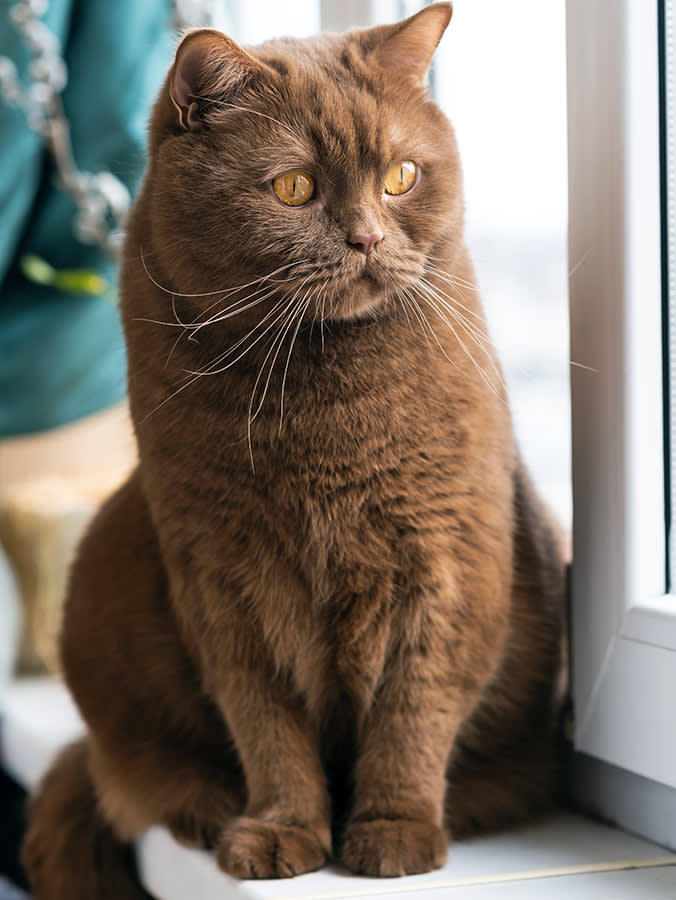
Most explanations of the brown cat treat coat color like a light switch: black or brown, B or b, on or off. That tidy binary is also wrong, and the error is exactly why a truly solid-brown cat is one of the rarest sights in the cat world. The real mechanism is not a switch with two positions. It is a dial with three. Once you see the third setting, you understand both why brown cats are uncommon and why two brown cats can look like completely different colors.
So let me start where the usual articles end: with the gene itself, because the gene is the whole story.
The gene has three settings, not two
The pigment that makes a cat black is called eumelanin, and a single gene, TYRP1, controls how that pigment gets built. Geneticists call it the B locus, and here is the part the “B equals black, b equals brown” version leaves out: this gene comes in three versions, not two.
- B produces full black pigment. It is the dominant, default setting.
- b produces chocolate, a warm, rich brown. The pigment is still made, just altered into a softer shade.
- b-light (written bl) produces cinnamon, a lighter, redder brown, the palest setting of all.
The order of dominance runs B over b over b-light. A cat needs two non-black copies to look brown at all, and which brown depends on which two it inherited. A cat with two chocolate copies (b/b) is chocolate. A cat carrying one chocolate and one cinnamon copy (b/b-light), or two cinnamon copies, comes out cinnamon. This is confirmed at the molecular level: the chocolate version comes from a splice mutation in TYRP1, and cinnamon from a separate nonsense mutation, two different typos in the same gene producing two different browns.
That three-way structure is the missing piece. The common explanation can describe chocolate but cannot explain cinnamon at all, because cinnamon needs a third allele the two-setting model doesn’t have.
Why “rare” is an understatement for solid brown
For any brown to appear, a cat has to inherit a non-black copy from both parents, because a single B copy overrides everything and the cat reads as black on the outside. Plenty of black cats are secretly carrying a hidden chocolate or cinnamon allele, and you would never know unless they happened to mate with another carrier. Two carriers meeting, and both passing the recessive copy to the same kitten, is already an uncommon event in the general population.
Then add the layers most people forget. A separate dilution gene can lighten chocolate into lilac and cinnamon into fawn, so even a brown cat may not look brown. Pattern genes decide whether the coat is solid, tabby, pointed, or shaded, and the agouti gene that produces tabby striping is itself dominant, which means most brown cats show up wearing stripes rather than a single unbroken color. A pure, solid, stripe-free chocolate coat requires the brown alleles and the recessive non-agouti pattern and no dominant white or spotting interrupting it. Each condition is uncommon on its own. Stacking all of them onto one cat is why a solid-brown cat is genuinely rare, while a brown tabby is merely uncommon.
The breeds that put the gene to work
Because the brown alleles are recessive and easy to lose in a random-bred population, the reliable way to get a brown cat is a breeder who selects for it on purpose. A handful of breeds do.
Havana Brown: the rarest brown of all
The Havana Brown exists for one reason, the chocolate coat, and the breed’s own scarcity tells you how hard that color is to fix. Developed in 1950s England by crossing Siamese cats with black domestic shorthairs that carried the chocolate allele, the Havana Brown was accepted for registration by the Cat Fanciers’ Association in 1959 and reached championship status in 1964. Then the numbers collapsed. When the CFA closed the breed’s stud book in 1974, it locked in a tiny gene pool, and by 1997 only 36 Havana Browns were registered with the CFA in a single year, the smallest count of any breed. A regulated outcrossing program was approved to rescue the line, allowing carefully chosen Oriental Shorthairs, chocolate-point Siamese, and unregistered black domestic shorthairs back into the pedigree. The breed remains one of the rarest in the world, with global registered numbers often estimated below a thousand. Its signature is a smooth, even chocolate coat with no pattern, vivid green eyes, and forward-tilted ears.
Burmese
The Burmese carries chocolate as one of its foundational colors, where it reads as a deep sable brown. Pair that with a muscular, compact body, a satin-short coat, and round golden eyes, and you get one of the most recognizable brown cats going. Burmese are also famously people-oriented, the sort of cat that follows you room to room.
European Burmese
A close cousin of the Burmese, the European line was bred toward a wider palette and reliably produces brown, chocolate, and cinnamon. Its browns tend to run a touch softer and lighter than the American Burmese sable, making it one of the better breeds to see the chocolate-versus-cinnamon distinction side by side.
Oriental Shorthair
No breed offers more color variety, hundreds of recognized combinations, and the Oriental Shorthair shows brown-family coats more often than the general cat population simply because breeders work with the full allele set. Solid chocolate, cinnamon, lilac, and fawn all appear here, and the breed’s long lines and oversized ears make every shade look more dramatic than it would on a rounder cat.
Tonkinese
A Burmese-Siamese hybrid, the Tonkinese inherits chocolate and cinnamon from both sides of its ancestry and wears them in a softer, mink-shaded form, often with aqua eyes. It is an underappreciated route to a brown cat, and a gentler, less polarizing brown than the Havana’s deep chocolate.
RagaMuffin
The plush, easygoing RagaMuffin is not bred primarily for brown, but the alleles surface in the line, producing chocolate, chocolate mink, cinnamon, and chocolate-shaded patterns. Solid-brown RagaMuffins exist; patterned ones are far more common, which is a perfect illustration of how the pattern genes usually win even when the brown genes are present.
The bottom line
A brown cat is not a fluke of lighting or a dirty white cat. It is the visible result of a specific recessive setting on a three-way gene, expressed only when both parents pass along a non-black copy and no pattern or dilution gene gets in the way. Chocolate and cinnamon are two different alleles producing two different browns, which is why brown cats vary so much and why a single, solid, unpatterned brown coat is rarest of all. If a Havana Brown, Burmese, or chocolate Oriental ever crosses your path, you are looking at a genetic long shot in fur. Count yourself lucky.
References
- Schmidt-Küntzel, Anne, et al. “Tyrosinase and Tyrosinase Related Protein 1 Alleles Specify Domestic Cat Coat Color Phenotypes of the Albino and Brown Loci.” Journal of Heredity, vol. 96, no. 4, 2005, pp. 289-301. https://doi.org/10.1093/jhered/esi066
- Veterinary Genetics Laboratory, UC Davis. “Brown (Chocolate and Cinnamon).” https://vgl.ucdavis.edu/test/brown-cat
- Kaelin, Christopher B., et al. “Developmental Genetics of Color Pattern Establishment in Cats.” Nature Communications, vol. 12, no. 1, 7 Sept. 2021, p. 5127. https://doi.org/10.1038/s41467-021-25348-2
- Cat Fanciers’ Association. “Havana Brown.” https://cfa.org/breed/havana-brown/
Not a substitute for your vet. Our guidance is educational. For urgent symptoms, contact a vet or emergency clinic right away. Editorial standards
Dr. Chen is a small-animal veterinarian who leads health and safety coverage at The Pet Times. She writes and reviews the bulk of our illness, condition, and safety content, translating clinical guidance into clear, practical advice owners can act on at home.
Meet our experts ↗Keep reading
 Health & WellnessYour Cat's Nipples Won't Tell You She's Pregnant. They Might Tell You Something Worse.Dr. Lena Park · 9 min
 Health & WellnessYour Cat Hasn't Pooped in Days. Here's the Line Between 'Wait' and 'Vet Now'Dr. Mara Chen · 9 min
 Health & WellnessYour Cat Pooping on the Floor Isn't Spite. It's a Symptom.Dr. Lena Park · 8 min
 Health & WellnessYour Cat Sounds Stuffy. The Noise Isn't the Emergency, the Effort Is.Dr. Ravi Mehta · 7 min
 Health & WellnessYour Cat Isn't Hiding That It's Sick. You Just Never Learned Its 'Normal.'Dr. Mara Chen · 6 min
 Health & WellnessYour Cat's 'UTI' Probably Isn't One. Here's What's Really Going OnDr. Lena Park · 8 min