


Eggplant Isn't the Nightshade to Fear for Your Dog
The word 'nightshade' scares dog owners off eggplant, but the plant that toxin belongs in isn't the one on your cutting board. The real question isn't solanine. It's your individual dog.

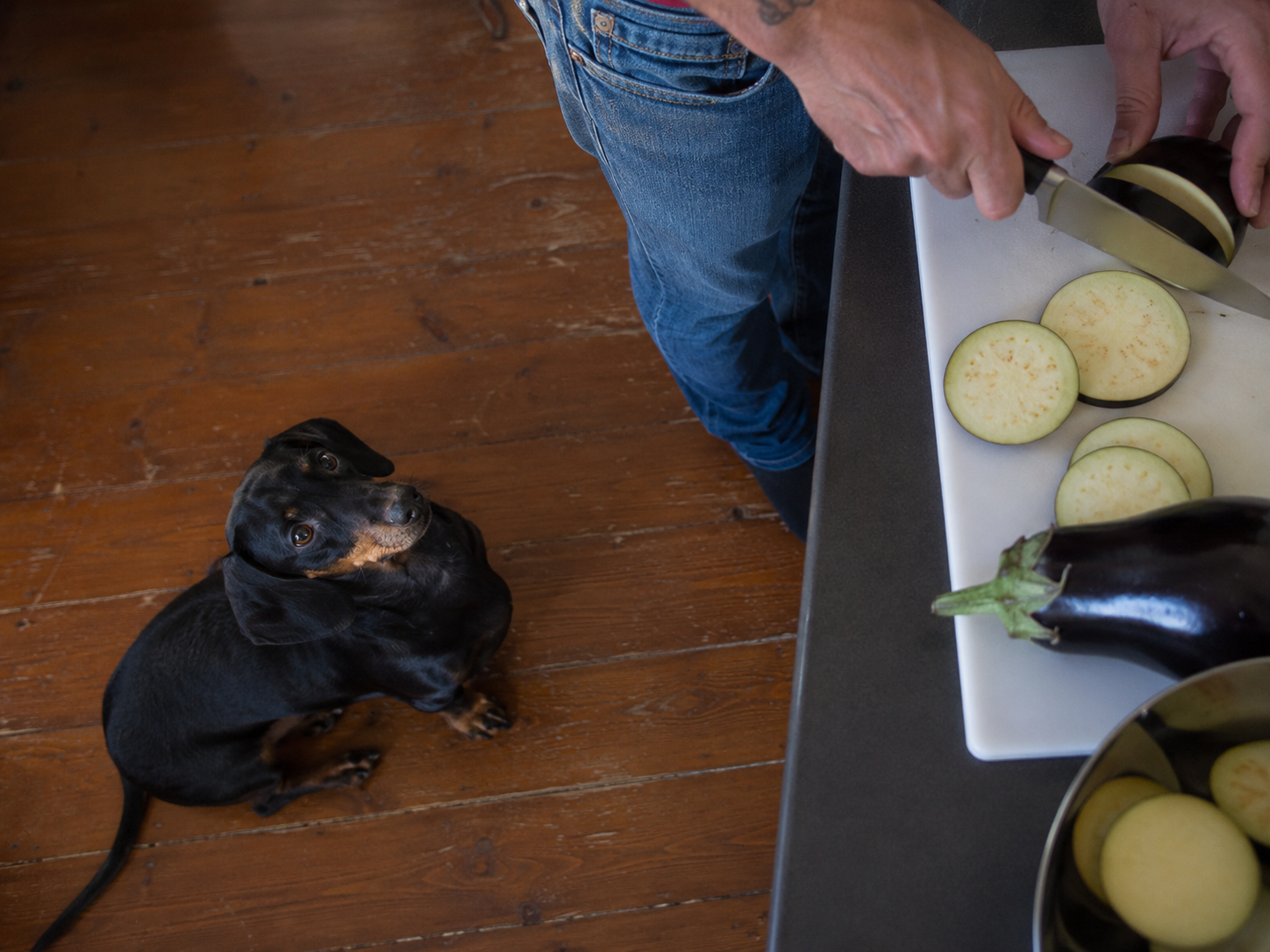
Say “nightshade” to a dog owner and you can watch the worry cross their face. Tomatoes, potatoes, eggplant, all in the same botanical family as some genuinely poisonous plants, so the instinct is to keep the whole group away from the dog. It is a reasonable instinct pointed at the wrong target. The toxin people are picturing lives overwhelmingly in the leaves, stems, and unripe green parts of certain nightshades, not in a cooked slice of the eggplant you had for dinner.
So the honest answer to “can dogs eat eggplant” is yes, with an asterisk, and the asterisk has nothing to do with solanine scares. It has to do with your particular dog.
What “nightshade” actually means here
The nightshade family is large, and it holds both everyday foods and truly dangerous species. The plants that poison dogs, deadly nightshade (belladonna), jimsonweed, henbane, and mandrake, contain glycoalkaloids like solanine in amounts that can cause severe neurological and heart effects even in small doses.
Culinary eggplant sits at the opposite end. It contains only trace solanine, concentrated in the parts you would not feed anyway, the leaves and stems, and cooking reduces its potency further. That is the whole reason cooked eggplant is safe while chewing on the plant’s foliage is not. The signs of real nightshade poisoning, drooling, vomiting or diarrhea, weakness, tremors or seizures, and an abnormal heart rate, come from the toxic species and the green plant parts, not from a soft cube of baked aubergine.
The nightshade label does a lot of unnecessary scaring. Cooked eggplant flesh carries a trace of solanine at most. When a dog reacts to eggplant, nine times out of ten it isn’t a toxin, it’s that particular dog’s stomach, or an allergy, or the olive oil and garlic it was cooked in.
The real question: is it right for your dog
This is where “can” and “should” split. Eggplant is not toxic, but it is also not special. Whatever it offers, fiber, antioxidants, vitamins B6 and K, and a low calorie count, your dog can get more reliably from vegetables that come with fewer caveats. And eggplant carries a few real ones:
Some dogs are simply sensitive to it. The fiber in eggplant can cause gas, bloating, vomiting, or diarrhea, particularly in dogs with easily upset stomachs. Some dogs are genuinely allergic to nightshade vegetables, showing it through itching, ear infections, GI upset, or paw licking. And for dogs with arthritis, the evidence that nightshades worsen inflammation is not there, but plenty of vets still err toward avoiding them, which is a fair cautious call rather than a proven danger.
For a healthy adult dog with no food sensitivities, a small amount of plain cooked eggplant now and then is fine. For a dog with a touchy gut, known allergies, or an inflammatory condition, even a little can cause problems, and there are better options.
Preparation is where dogs actually get hurt
If eggplant sends a dog to the vet, the vegetable itself is rarely the reason. The preparation is. Raw eggplant is tough, bitter, and hard to digest, which invites stomach upset. Far worse is eggplant cooked the way people like it: fried, or built into eggplant parmesan, or sautéed in oil with garlic and spice. Those additions are dramatically more dangerous to a dog than the eggplant. Oil and fat can inflame the pancreas, and garlic and onion are toxic outright.
So the rule is simple and worth repeating: if you would enjoy eating it, your dog probably shouldn’t. Plain, cooked, unseasoned, and cut small is the only version that belongs in a dog bowl.
How much, and what to give instead
Keep eggplant to no more than 10 percent of your dog’s daily calories, which comes out to only a few small pieces for most dogs, a dozen small bites for a small dog, a few cubes for a medium one, up to about a quarter cup for a large one. Introduce it slowly and watch for a day.
Honestly, though, several vegetables do the same job with less fuss. Carrots are low-calorie, crunchy, and good for teeth. Green beans are filling and weight-friendly. Zucchini is mild and easy to digest. Plain cooked pumpkin is excellent for digestion. Cooked sweet potato is nutrient-dense and well tolerated. Any of these is an easier yes than eggplant.
The bottom line
Yes, dogs can eat eggplant, and no, it is not the nightshade menace its reputation suggests. Plain, cooked, and served to a healthy dog in small amounts, it is a fine occasional treat. The reasons to skip it are individual, a sensitive stomach, a known allergy, arthritis you would rather not poke at, and the fact that safer, more useful vegetables are sitting right next to it in the fridge. When you do introduce it, your dog’s digestion gets the final word.
What’s new since this was written
The useful update here is less about eggplant and more about how confident we can be in the arthritis warning, and the answer is: not very. Despite how often you will see nightshades blamed for inflammation, there is still no clear evidence in dogs that eggplant or its relatives aggravate arthritis. That does not mean feed it freely to an arthritic dog, it means the caution is precautionary, not proven, so it is a conversation to have with your own vet rather than a hard rule.
The steadier point that has not changed is the preparation risk. The move toward garlic-and-oil-heavy home cooking means the way eggplant reaches most tables is exactly the way that hurts dogs. If you share it, share it plain and cooked, before any of that goes on.
References
- Kees, Megan, et al. “Successful Treatment of Solanum Dulcamara Intoxication in a Labrador Retriever Puppy.” The Canadian Veterinary Journal, vol. 56, no. 12, Dec. 2015, p. 1283. https://pmc.ncbi.nlm.nih.gov/articles/PMC4636809/
- “Solanine Poisoning.” ASPCA Animal Poison Control Center. https://www.aspca.org/pet-care/animal-poison-control
- Ruiz-Cano, Domingo, and Marino B. Arnao. “Beneficial Effects of Nutraceuticals, Especially Polyphenols, on Canine Health.” 2024. https://doi.org/10.3390/pets1030018
Common questions
Can eggplant make arthritis worse in dogs?
There's no solid scientific evidence that nightshade vegetables worsen arthritis in dogs. Because the question is unsettled and some vets prefer caution, many suggest skipping eggplant for arthritic dogs, but this is a judgment call, not a proven risk.
How much eggplant can my dog have?
Keep it to no more than 10 percent of daily calories, which for most dogs is only a few small pieces. Small dogs: a dozen small bites. Medium dogs: a few cubes. Large dogs: up to about a quarter cup.
Not a substitute for your vet. Our guidance is educational. For urgent symptoms, contact a vet or emergency clinic right away. Editorial standards
Dr. Chen is a small-animal veterinarian who leads health and safety coverage at The Pet Times. She writes and reviews the bulk of our illness, condition, and safety content, translating clinical guidance into clear, practical advice owners can act on at home.
Meet our experts ↗Keep reading
 FoodButternut Squash Is a Cozy Win for Dogs. Skip One PartDr. Amara Solis · 5 min
 FoodYogurt Isn't a Health Food for Your Dog. It's a Brilliant Delivery DeviceDr. Priya Nair · 6 min
 FoodKale Is a 'Superfood.' For Dogs, It Comes With a Catch.Dr. Priya Nair · 5 min
 FoodRaw Sesame Seeds Pass Right Through Your Dog. Toast Them or Skip Them.Dr. Nina Kohl · 4 min
 FoodBeef Jerky and Dogs: The Word Tells You Nothing, the Label Tells You EverythingDr. Mara Chen · 7 min
 FoodThe Bread Is Never the Problem. What's Baked Into It IsDr. Mara Chen · 5 min