


That Stare Into the Empty Corner Has a Boring Explanation
When your dog freezes and fixes on a wall, it feels paranormal. It almost never is. Here's the real, more useful list of what they're actually detecting, and the one explanation you shouldn't ignore.

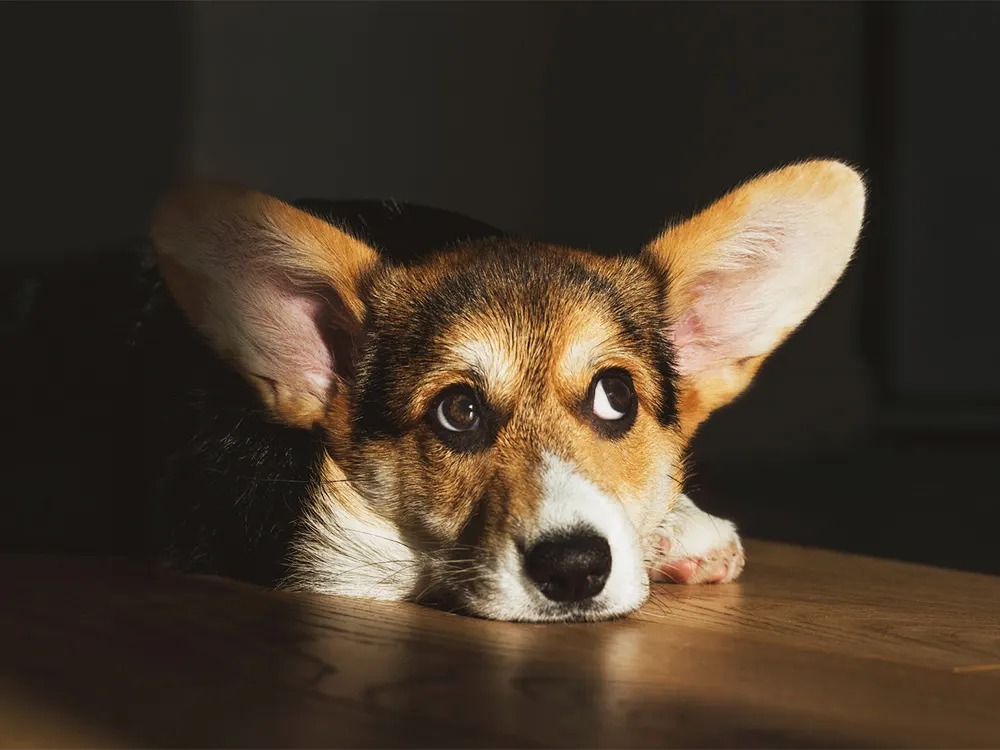
Your dog stops mid-step, ears up, body still, and locks onto a spot on the wall where there is absolutely nothing. The fur along their spine might lift. They might let out a low woof at the empty hallway. It is the exact beat before something goes wrong in every horror movie ever made, and for a second your rational brain loses the argument.
Here is the reassuring, slightly deflating truth: that stare almost always has a completely ordinary explanation. Your dog is not tuned to the afterlife. They are tuned to a version of the physical world that is far richer than yours, and they are reacting to something in it that your duller senses simply missed. The interesting question was never “is it a ghost.” It is “what real thing is my dog detecting that I can’t,” and there is a good, useful answer, plus one item on the list you shouldn’t wave off.
Your dog lives in a bigger world than you do
Before blaming the paranormal, it helps to appreciate just how much more of the environment a dog takes in. Their senses aren’t magic, but next to ours they might as well be.
Smell is the headliner. A dog’s nose can register scents laid down hours or even days earlier, and detect concentrations far below anything a human could notice. Dogs are trained to smell out cancer and predict seizures precisely because they perceive chemical changes we cannot. They can even pick up on subtle shifts in the environment tied to weather and barometric pressure.
Hearing is the other big one. Dogs detect much higher frequencies than we do and hear faint or distant sounds from far outside human range. So when your dog snaps to attention at “nothing,” they may be reacting to a noise that is genuinely there, just not for you: a mouse in the wall, a truck three streets over, an ultrasonic whine from an appliance.
Vision plays a supporting role. Dogs are somewhat nearsighted and see fewer colors than we do, but they have a wider field of view and much better low-light vision, so at dusk or in a dim room they may catch a flicker of movement, a moth, a shadow, a chipmunk beyond the window, that never registers with you.
The real reasons behind the “haunted” moment
Line up the everyday explanations and the empty-corner stare stops being spooky fast.
- A sound you can’t hear. This is the most common one. A high or distant noise that sits above your hearing range but well within your dog’s can trigger a freeze, a head tilt, or a bark at a blank wall.
- A scent that’s faded for you. Dogs track smells long after they’d vanish for us. A dog drawn to a specific chair or spot, especially one a departed person or pet used to favor, may be reading a scent trace, not a presence.
- Movement at the edges. A bug on the ceiling, a shifting shadow, or an animal outside the window can catch a dog’s motion-sensitive, wide-angle vision before you notice a thing.
- You. Dogs are exquisitely attuned to human emotion. If you tense up, hold your breath, or act uneasy, your dog can catch it and mirror the anxiety right back, which then looks like they’re reacting to something in the room.
The one explanation worth taking seriously
Most blank stares are trivial. One category is not, and it is the reason this topic deserves more than a shrug.
Repeated, aimless staring, especially in an older dog, can be an early sign of a health problem rather than a quirk. As dogs age, some develop a degenerative condition similar to dementia, canine cognitive dysfunction, that can cause pacing, restlessness, disorientation, and yes, staring off into space. A dog fixating on walls or corners with growing frequency, particularly alongside sleep-cycle changes or confusion in familiar rooms, should see a vet.
Other medical or behavioral drivers can produce the same picture. Anxiety disorders, partial (focal) seizures that make a dog snap at invisible things, and compulsive fixations on light or shadow can all look like a dog haunted by something unseen. None of these are diagnosable from the couch, which is exactly why the pattern matters more than any single episode.
The word I want owners to reach for isn’t ‘ghost,’ it’s ‘new.’ A dog who’s always given the occasional weird stare is just being a dog. A senior who suddenly starts locking onto corners for minutes at a time, or a young dog who can’t stop chasing shadows, that’s worth a real exam. The behavior is data, not a séance.
Which dogs do this most
Any dog can react to unseen stimuli, but some are wired to notice more. Breeds developed for hunting or working, pointers, hounds, German Shepherds, retrievers, and scent breeds generally, tend to have especially sharp noses, ears, and eyes, so they’re quicker to alert to a sound or smell their humans can’t register. A more reactive, environmentally tuned dog will simply have more “haunted” moments, because they’re catching more of the ordinary world you filter out.
What to do in the moment
If the behavior is occasional and brief, you don’t need to do anything, your dog is just out-sensing you, and reacting calmly (rather than gasping) keeps you from feeding the moment. If it’s becoming frequent, compulsive, or is paired with disorientation, anxiety, appetite changes, or anything that looks like a seizure, note when it happens and take a short video to show your vet. Patterns are far more useful to a clinician than a single dramatic episode.
What’s new since this was written
The science on how well dogs read us has firmed up, and it reframes a lot of “sixth sense” stories. Controlled studies now show dogs can smell the difference between a stressed and a relaxed human from breath and sweat alone, and that the scent of human stress can actually shift a dog’s own behavior and choices. So when your dog seems to react to an atmosphere in the room, they may quite literally be smelling your stress chemistry, not sensing a spirit.
Aging research has also sharpened the practical advice. Cognitive decline in dogs is now recognized as something that shows up gradually, often first as subtle changes in sleep, orientation, and yes, blank staring, so vets increasingly treat a new pattern of “staring at nothing” in a senior dog as a prompt to screen for cognitive dysfunction early, when support helps most. The takeaway isn’t spookier. It’s more useful: pay attention to changes, and let a vet weigh in on the ones that stick around.
Bottom line
When your dog stares down an empty hallway, they are almost certainly detecting something real, a sound, a smell, a flicker of movement, that your senses can’t reach, or simply mirroring your own unease. It is not evidence of ghosts, and science can neither confirm nor deny the paranormal anyway. The genuinely important exception is the older dog whose blank staring is new and increasing, because that can signal cognitive decline or another medical issue that deserves a vet’s eyes. Trade the chill down your spine for a bit of curiosity, and if the behavior changes, trade it for an appointment.
References
- Parr-Cortes, Zoe, et al. “The Odour of an Unfamiliar Stressed or Relaxed Person Affects Dogs’ Responses to a Cognitive Bias Test.” Scientific Reports, 2024. https://www.nature.com/articles/s41598-024-66147-1
- Landsberg, Gary, et al. “Cognitive Dysfunction Syndrome in Dogs.” Veterinary Clinics of North America. https://pubmed.ncbi.nlm.nih.gov/22035861/
- Horowitz, Alexandra. “Being a Dog: Following the Dog Into a World of Smell.” Scribner.
- American Kennel Club. “How Well Do Dogs Hear?” https://www.akc.org/expert-advice/health/how-well-can-dogs-hear/
Common questions
Why does my dog stare at the wall or an empty corner?
Usually because their senses picked up something yours didn't: a high-pitched noise, an animal inside the wall or outside, or a faded scent. In older dogs, repeated blank staring can be a sign of canine cognitive dysfunction and is worth a vet visit.
Should I worry when my dog reacts to something invisible?
Occasional, brief reactions are normal, dogs simply out-sense us. Worry more if the behavior is new, frequent, compulsive, or paired with disorientation, anxiety, or other changes, which can point to a health issue rather than a quirk.
Can dogs sense 'bad energy' or emotions?
Dogs are excellent at reading human emotion through body language, tone, smell, and routine. What feels like sensing 'energy' is usually your dog picking up on your stress or on a sound or odor in the environment and mirroring it back.
Dr. Kohl is a board-certified veterinary dentist with a particular interest in preventive oral care. She reviews all dental health content at The Pet Times and contributes practical guides on home dental routines, professional cleaning, and oral disease prevention.
Meet our experts ↗Keep reading
 TrainingIt's Not Why Your Dog Licks Your Legs. It's How Long.Dr. Mara Chen · 7 min
 TrainingYour Dog Doesn't Need a Bad Memory to Be Terrified of the VacuumDr. Priya Nair · 9 min
 TrainingYour Dog Curls Its Lip and Chatters Its Teeth. It's Reading a Smell You Can't.Dr. Priya Nair · 5 min
 Health & WellnessNo, Your Dog Isn't Schizophrenic. But What They Have Is Real.Dr. Lena Park · 7 min
 TrainingYou're Not Reading Your Dog. You're Reading the Room Behind Him.Dr. Ravi Mehta · 7 min
 TrainingYour Dog Isn't Standing Guard. They're Just Not All the Way Asleep.Dr. Nina Kohl · 7 min