


Your Dog Doesn't Need a Bad Memory to Be Terrified of the Vacuum
The most common myth about dog fear is that something must have happened. It didn't. Seven things dogs are strangely scared of, why unfamiliarity alone is enough, and the comforting advice that turns out to be wrong.


Everyone knows about fireworks and thunder. That is the baseline. What nobody warns you about is the day your fifty-pound dog levitates onto the couch because a basketball bounced.
And then the second thing happens, which is that a well-meaning person asks what must have happened to him.
Usually the answer is nothing. Nothing happened. That single misunderstanding, that fear requires a bad memory, is why so many people manage their dog’s fears badly. They go looking for the trauma instead of dealing with the dog in front of them.
Fear does not need a backstory
Dogs, like any animal, can become afraid of essentially anything. And they do not need a negative experience with a thing to be frightened of it. They can be frightened of something they have simply never encountered before.
Think about what that means in a house. A vacuum is not scary because it once ran over a paw. It is scary because it is enormous, it howls, it moves in an unpredictable line, and it did not exist in your dog’s world until it did.
Trauma is real and it leaves lasting marks. But novelty is the far more common culprit, and it explains the ridiculous ones, the fears that make you laugh and then feel guilty for laughing.
The scale of the problem is bigger than most owners assume. A survey of nearly 13,700 pet dogs in Finland, published in Scientific Reports, found that 72.5 percent showed some highly problematic anxiety-related behavior. Noise sensitivity was the single most common trait: 32 percent of dogs were highly fearful of at least one noise, and fear of fireworks alone came in at 26 percent. General fearfulness followed at 29 percent.
Your dog is not being dramatic. Your dog is being a dog, at scale.
Owners keep asking me what happened to their dog, and most of the time the honest answer is that nothing happened. The thing was new, and new is enough. Once people accept that, they stop hunting for a story and start doing the work.
Seven things dogs are strangely afraid of
1. The vacuum, and its small round descendant
The classic. Loud, large, erratic, and it comes toward them. Robot vacuums are, if anything, worse: they are silent-ish, low to the ground, and they pursue. A dog who tolerates the upright can still lose their mind over a disc that follows them around the room with no visible person driving it.
2. Airplanes, helicopters, and anything overhead
This one is genuinely strange and genuinely common. Unanticipated noisy objects in the sky, planes, helicopters, hot air balloons, drones, can rattle a dog badly. The sound arrives from a direction dogs cannot easily orient to, and there is nothing to approach, investigate, or move away from. It is threat without a location, which is the worst kind.
3. Strangers, and men in particular
This is the one on the list that is not a quirk. Fear of unfamiliar people is a genuine behavioral concern, and it tends not to stay put. Left alone it deepens, and it commonly travels with fear of being alone, which is how it snowballs into separation anxiety and defensive aggression. Fear of men specifically is often chalked up to trauma, but under-socialization during puppyhood explains at least as many cases: a dog raised in a household of women may simply never have learned that deep voices and heavy footsteps are ordinary.
Get professional help with this one early. It is the fear on this list most likely to end badly.
4. Water, and things that float on it
Plenty of dogs dislike swimming, and plenty of breeds cannot swim well. That is not the interesting part. The interesting part is the dogs who are unbothered by water itself but come unglued at balloons, pool floats, and inflatable things bobbing on a surface. It is not the water. It is the objects that appear to have conquered it.
5. Balls, if they are the wrong size
Dogs are stereotyped as ball-obsessed, and then a basketball bounces past and the illusion collapses. A large ball that bounces unpredictably near a dog who is only used to tennis balls is a genuinely alarming object: it is bigger than their head, it moves on its own, and it makes a noise on every impact.
6. Slick floors, stairs, and surfaces underfoot
The Finnish survey tracked fear of surfaces and heights as its own category for good reason. A dog who suddenly refuses to cross the kitchen tile or take the stairs is not being stubborn, and this fear has a nasty habit of being physical: a dog whose hips hurt learns that slick floors are where the pain happens. Which brings us to the important one.
7. Sound itself, arriving suddenly in middle age
A dog who has been fine with noise for six years and abruptly is not has told you something. Adult-onset noise sensitivity is disproportionately associated with undiagnosed pain, particularly musculoskeletal pain, and the leading explanation is that a dog who tenses hard at a startling sound and feels a jolt of pain rapidly learns to dread the sound. This is the fear that should send you to a vet before a trainer.
Two pieces of common advice, one right and one wrong
Wrong: “Don’t comfort them, you’ll reinforce the fear.”
This is the most durable bad advice in dog training, and it needs to die. Fear is an emotional state, not a trick your dog is performing for treats. You cannot reinforce an emotion into permanence by being kind during it.
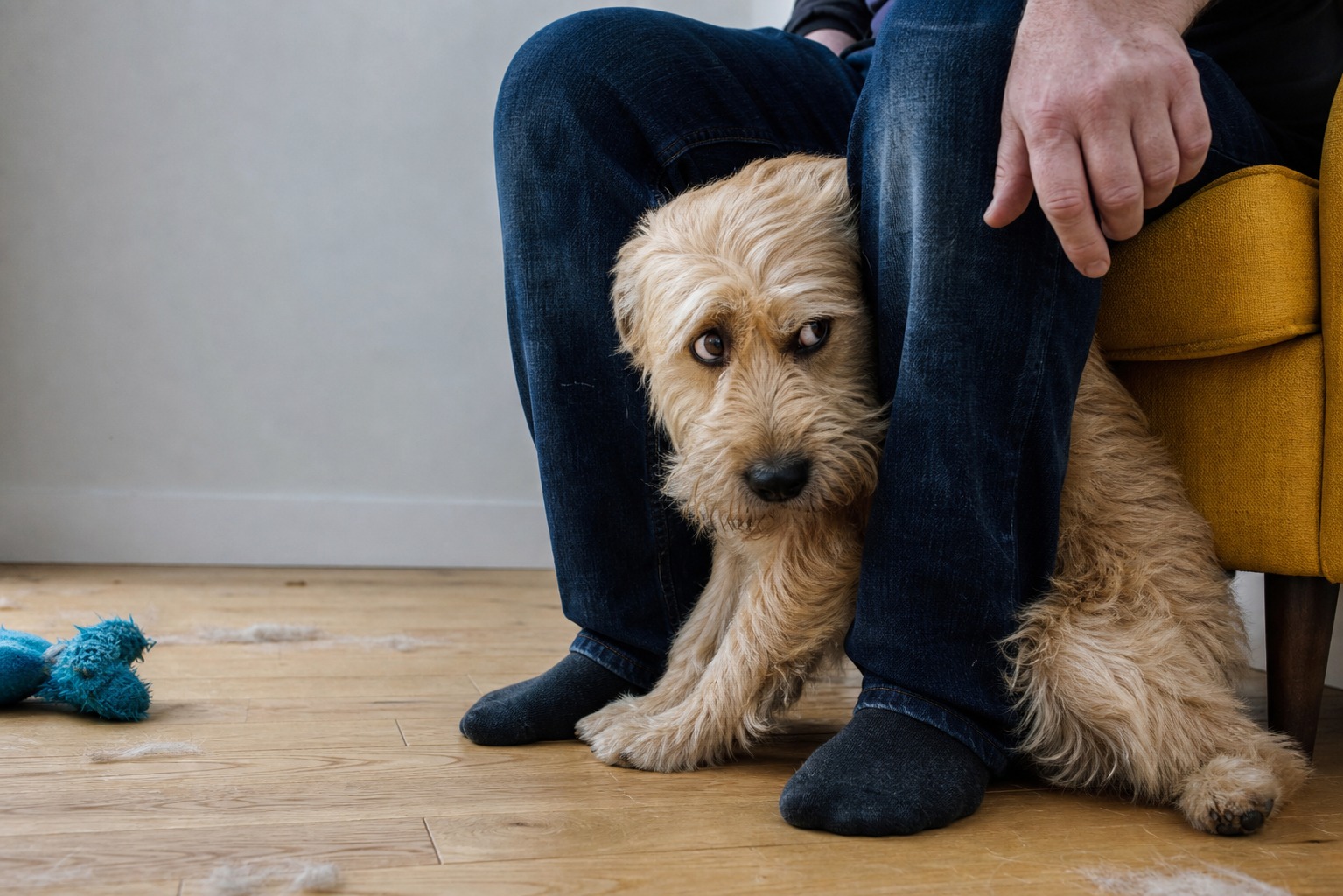
What is actually happening when your dog presses into you during a thunderstorm is that your dog has decided you are the safe thing in the room. That is a functioning bond doing exactly what it is for. Turning them away teaches them only that the safe thing is not reliable.
Right: don’t let them flee, and don’t force them forward, either.
The instinct when a dog reacts badly is to let them run. It feels compassionate. But bolting is practice, and every successful escape makes the next escape more likely and the fear a bit larger.
The version that actually builds resilience is neither escape nor exposure. Stay with them. Let them recover next to you. Then move away together, on your terms, as a unit. The dog learns that the scary thing ended and they walked away from it with you, which is a completely different lesson than “I ran and survived.”
Forcing them toward the thing they are afraid of, on the other hand, is not brave and it does not work. It is cruel and it reliably makes the fear worse.
What actually helps
Build the safe place first. A crate, a bed, a room, somewhere your dog can go where nothing is ever asked of them and nobody follows. Fear work does not start with the scary thing. It starts with a dog who has somewhere to be.
Then introduce the fear from inside the safety. With the retreat available and the dog under threshold, let them investigate the vacuum while it is off, sitting in a corner, boring. Pair it with food. Move it a foot. Pay again. The order matters: safety first, then curiosity, then the object.
Consider the physical supports. Pressure wraps and calming collars help some dogs through longer exposures. For predictable, high-intensity events, storms, fireworks, a move, talk to your vet about situational anti-anxiety medication given ahead of time. Medication is not a failure of training. It is what makes training possible for a dog whose brain is currently underwater.
Know when the quirk is not a quirk. The line is spillover. If your dog is struggling with daily life, not sleeping, not eating, or getting worse in areas that have nothing to do with the original trigger, that is not a funny fear anymore. Call your vet or a qualified behaviorist.
What newer research adds
Two findings have changed how this is handled.
The first is the pain connection. Noise sensitivity that appears later in life is now taken seriously as a possible pain signal rather than a training problem. Vets are more likely to check a dog’s joints when an older dog develops a sudden fear of sounds, and treating the pain sometimes resolves the fear.
The second is more hopeful, and it is about the ordinary life you give your dog. Another large Finnish study found that dogs with more active, more social lives, more daily exercise and more contact with other dogs and people, showed lower non-social fearfulness, the category that covers exactly these fears of noises, objects, and surfaces. It is an association rather than proof of cause, and a fearful dog may simply get taken out less. But the direction is worth acting on.
The takeaway is plain enough for a Tuesday: a dog who gets out more, sniffs more, and meets more of the world tends to be a dog with less of it left to be afraid of. You cannot socialize away a phobia. You can make the world a smaller and more familiar place, one boring introduction at a time.
References
- Salonen, M., Sulkama, S., Mikkola, S., Puurunen, J., Hakanen, E., Tiira, K., Araujo, C., & Lohi, H. (2020). Prevalence, comorbidity, and breed differences in canine anxiety in 13,700 Finnish pet dogs. Scientific Reports, 10, 2962. https://www.nature.com/articles/s41598-020-59837-z
- Puurunen, J., Hakanen, E., Salonen, M. K., Mikkola, S., Sulkama, S., Araujo, C., & Lohi, H. (2020). Inadequate socialisation, inactivity, and urban living environment are associated with social fearfulness in pet dogs. Scientific Reports, 10, 3527. https://www.nature.com/articles/s41598-020-70722-7
- Lopes Fagundes, A. L., Hewison, L., McPeake, K. J., Zulch, H., & Mills, D. S. (2018). Noise sensitivities in dogs: an exploration of signs in dogs with and without musculoskeletal pain using qualitative content analysis. Frontiers in Veterinary Science, 5, 17. https://www.frontiersin.org/articles/10.3389/fvets.2018.00017/full
- American Veterinary Society of Animal Behavior. Position statement on humane dog training. https://avsab.org/resources/position-statements/
Common questions
Will comforting my scared dog make the fear worse?
No. Fear is an emotion, not a behavior you can accidentally reward into permanence. A dog who comes to you when frightened is telling you that you are safe. Comfort them.
Is my dog's fear a real problem or just a quirk?
Look at the spillover, not the trigger. A dog who bolts from the vacuum and then goes back to napping has a quirk. A dog who stops eating, stops sleeping, or whose behavior deteriorates in areas unrelated to the fear has a problem worth a vet or behaviorist visit.
Can pain cause a sudden new noise phobia?
It can, and it is under-recognized. Dogs with undiagnosed musculoskeletal pain are over-represented among dogs who develop noise sensitivity later in life. A dog who suddenly becomes afraid of sounds in middle age deserves an orthopedic exam, not just a training plan.
Dr. Nair is a veterinarian focused on diet and feeding. She covers everyday nutrition, treats, and the many "can they eat this?" questions owners ask, grounding each answer in what is actually safe and sensible for dogs and cats.
Meet our experts ↗Keep reading
 TrainingThe Algorithm Rewards Bad Dog Training. Here Are 10 Tells.Dr. Mara Chen · 7 min
 TrainingYour Dog Isn't Being Rude. He's Cornered.Dr. Amara Solis · 8 min
 TrainingSending Your Dog to Its Crate as Punishment Ruins the One Room That's TheirsDr. Amara Solis · 7 min
 TrainingWhen Your Dog Turns to Stone on a Walk, Don't Pull. Read It.Dr. Amara Solis · 6 min
 TrainingWhining Is Your Dog's Word for Fear. Barking Is the One for Frustration.Dr. Lena Park · 8 min
 TrainingYour Dog Between Your Legs Is Either a Cuddle or a Cry for HelpDr. Mara Chen · 6 min