


195,000 Button Presses Later: The Dogs Weren't Copying Us
The obvious explanation for a dog 'talking' with soundboard buttons was that they were imitating their owner or hitting things at random. Researchers checked both. Neither held up.

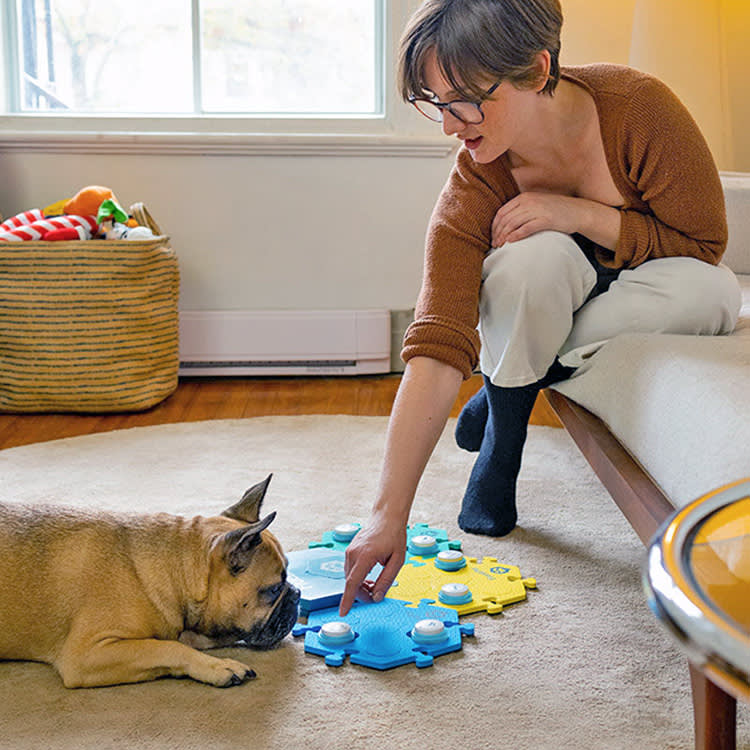
The skeptic’s case against talking-dog videos was always the strong one, and it went like this.
The dog is not communicating. The dog is either mashing buttons at random and the owner is editing the footage, or the dog is copying what they have seen their owner do. Both explanations are boring, both are plausible, and neither requires a dog to mean anything.
So researchers went and tested exactly those two explanations. They are, it turns out, the two that fail.
What they actually did
A team led by Federico Rossano at UC San Diego’s Comparative Cognition Lab, with lead author Amalia Bastos, collected 21 months of data through the FluentPet app, where owners log button presses, their pets’ and their own.
The final dataset covered 152 dogs and more than 260,000 button presses, roughly 195,000 of them made by the dogs themselves. Of the dogs’ soundboard interactions, close to 30 percent, some 56,676 presses, were multi-button combinations rather than single words.
That is not a viral clip. That is a corpus.
Test one: was it random?
If dogs are hitting buttons arbitrarily, then which buttons appear together should follow chance. Any two-button pairing should be roughly as likely as any other, adjusted for how often each button gets used.
It did not come out that way. The combinations dogs produced were statistically distinguishable from random, and certain pairings recurred far more often than chance predicted. Words like “outside” and “potty” clustered. So did “food” and “water.”
“Our results suggest that owner-trained dogs can press buttons on their soundboards in a non-accidental and non-random fashion,” Bastos wrote.
Notice what those clusters are. The dogs were not producing poetry. They were pairing concepts that genuinely go together from a dog’s point of view, which is both less magical and considerably more convincing than the alternative.
Test two: were they copying us?
This is the sharper objection, and the more interesting result.
If dogs were simply mimicking their owners’ button use, the buttons dogs press most should mirror the buttons owners press most. The researchers had both sets of data, so they checked.
They barely matched. “We found that there was only a minimal association between the identity of individual buttons pressed by dogs and the buttons pressed by their owner,” Bastos wrote.
The dogs were pressing their own buttons, about their own priorities. If imitation were driving the behavior, that is the last pattern you would expect to see.
Ruling out imitation is the part that should make people sit up. Once the dog’s choices stop tracking the human’s choices, you are no longer looking at a trained trick. You are looking at a dog with an agenda.
What this does not prove
It would be easy to over-read this, and the researchers do not.
Dogs varied enormously. Some were consistent with their combinations; others hovered near randomness. The so-called Gifted Word Learner dogs can pick up dozens of words, while most dogs have far more modest vocabularies. Evidence that dogs can intentionally combine words is not evidence that any particular dog is composing sentences, and it is certainly not evidence of the emotional monologues that get captioned onto social media clips.
How far a dog’s understanding of these buttons actually extends remains open. The study establishes something narrower and firmer: the presses are deliberate, they are structured, and they are the dog’s own.
Why it might matter for your dog
Rossano’s interest is in what this could do for ordinary communication between species.
His argument is that a soundboard offers precision that a dog’s existing vocabulary cannot. A bark at the door, or a scratch at it, is a request with no object attached. A dog who can pair “outside” with “park,” or with “beach,” has told you not only that they want something but which thing, and Rossano expects that specificity to make living alongside a dog easier and the relationship closer.
That is worth taking seriously, and it is worth being honest about what it replaces. Your dog already communicates constantly, through posture, gaze, position, and noise, and most owners read maybe a third of it. A soundboard does not give a dog a voice they lacked. It gives them a channel we happen to be better at hearing, because it is made of our words.
Which raises the uncomfortable possibility that the buttons are less an upgrade for the dog than a translation aid for us.
What newer research adds
The follow-up work has been narrowing the question rather than inflating it, which is a good sign for the field.
The same UCSD lab has published separate evidence that dogs process the words the buttons produce as words, rather than as arbitrary sounds tied to a location, meaning a dog responds to what the button says rather than merely to which tile they stepped on. That closes off another deflationary explanation.
And the team has been explicit about the next frontier. What Rossano wants to establish is whether a dog can use a soundboard to refer to something that is not in front of them: an object that is absent, a thing that already happened, a thing that has not happened yet. He has said plainly that a dog who could do that would force a substantial rethink of how we understand animal minds and animal communication.
That is the real test, and it has not been passed yet. Every result so far involves dogs telling us about things that are happening now and that they want now: outside, food, water, play. A dog who presses a button about yesterday would be a different kind of finding entirely.
For now, the honest summary is this. Your dog is probably not lying awake composing thoughts about mortality. Your dog is, with statistical reliability, telling you they need to pee, and doing it on purpose, in a way they worked out themselves.
Which, if you think about what we assumed a decade ago, is quite a lot.
References
- Bastos, A.P.M., Houghton, Z.N., Naranjo, L., and Rossano, F. “Soundboard-Trained Dogs Produce Non-Accidental, Non-Random and Non-Imitative Two-Button Combinations.” Scientific Reports, vol. 14, 2024. nature.com/articles/s41598-024-79517-6
- UC San Diego Today. “Dogs Use Two-Word Button Combos to Communicate, Study Shows.” today.ucsd.edu/story/dogs-use-two-word-button-combos-to-communicate-study-shows
- UC San Diego Today. “Dogs Understand Words from Soundboard Buttons, Study Reveals.” today.ucsd.edu/story/dogs-understand-words-from-soundboard-buttons-study-reveals
- Boros, M., et al. “Dogs Build Semantic Expectations Between Spoken Words and Objects.” Current Biology, 2024. cell.com/current-biology/fulltext/S0960-9822(24)00385-3
Common questions
Does this mean my dog understands language?
No. It means the combinations dogs press are not random and are not copied from their owners, which is a much narrower claim. Whether dogs grasp meaning the way we do remains an open question.
Can any dog learn to use buttons?
Dogs vary enormously. Some in the study combined buttons consistently; others approached randomness. Some so-called Gifted Word Learner dogs pick up dozens of words while most dogs have far more limited vocabularies.
Are the viral talking-dog videos real?
The specific claim that dogs press multi-button combinations non-randomly and non-imitatively now has data behind it. The claim that a dog is philosophizing about death does not.
What did the dogs press most?
Combinations like 'outside' with 'potty,' and 'food' with 'water,' occurred more often than chance would predict. Which is to say, dogs mostly talked about what dogs mostly want.
Dr. Kohl is a board-certified veterinary dentist with a particular interest in preventive oral care. She reviews all dental health content at The Pet Times and contributes practical guides on home dental routines, professional cleaning, and oral disease prevention.
Meet our experts ↗Keep reading
 TrainingAn AI Sorted Dogs Into 5 Personality Types. Here's What It's Really ForNina Vasquez · 7 min
 TrainingYour Dog Isn't Watching the Door. They're Smelling the Clock.Dr. Amara Solis · 5 min
 TrainingMarking Isn't a Potty Accident. Punishing It Backfires.Dr. Nina Kohl · 6 min
 TrainingFace Bites Are Almost Always Our Fault, Not the Dog'sDr. Amara Solis · 5 min
 TrainingYour Reactive Dog Can't 'Settle.' Stop Asking and Give Them a Job.Dr. Mara Chen · 8 min
 TrainingTell Your Dog to 'Create,' and They Actually CanJordan Ellis · 6 min