


Your Dog Has No Idea When He's Full. That's Not a Flaw, It's the Design
Dogs have the same fullness signals we do, and most of them blow right past them. They're built to bolt food before a rival can take it. Which means knowing when enough is enough was never your dog's job. It's yours.

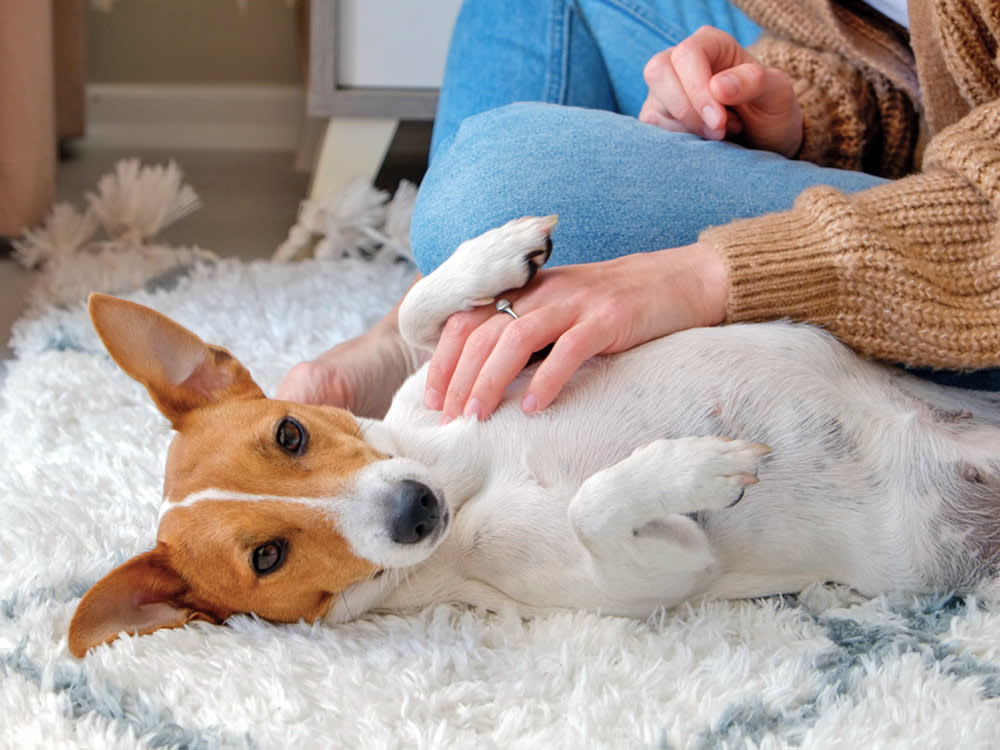
Pour the food, and the show begins: the spinning, the barking, the laser focus, the bowl licked so clean it could go back in the cupboard. Somewhere in the middle of that nightly performance, most owners have wondered the same thing. Is there any amount of food that would make my dog stop and say, that’s plenty, thanks? For a lot of dogs, the honest answer is no. And that’s not a defect in your dog. It’s the design working exactly as intended.
Dogs are not broken eating machines, but they’re not reliable self-regulators either. The signals exist. Your dog just isn’t built to trust them. Once you understand why, the whole job of feeding shifts onto the right set of shoulders, which is to say, yours.
Owners keep waiting for their dog to hit some internal brake, and for many dogs that brake was never wired to work. The dog has the fullness hardware. What he doesn’t have is a reason to listen to it. So the portion decision isn’t something you’re taking away from your dog. It’s something he was never equipped to make.
The hardware is there. The habit isn’t.
Dogs do have the equipment to sense fullness. Like us, their stomachs are lined with stretch receptors that fire a fullness cue toward the brain as the organ expands. So in theory, a dog should feel full. In practice, “full” is partly a human framing, a description of feeling sated or of meeting energy needs, and dogs meet it inconsistently. Some dogs left to free-feed will self-regulate just fine. Many will not, and food left down can also spark resource guarding in multi-dog homes. Anyone who’s watched their dog swallow a sock knows dogs aren’t always careful about what, or how much, goes down. Keeping them safe falls to us.
Why dogs overeat
A big part of it is baked in. Dogs have been described as “bolt-feeders,” animals that wolf food down so fast they blow past the signals that would tell them to stop. Just as a human who inhales a meal doesn’t feel it until it’s too late, a dog can eat faster than his own fullness cues can fire.
That makes sense given where dogs come from. For a scavenging pack animal, eating quickly was a survival advantage: gulp your share before a neighbor or competitor takes it. That legacy is probably why a dog will often put away more when another animal is in the room, an old reflex to claim your portion before anyone else can.
Food itself contributes. A very calorie-rich formula packs a lot of energy into a small volume, so a bowl that looks modest can deliver far more than it appears to. Palatability piles on top of that: a food a dog finds irresistible is one he’ll keep eating past the point of need, the canine version of reaching for a second slice of cake. Even rotating flavors can backfire, tempting a dog to take in more than he otherwise would.
Medical conditions matter too. Certain diseases and medications, including hyperadrenocorticism (Cushing’s disease), can crank up appetite. A significant, sudden change in how much your dog wants to eat, up or down, is worth a vet visit to rule out an underlying cause. And then there’s plain human error: many loving owners overfeed as a form of affection, and don’t notice the weight creeping on over months.
Is it a breed thing?
Overeating isn’t tied to one breed, and it has more to do with an individual dog’s personality and food history than their pedigree. A dog who once went hungry, or had to compete for every meal, may eat as if famine is always around the corner, stocking up against a future shortage that never comes. One important nuance from recent genetics research: Labrador Retrievers (and the closely related Flat-Coated Retriever) disproportionately carry a variant in the POMC gene linked to a stronger food drive and higher obesity risk, which helps explain why “my Lab is obsessed with food” is such a universal refrain. But even there, environment and portioning decide the outcome.
Why it matters: the health stakes
Chronic overfeeding does real damage. Overweight and obese dogs face higher rates of arthritis and mobility problems, cancer, heart disease, urinary disorders, skin infections, and breathing difficulty, along with a shorter life expectancy. This isn’t a cosmetic issue.
And there’s an acute danger that’s easy to underestimate. A dog who normally eats a sensible amount but suddenly gorges, into the trash, a burst bag of kibble, a holiday spread, can develop vomiting, regurgitation, diarrhea, panting, pacing, bloating, or lethargy. In the worst cases, sudden overeating can trigger life-threatening emergencies: pancreatitis, and gastric bloat or gastric dilatation-volvulus (GDV), a twisting of the stomach that is an acute, time-critical emergency, especially in large, deep-chested breeds. Many dogs develop GDV without overeating at all, but a sudden large volume of food can help set the stage.
What to actually do
The fix isn’t to hope your dog develops willpower. It’s to manage the food.
Start by learning your dog’s real caloric needs, and build a feeding plan with your vet, since ideal weight and nutrition depend on age, breed, sex, activity level, and lifestyle, and those needs shift over time as a dog ages or slows down. Divide the daily amount across two to three meals rather than one big dump, and adjust how you dole it out based on your dog’s habits. Slow down a fast eater with a slow-feed bowl or puzzle feeder so the fullness signals have time to catch up. And control access to unlimited food: close cupboards, secure feed containers, lock down the garbage. If your dog has already overeaten and shows any of the emergency signs above, especially a distended belly or unproductive retching, call your vet immediately, because pancreatitis and GDV can be deadly and need treatment fast.
Holidays deserve a specific warning. As tempting as it is to share the Thanksgiving or Christmas table, emergency vets see a wave of very sick dogs after the fatty-food overindulgence of the season, turkey skin, gravy, and rich scraps. A little restraint on your part is a lot of protection for your dog.
What newer data adds
The scope of the problem has come into sharper focus recently, and it’s bigger than most owners think. The Association for Pet Obesity Prevention’s 2024 survey found that by clinical body-condition scoring, well over half of U.S. dogs, roughly 59 percent, land in the overweight-to-obese range, with about 22 percent clinically obese. Just as telling is the perception gap: only 35 percent of owners recognized their own dog as overweight, meaning a large share of heavy dogs have owners who think they look just right. That gap is the real takeaway. Your dog isn’t going to tell you he’s had enough, and your own eyes may not either, so the reliable move is to feed by a measured plan built with your vet, not by the bowl or the begging.
References
- Association for Pet Obesity Prevention. “2024 Pet Obesity Survey Results.” petobesityprevention.org, 2024.
- Raffan, Eleanor, et al. “A Deletion in the Canine POMC Gene Is Associated with Weight and Appetite in Obesity-Prone Labrador Retriever Dogs.” Cell Metabolism, vol. 23, no. 5, 2016, pp. 893–900, https://doi.org/10.1016/j.cmet.2016.04.012.
- German, Alexander J. “The Growing Problem of Obesity in Dogs and Cats.” Journal of Nutrition, vol. 136, no. 7, 2006, pp. 1940S–1946S, https://doi.org/10.1093/jn/136.7.1940S.
- Bell, Emily, et al. “Overweight and Obese Body Condition in ~4.9 Million Dogs and ~1.3 Million Cats Seen at Primary Practices Across the USA.” Preventive Veterinary Medicine, 2024, https://doi.org/10.1016/j.prevetmed.2024.106360.
Common questions
Why does my dog act starving all the time?
It's largely instinct. Dogs evolved as scavengers and pack animals, where gulping your share before a competitor arrives was an advantage. Some dogs, notably Labradors, also carry a genetic variant linked to a stronger food drive. A bottomless appetite is usually normal, but a sudden increase can signal a medical issue worth checking.
What should I do if my dog ate way too much at once?
Watch closely and call your vet if you see vomiting, a distended or painful belly, restlessness, unproductive retching, drooling, or lethargy. Sudden large-volume eating can trigger pancreatitis or life-threatening bloat (GDV), especially in large, deep-chested dogs. When in doubt, treat it as urgent.
Not a substitute for your vet. Our guidance is educational. For urgent symptoms, contact a vet or emergency clinic right away. Editorial standards
Dr. Mehta is a board-certified veterinary nutritionist who evaluates pet food formulations, ingredient quality, and the science behind dietary trends. He writes and reviews all nutrition content at The Pet Times, including our food rankings and feeding guides.
Meet our experts ↗Keep reading
 FoodYou're Probably Guessing Your Dog's Portions. Here's the Math.Dr. Ravi Mehta · 8 min
 FoodYour Dog Isn't Spoiled. 6 Fixes That Actually Get a Picky Eater EatingDr. Amara Solis · 6 min
 FoodYour Dog Has a Sweet Tooth. That's Exactly the Problem.Dr. Nina Kohl · 7 min
 FoodHome-Cooked Dog Food Can Run $3 a Day. The Real Price Is Your Sundays.Dr. Amara Solis · 9 min
 FoodWhy Adult Dogs Shouldn't Live on Puppy Food Comes Down to One MineralDr. Lena Park · 8 min
 Health & WellnessOne Bowl, Two Dogs: The Feeding Habit That Breeds FightsDr. Amara Solis · 6 min