


One Bowl, Two Dogs: The Feeding Habit That Breeds Fights
Feeding multiple dogs from a shared bowl looks efficient and quietly causes three problems: mismatched portions, hidden health needs, and resource guarding. Here's why separate bowls win, and where water is the exception.

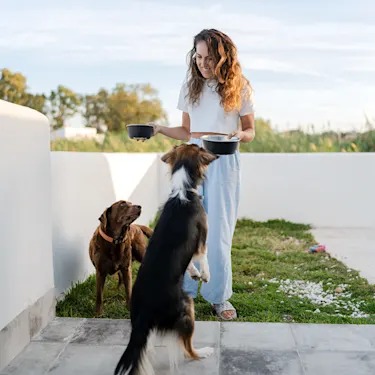
Two dogs, one big bowl, dinner done in half the time. It reads like a life hack, and in busy multi-dog homes plenty of people do it without a second thought. But that single bowl quietly creates three separate problems, and the worst of them isn’t about germs. It’s about turning every meal into a low-grade competition between animals who are supposed to be family.
The case for two bowls isn’t fussiness. It’s that a shared food bowl makes it impossible to do the two things good feeding requires: give each dog the right food in the right amount, and keep mealtime calm. Here’s how the one-bowl habit breaks both, and the one place, water, where sharing is usually fine.
Problem one: you can’t control the portions
Dogs are not interchangeable eaters. Two dogs in the same house often have different caloric needs based on size, age, activity, and metabolism, and a shared bowl erases your ability to meet them. Out of one dish, the faster or pushier eater tends to take more than their share while the slower or shyer dog comes up short. One dog creeps toward overweight; the other doesn’t get enough.
And you can’t fix what you can’t see. Even if you stand there watching, it’s essentially impossible to know how much each dog actually ate from a common bowl. Portion control is the foundation of weight management, and a shared bowl removes it entirely.
Problem two: it hides individual health needs
Portions are only half of it. Dogs’ diets are not one-type-fits-all. One dog may be on a prescription kidney or weight-management food while the other eats standard kibble. Pour both into a single bowl and you’ve undone the whole point of the special diet, the dog who needs the therapeutic food may not get enough of it, and the dog who doesn’t need it eats food that isn’t right for them.
Separate bowls are how you guarantee each dog gets their specific food, in the specific amount their vet recommends for their breed, size, ideal weight, and any medical condition. That precision is impossible to fake with one dish.
Problem three: the bowl becomes a battleground
This is the one that surprises people, and it’s the most important. Sharing a single food bowl manufactures competition, and competition around food is where resource guarding and food aggression are born.
Even dogs who have never so much as curled a lip can start guarding when they’re forced to eat shoulder to shoulder from the same source. The setup itself, two mouths, one finite pile of food, tells each dog that eating is a contest with a rival. For less confident dogs and dogs already prone to guarding, a shared bowl can be genuinely stressful, and stress at mealtime is exactly the soil food aggression grows in. The risk simply isn’t worth the few seconds a shared bowl saves.
I’ve watched a shared bowl turn two easygoing housemates into dogs who freeze and stiffen the second food appears. Nobody planned it. The bowl taught them to compete. The fix is almost boringly simple: give each dog their own dish, ideally out of sight of each other, and the tension usually drains right out of dinner.
What to do instead
Feed each dog from their own bowl, and where you can, in separate areas or even separate rooms. Separation does three things at once: it guarantees equal access to food, lets you deliver each dog’s correct type and portion, and removes the sense of competition before it can build. If you’re not sure what the right amount or food is for each dog, that’s a conversation with your vet, who can set portions around each dog’s individual needs rather than a household average.
Water is a different question
Food and water aren’t the same risk, and it’s worth separating them. Dogs who share a home can generally share a water bowl without much trouble. They’re already exposed to the same everyday germs under one roof, so a communal water dish usually doesn’t change their disease risk in any meaningful way. If your two dogs have a “whichever one’s closest” attitude about water, that’s typically fine.
A few sensible precautions still apply. There’s always some chance one dog gets sick and passes it along through a shared bowl, so if a dog in the house is ill, separate their water too. In multi-dog homes, keep several water stations around so every dog has easy, unguarded access to fresh water, and wash all the bowls regularly with soap and hot water.
Public water bowls are where I’d draw the line
The communal bowl outside a shop or at the dog park is a different animal. Stagnant, rarely-cleaned water can collect environmental junk, plant matter, parasites, and toxins, and can grow mold or algae; wildlife and rodents can contaminate it too. A good gut check: if it looks like pond water, your dog shouldn’t drink it.
Even a clean-looking public bowl carries real transmission risk. Kennel cough, canine papilloma virus (spread through saliva, causing warts around the mouth), and bacteria like salmonella and E. coli can pass through shared bowls, and giardia can too. There’s even the uncomfortable possibility of a stranger tampering with an open public bowl, and for dogs with food allergies, trace residue left behind by another dog’s treats can be enough to trigger a flare. The simplest protection is to bring your own: a collapsible travel bowl and a bottle of fresh water, or a quick stop to ask a café or shop for a cup of water.
What’s new since this was written
Recent hygiene research has added a wrinkle worth knowing: pet bowls, including the ones you think are clean, are among the more contaminated surfaces in a home, and how (and how often) you wash them meaningfully changes the bacterial load. FDA-linked studies on pet-bowl hygiene found that many owners rarely wash food bowls and that washing with hot, soapy water after meals cuts bacteria substantially. In a multi-dog home, that reinforces the case for individual bowls you can actually keep on top of, rather than one shared dish passing germs between dogs.
The behavior side has moved in the same practical direction. Trainers and veterinary behaviorists increasingly frame mealtime setup as prevention, not just management, meaning the easiest way to avoid ever needing to treat food aggression is to never let the competition start. Separate feeding stations from day one, especially when introducing a new dog, is now standard first advice for exactly that reason.
Bottom line
Sharing one food bowl between dogs looks efficient and quietly causes real harm: you lose control of portions, you can’t honor individual health needs, and you breed competition that can curdle into resource guarding and food aggression. Feed each dog separately, ideally apart, and let your vet set the right food and amount for each. Water is more forgiving, dogs who live together can usually share a home water bowl, but keep it clean, offer several stations, and skip the questionable public bowls in favor of water you brought yourself.
References
- American Veterinary Medical Association. “Household Safety: Feeding Multiple Pets.” https://www.avma.org/resources-tools/pet-owners
- FDA Center for Veterinary Medicine. “Tips for Safe Handling of Pet Food and Treats.” https://www.fda.gov/animal-veterinary/animal-health-literacy/tips-safe-handling-pet-food-and-treats
- Companion Animal Parasite Council. “Giardia.” https://capcvet.org/guidelines/giardia/
- Merck Veterinary Manual. “Resource Guarding and Food Aggression in Dogs.” https://www.merckvetmanual.com/behavior/normal-social-behavior-and-behavioral-problems-of-domestic-animals
This article covers feeding management and canine behavior. Established food aggression can be dangerous and is best addressed with your veterinarian or a qualified, positive-reinforcement trainer.
Common questions
Can dogs share a water bowl?
Usually yes. Dogs who live together are generally exposed to the same germs anyway, so sharing a water bowl at home is typically fine. Keep it clean, and offer multiple water stations in a multi-dog home so everyone has easy access.
Is it safe for my dog to drink from a public or dog-park water bowl?
That's riskier. Shared public bowls can harbor bacteria, parasites like giardia, kennel cough, and canine papilloma virus, especially if the water is stagnant or the bowl is rarely cleaned. Carry a collapsible bowl and your own water instead.
How do I stop food aggression between my dogs?
Start by feeding them in separate bowls and ideally separate areas so no dog feels the need to defend their food. Consistent separation removes the competition that drives most mealtime guarding. For established aggression, work with your vet or a qualified trainer.
Not a substitute for your vet. Our guidance is educational. For urgent symptoms, contact a vet or emergency clinic right away. Editorial standards
Dr. Solis is a board-certified veterinary dermatologist with over twelve years of clinical experience. She advises on skin conditions, allergies, and grooming practices that affect coat and skin health. All dermatology and allergy content at The Pet Times is reviewed by her team before publication.
Meet our experts ↗Keep reading
 FoodYour Dog Isn't Spoiled. 6 Fixes That Actually Get a Picky Eater EatingDr. Amara Solis · 6 min
 FoodYour Dog Has a Sweet Tooth. That's Exactly the Problem.Dr. Nina Kohl · 7 min
 FoodThe Dog Treat That's Basically Calorie-FreeDr. Priya Nair · 7 min
 FoodThe Pumpkin Myth for Dogs, Solved With a Tablespoon and Some ArithmeticDr. Lena Park · 8 min
 FoodYour Dog Has No Idea When He's Full. That's Not a Flaw, It's the DesignDr. Ravi Mehta · 6 min
 FoodCan Dogs Eat Bacon? Why the Salty Strip Is a SkipDr. Lena Park · 5 min