


You're Probably Guessing Your Dog's Portions. Here's the Math.
The feeding chart on the bag is a rough average, not your dog. Here's the vet formula for what your dog actually needs, plus the one check that beats any calculator.

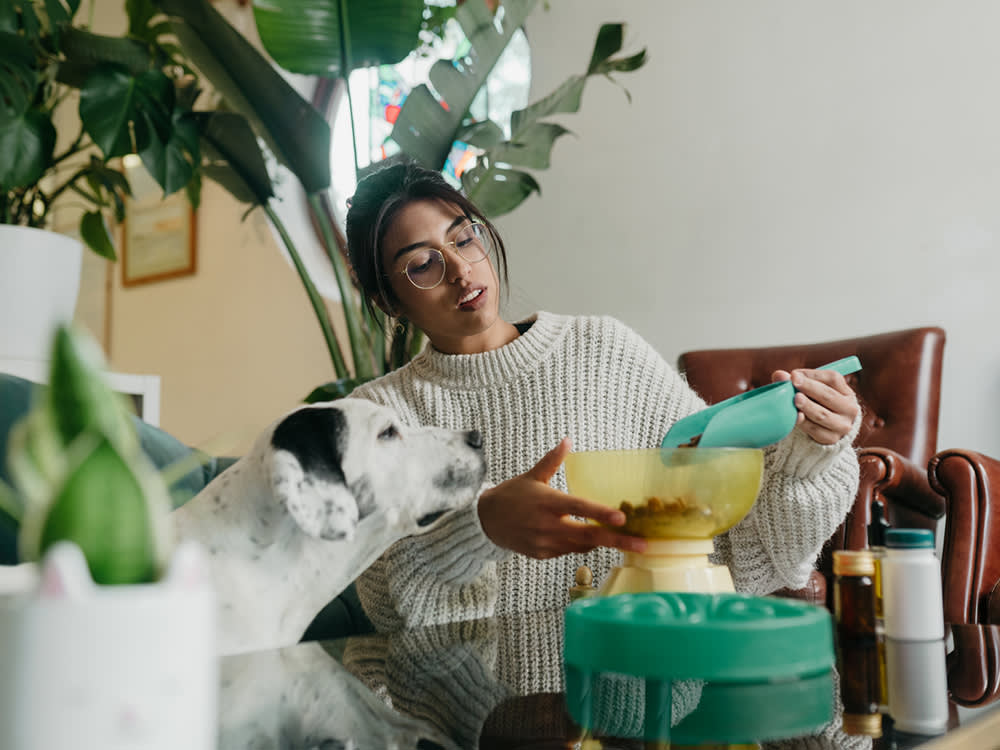
The feeding guide printed on your dog’s food bag is an average built for an imaginary average dog, and your dog is not that dog. That gap is a big reason so many dogs are quietly overfed. The fix is not more worry, it is a little math up front and one simple check afterward. Here is how to figure out what your dog actually needs, and, more importantly, the feedback loop that matters more than any number you calculate.
Feeding is one of the most anxiety-prone parts of dog ownership, and it does not need to be. Whether you feed kibble, home-cooked meals, or a mix, the goal is the same: keep your dog at a healthy weight. Let’s make it concrete.
First, the number: your dog’s daily calories
To feed the right amount, you need to estimate how many calories your dog burns. Vets use a formula called daily energy requirement (DER). The total it gives should be divided across your dog’s meals (usually two), and all treats count, their calories come out of the total, not on top of it. A quick note on units: a “calorie” in this context is the same thing as a kilocalorie, which is why you’ll see labels flip between the two words as though they were synonyms. They are.
The starting formula looks scarier than it is: RER = 70 × (body weight in kg)^0.75. Walk through it slowly.
Take your dog’s weight and convert to kilograms by dividing pounds by 2.2. A 45-pound dog is 20.45 kg. Next, raise that to the power of 0.75, the exponent, shown by the ^ symbol (any calculator or a quick web search does this). For our example, 20.45^0.75 comes to about 9.616. Multiply by 70 and you get 673. That number is the resting energy requirement (RER), the calories your dog would burn just existing at rest.
Then adjust for real life
Real dogs are not at rest all day, so you scale RER up with a multiplier based on age and activity to get DER:
- Weight loss: 1×
- Senior or inactive dog: 1.1×
- Neutered, moderately active adult: 1.6×
- Intact, moderately active adult: 1.8×
- Active dog: 2×
- Highly active dog: 3×
- Puppy under 4 months: 3×
- Puppy at 50 to 80 percent of adult weight: 2.5×
- Puppy at 80 to 100 percent of adult weight: 2×
So if our 673-calorie example dog is a senior, multiply by 1.1 for about 740 calories a day, split across meals with treats accounted for.
What counts as “active”? A dog who mostly lounges with you is inactive. One who gets a brisk 15-to-30-minute walk daily is moderately active. An active dog walks twice a day for roughly 45 minutes each, and a highly active dog logs several hours of exercise daily. These multipliers are estimates, not gospel, and your dog’s weight, age, spay or neuter status, health, and individual metabolism all shift the real number, which is exactly why the check in the next section matters so much.
The check that beats the calculator
I love that people run the numbers, it’s a great starting point, but the formula is an educated guess, not a prescription. The real instrument is your hands. Body condition score tells you whether the math is actually working for the dog in front of you, and it’s the thing I wish every owner learned before they memorized a calorie figure.
Body condition score (BCS) is the feedback loop. On a healthy dog you should be able to feel the ribs easily with light pressure, see a waist when you look down from above, and see the belly tuck up when you look from the side. Too much padding over the ribs or a missing waist means cut back; ribs and spine that jut out mean add. Recheck every few weeks and let the trend, weight going up or down over time, guide your adjustments. No formula substitutes for that.
What newer data shows, and why this matters
The stakes are higher than most owners realize. In 2024, the Association for Pet Obesity Prevention found that roughly 59 percent of dogs fall into an overweight-to-obese body condition (a BCS of 6 to 9), and about 22 percent are clinically obese. Yet fewer than half of dog owners were even familiar with body condition scoring, and under a third recalled ever getting a BCS from their vet. That awareness gap is the problem in one statistic: dogs are being overfed by well-meaning people who were never taught how to read their dog’s shape.
It is worth the effort because leanness buys time. Studies have consistently found that dogs kept at a healthy weight live meaningfully longer, on the order of a couple of extra years, than overweight dogs, and stay mobile and comfortable longer too. Portion control is not fussiness; it is one of the highest-impact things you can do for your dog’s lifespan.
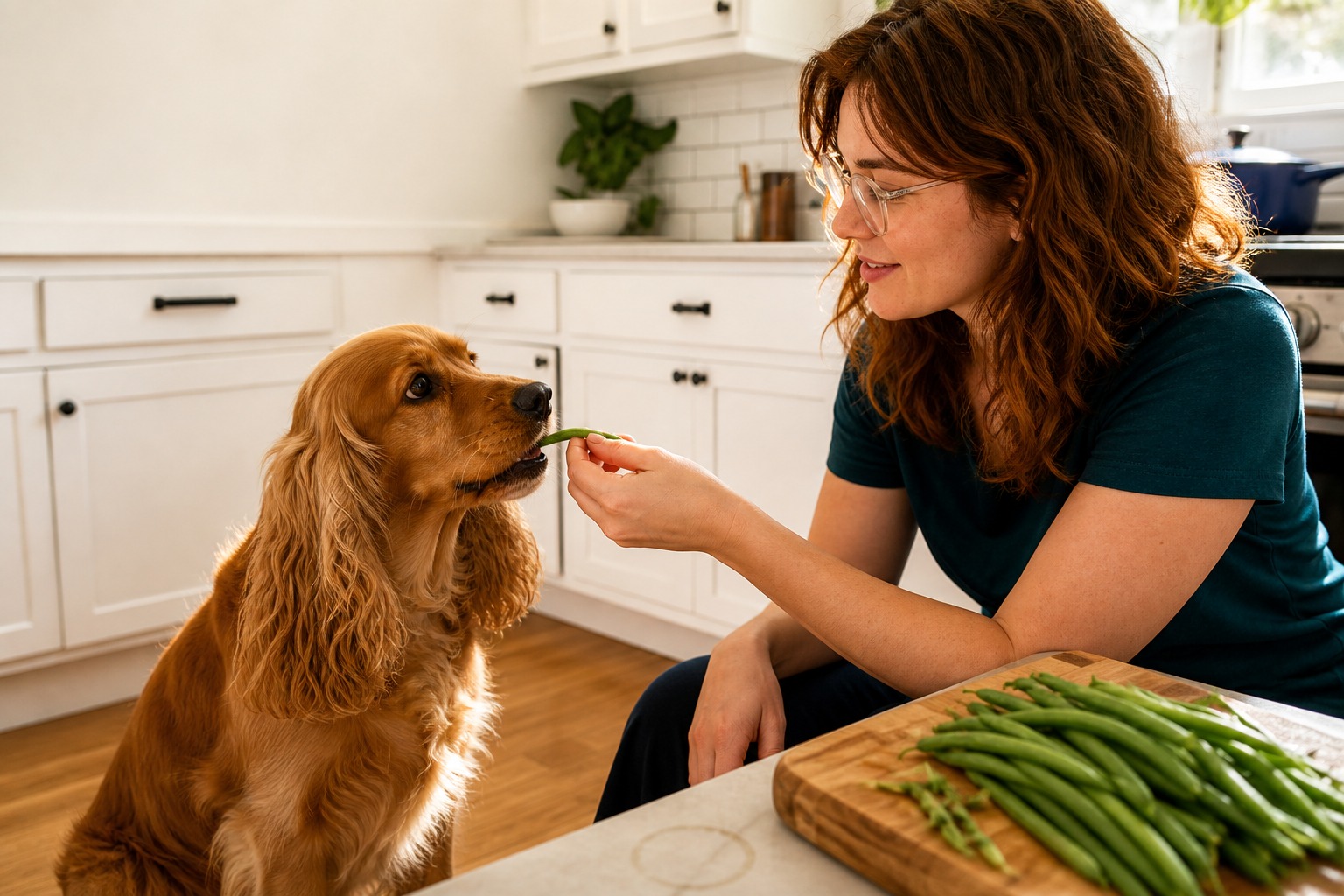
And treats fit inside the math, not outside it. The 10 percent rule, treats and extras capped at 10 percent of daily calories, exists because going over it throws off the balance of protein, fats, vitamins, and minerals a complete diet provides. Practical ways to stay under it: favor frequency over volume with pinkie-nail-size pieces, keep low-cal options like carrots, green beans, cucumber, and blueberries on hand, and lean on plain air-popped popcorn (about 20 calories a cup, and a little scattered around goes a long way).
Calculating calories in homemade food
If you cook for your dog, use a database like the USDA FoodData Central to find calories, which vary by ingredient weight and cooking method. Weigh ingredients on a digital kitchen scale, actual weight, not volume, since cups measure space, not mass. For slow-cooker meals, add the weight of the cooking water to your totals; most slow-cooker dog meals run about 20 to 35 calories per ounce.
Homemade diets, especially those with no commercial food, usually need supplementation to be complete. Common additions include calcium or bone meal (about 1 tsp per pound of food), vitamin E, and an omega-3 source such as sardines in water or fish oil. Do not freelance this, a complete-and-balanced homemade diet needs a recipe formulated by a veterinary nutritionist, or your dog can end up deficient even while eating “healthy” food.
Homemade resources worth knowing
If you want to cook for your dog properly, these are solid starting points: Dr. Richard Pitcairn’s Complete Guide to Natural Health for Dogs & Cats, with its helpful ingredient and water-ratio charts; nutrition consulting services from Monica Segal, Rebecca Remillard, DVM, and Sean Delaney, DVM (whose Balance It service lets you build recipes and see their nutrient composition); Mary Straus’s sample diets; and recipe books including Dr. Becker’s Real Food for Healthy Dogs & Cats, Dinner PAWsible, Greg Martinez’s Dog Dish Diet, and Rick Woodford’s Feed Your Best Friend Better. For the deeper end, Dog Food Logic by Linda Case and the textbook Applied Veterinary Clinical Nutrition are excellent.
The bottom line
Run the formula to get a starting portion, keep treats inside the 10 percent, and then let body condition, checked with your hands every few weeks, tell you whether you got it right. Always talk to your vet before changing your dog’s diet, especially for weight loss or a home-cooked plan. The calculator gets you close. Your dog’s waistline tells you the truth.
Common questions
How do I know if I'm feeding my dog the right amount?
The most reliable check isn't a calculator, it's body condition score. You should be able to feel your dog's ribs easily without pressing hard, see a visible waist from above, and see a tucked-up belly from the side. If not, adjust portions and recheck in a few weeks.
How many treats can my dog have?
Treats should make up no more than 10 percent of your dog's daily calories. The other 90 percent should come from a complete, balanced diet so your dog gets the right nutrients.
Not a substitute for your vet. Our guidance is educational. For urgent symptoms, contact a vet or emergency clinic right away. Editorial standards
Dr. Mehta is a board-certified veterinary nutritionist who evaluates pet food formulations, ingredient quality, and the science behind dietary trends. He writes and reviews all nutrition content at The Pet Times, including our food rankings and feeding guides.
Meet our experts ↗Keep reading
 FoodYour Dog Isn't Spoiled. 6 Fixes That Actually Get a Picky Eater EatingDr. Amara Solis · 6 min
 FoodStop Measuring Your Dog's Food in Cups. Here's the Number That Matters.Dr. Amara Solis · 7 min
 FoodYour Dog Has No Idea When He's Full. That's Not a Flaw, It's the DesignDr. Ravi Mehta · 6 min
 FoodOnly 6% of Homemade Dog Diets Are Complete. Yours Is Probably in the Other 94%.Dr. Amara Solis · 12 min
 FoodYour Dog Has a Sweet Tooth. That's Exactly the Problem.Dr. Nina Kohl · 7 min
 FoodGreen Beans Are a Great Dog Treat. The 'Green Bean Diet' Is NotDr. Priya Nair · 6 min