


A Dog Invented the Booty Call. Now Science Is Building the Dog Phone
A researcher gave her Labrador a ball that video-calls her when he nudges it. What happened over 16 days says a lot about who pet tech is really built for.
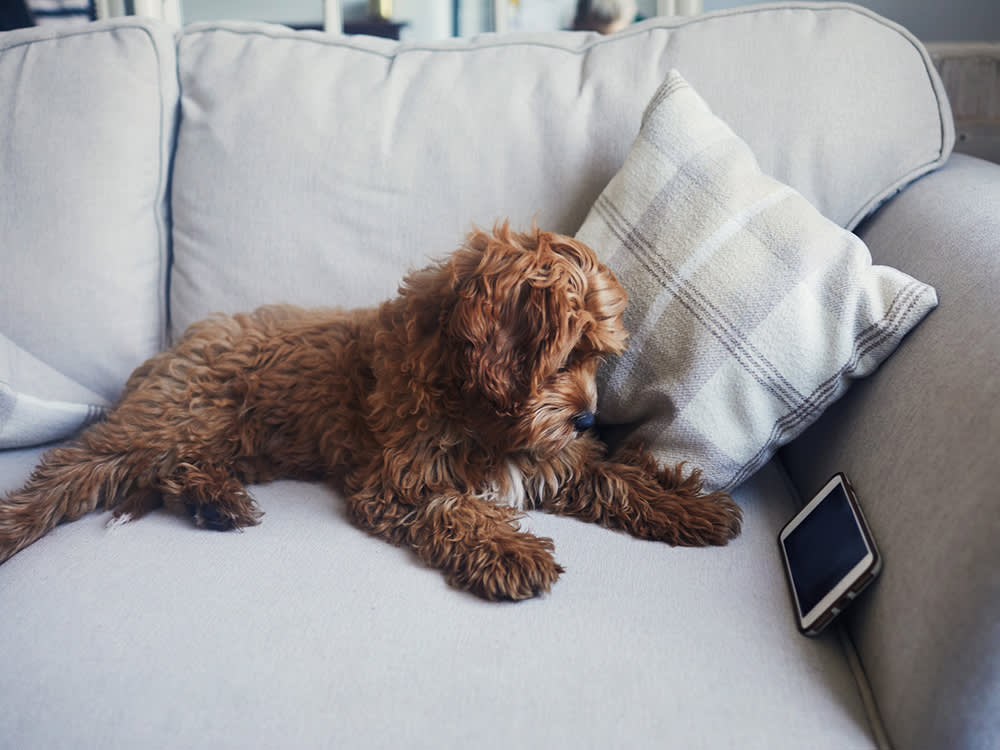
Every dog owner has run the same daydream. If you could just get them on the phone for one minute, you would explain that you are coming back, that the mail carrier is not a threat, and that the new sneakers are not, in fact, food. We can already ping our dogs from the office with a camera. What we cannot do is let the dog decide to ping us. Almost every gadget aimed at lonely pets flows one direction: from the worried human to the animal who never asked for it.
That imbalance is exactly what one scientist set out to flip.
A ball that makes a call
Dr. Ilyena Hirskyj-Douglas, who studies how animals interact with computers at the University of Glasgow, built a prototype she calls the DogPhone. It is not a handset. It is a soft ball rigged with a motion sensor, and when a dog picks it up or knocks it around, the movement triggers a laptop at home to place a video call to the owner. Pick up the call and you appear on the screen in the living room, in sound and picture. In theory the dog can answer your calls the same way, by batting the ball, making the whole thing a genuine two-way line rather than a one-sided surveillance feed.
The idea grew out of a specific frustration. Watching the flood of “call your dog” products hit the market, Hirskyj-Douglas noticed they were all designed around the person. The dog was the thing being watched, with no say in when contact happened. She wanted to hand the controls to the animal instead, a device a dog could choose to use.
What the dog actually did with it
She tested the setup on her own ten-year-old Labrador, Zack, over 16 days, giving him the ability to summon her whenever the mood struck. The raw numbers sound like a resounding success: Zack triggered a call around five times a day, more than fifty over the run.
The catch is the honest part. By the study’s own account, nearly every one of those calls looked accidental, the ball getting jostled rather than a dog deliberately reaching out for a chat. Which is its own kind of finding. Handing an animal a new communication tool is easy; teaching them that the tool means something, and that they can wield it on purpose, is the hard science that comes next.
Do not order one yet
If you are already picturing a furrier version of a horror-movie plot, calls coming from inside the doghouse, slow down. The DogPhone is a research prototype, not a product with a shipping date. It has been tested on exactly one dog so far, and there is a long list of open questions before anyone knows whether it actually helps, especially the big one: does giving a dog this kind of control ease separation anxiety, or could it feed the very stress it is meant to soothe? Nobody can answer that yet, and that uncertainty is the whole reason it is still in a lab.
“The instinct to check on a dog who struggles alone is a loving one, but control cuts both ways,” says Dr. Priya Nair. “For some dogs, being able to reach their person on demand would be a comfort. For an already anxious dog, a person who flickers onto a screen and then vanishes could be more confusing than reassuring. That is precisely the question this kind of research needs to answer before any of it reaches your living room.”
What’s new since this was written
The DogPhone was an early flag in the ground for a field that has kept growing. Hirskyj-Douglas now runs an Animal-Computer Interaction group and has moved from a single calling ball toward a broader idea she describes as building a “dog internet,” interfaces animals can operate on their own terms, including designs for dog-to-dog connection rather than just dog-to-human. Her lab has extended the same philosophy to other species, building systems that let zoo animals like monkeys start and stop their own audio and video enrichment.
The work has drawn serious institutional backing, including a European Research Council grant and a Royal Society of Edinburgh fellowship, and Hirskyj-Douglas has served on a UK committee advising the government on animals, technology, and ethics. The DogPhone still is not something you can buy. But the premise behind it, that pet technology should give animals a choice instead of just watching them, has quietly become a research program rather than a one-off gadget.
References
- Hirskyj-Douglas, I., et al. Forming the Dog Internet: Prototyping a Dog-to-Human Video Call Device. Proceedings of the ACM on Human-Computer Interaction (2021). https://dl.acm.org/doi/10.1145/3488539
- Animal-Computer Interaction Group. https://animalcomputerinteraction.com/
- Ilyena Hirskyj-Douglas, Animal Computer Interaction Researcher. https://ilyena.com/
James Okafor covers rescue, adoption, and the causes shaping animal welfare. His work follows the people and organisations working to give more pets a home, and the issues owners and advocates care about most.
Meet our experts ↗Keep reading
 TrainingAn AI Box Can Drill Your Dog. It Can't Do the Part That Matters.Marcus Webb · 6 min
 Product PicksThe Ball Launcher That Started With a Kid Dodging HomeworkMarcus Webb · 5 min
 Product PicksDog Trackers, Decoded: Match the Technology to Where You Live (10 Picks)Marcus Webb · 16 min
 Product PicksHow to Actually Buy an Air Purifier for a Pet Home (Plus 7 We'd Pick)James Okafor · 8 min
 Health & WellnessAn AI Can Now Grade Your Dog's Teeth From a Phone Photo. The Catch Is What It Can't DoDr. Amara Solis · 5 min
 Product PicksSmart Pet Gear, Sorted by the Problem It Actually SolvesMarcus Webb · 8 min