


How to Actually Buy an Air Purifier for a Pet Home (Plus 7 We'd Pick)
Two numbers and one certification tell you more than any marketing claim. Here's the buying framework for pet dander and smoke, then seven purifiers that pass it.

Affiliate disclosure. This article contains affiliate links. We may earn a small commission if you buy through a link, at no extra cost to you. How we handle recommendations.
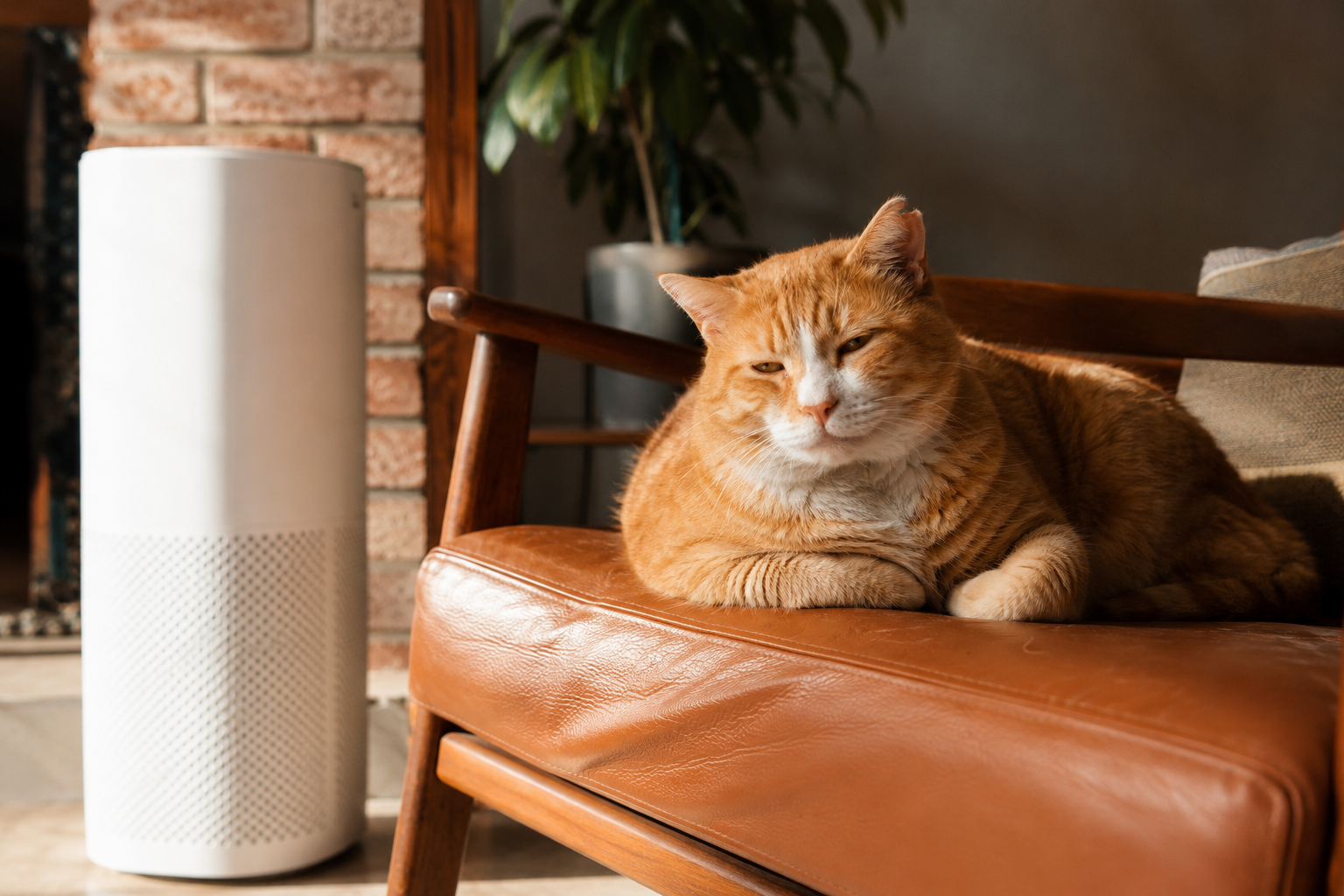
Air purifiers are sold on adjectives: “powerful,” “whisper-quiet,” “hospital-grade.” None of those words mean anything you can check. The good news is that the two numbers that actually matter are printed right on the box, and once you know what they are, you can walk past most of the marketing and buy the right machine on the first try. That is the part most “best air purifier” lists skip, so we are putting it first.
This matters more in a pet home than almost anywhere else. Dander, the flecks of skin and dried saliva that trigger most pet allergies, is one of the most persistent indoor particles there is, and it gets churned back into the air every time your dog shakes or your cat jumps off the couch. Layer wildfire smoke on top, which is no longer a seasonal West Coast problem but an on-and-off reality across much of the country, and clean indoor air stops being a luxury. So here is the framework, then the picks that pass it.
The two numbers and one seal that decide everything
CADR (Clean Air Delivery Rate). This is the single most useful spec, and it is the one manufacturers bury. CADR, governed by the Association of Home Appliance Manufacturers (AHAM), measures how much clean air a purifier actually delivers at full speed, with separate scores for smoke, dust, and pollen. Higher is faster. The rule of thumb worth memorizing: your purifier’s smoke CADR should be at least two-thirds of your room’s square footage. A 300-square-foot living room wants a smoke CADR around 200 or higher. A unit that “covers up to 1,000 square feet” on the box but posts a CADR of 120 is quietly telling you it will clean that big room slowly and only once an hour, which is not enough when the air outside is hazardous.
Air changes per hour (ACH). For a pet or smoke home, you want the purifier to clean the room’s full volume of air four to five times an hour, not the once or twice that “coverage area” claims usually assume. Four-plus air changes is the difference between a machine that keeps up with a shedding Husky and one that loses the race.
The AHAM Verifide seal. Look for it on the side or back of the box. It means an independent lab tested the CADR rather than the manufacturer simply asserting it. No seal, no trust.
Two cautions for pet owners specifically. First, CADR only measures particles, not odors. If litter box or wet-dog smell is part of why you are shopping, you need a real activated-carbon stage in addition to HEPA, because a HEPA filter alone does almost nothing for smell. Second, avoid ionizers and “ionic” purifiers, which charge particles instead of trapping them and can produce ozone as a byproduct, a respiratory irritant for both you and your pets. If a unit has an ion or “plasma” mode, make sure it can be switched off and run it with that feature disabled.
Seven purifiers that clear the bar
We changed the old roundup of six to seven, adding a true value pick that beats most of the field on cost-per-clean-air. Each entry below is here because it pairs real HEPA particle capture with a genuine carbon stage, the combination a pet home needs.
Levoit Core 600S, best for heavy shedders
Levoit built this one around pet messes, and it shows: independent testing puts its deodorization rate as high as 92 percent, and its three-stage system pulls down the dander that drives sneezing, coughing, and congestion. The pre-filter grabs visible fur before it can clog the HEPA, which is exactly what you want with a heavy shedder. A quiet sleep mode dims the lights and drops the fan so it can run in a bedroom overnight. .
Winix 5500-2, best value
The pick we added, and the one we would steer most pet owners toward first. It is AHAM Verified for 360 square feet with a CADR of 232 CFM, delivering nearly five air changes an hour in a medium room, and it does it for a fraction of the premium brands’ price. The standout for pet homes is the washable AOC activated-carbon filter, which means you are not buying a replacement carbon cartridge every few months. It includes a PlasmaWave ion mode; turn it off and run the HEPA-and-carbon stages, and you have one of the best dollar-for-dollar machines on the market. .
Coway Airmega AP-1512HH, best for one room
Sized for single rooms up to about 360 square feet, the Coway runs a four-stage system that captures 99.97 percent of fine particles while a carbon layer handles odor. A real-time air-quality light tells you exactly how dirty the air is, and an eco mode pauses the fan when the room is clean to save energy. Quiet, compact, and a long-running reviewer favorite. .
Molekule Air Pro, best for large open spaces
For a great room or open-plan space up to roughly 1,000 square feet, the Air Pro is the splurge. It offers 360-degree intake, six fan speeds, and 99.97 percent HEPA capture, plus an app that logs your air-quality history so you can watch the numbers fall over the course of a smoky afternoon. It is expensive, and you are paying partly for design, but the coverage is real. .

Dyson Purifier Cool, best two-in-one
If your window AC is not cutting it, Dyson’s purifier doubles as an oscillating fan, and the airflow that cools the room also drives circulation through the filter. Sealed HEPA and carbon filtration, remote and app control, and a display that flags when the filter is due. You pay a premium for the dual function and the styling, but in a small apartment where floor space is precious, one device doing two jobs earns its spot. .
Blueair Blue Pure 211+, best for speed
Blueair’s HEPASilent approach is quieter and more energy-efficient than conventional HEPA, sipping less power than a lightbulb on its lowest setting. An add-on carbon layer strips odors, gases, and chemicals, and it moves fast, clearing a 387-square-foot room in roughly 12 minutes. The washable fabric pre-filter sleeve comes in different colors, a small touch that makes it easier to live with in a main room. .
Rabbit Air MinusA2, best for design-conscious homes
If you refuse to look at an ugly appliance, the wall-mountable MinusA2 passes for a slim panel and even offers custom artwork fronts. Looks aside, it covers up to 815 square feet with a five-stage system, and one of those stages is a customizable filter with a pet-allergy option that targets dander specifically. A light sensor dims it automatically and an app handles remote control. The most expensive way to clean your air, but the only one you will not want to hide. .
The bottom line: measure your room, target a smoke CADR around two-thirds of its square footage, demand the AHAM Verifide seal and a carbon stage, and skip anything that leans on ionization. Do that and any of the seven above will keep the air honest, whether you are fighting a constant snow of fur or the next bad-air day rolling in from outside.
“People over-index on coverage area and ignore CADR, and they end up with an underpowered machine running flat-out in a room it can’t keep up with,” says Dr. Lena Park. “Match the CADR to the room first. For an animal household, insist on a carbon stage too, because dander and odor are two different problems and HEPA only solves one of them.”
References
- Air Filtration Standards, Association of Home Appliance Manufacturers (AHAM Verifide)
- Guide to Air Cleaners in the Home, U.S. Environmental Protection Agency
- Wildfires and Indoor Air Quality, U.S. Environmental Protection Agency
- Air Quality Index (AQI) Basics, AirNow.gov
- Pet Allergy Overview, American College of Allergy, Asthma & Immunology
James Okafor covers rescue, adoption, and the causes shaping animal welfare. His work follows the people and organisations working to give more pets a home, and the issues owners and advocates care about most.
Meet our experts ↗Keep reading
 LivingYour Dog Can Now Call You. It Costs $105 and a Monthly Data Plan.James Okafor · 4 min
 Product PicksSmart Pet Gear, Sorted by the Problem It Actually SolvesMarcus Webb · 8 min
 LivingAI Pet Tech Splits Into Two Camps: One Worth Your Money, One Worth Your SkepticismJordan Ellis · 9 min
 Product PicksTikTok Sold You the Demo, Not the Dog. 7 Gadgets That Survive Real Life.Sasha Ford · 8 min
 Product PicksSkip the 'Pet Cam.' The Best One Is a Security Camera.Marcus Webb · 5 min
 Product PicksA Cat DNA Test Won't Tell You What Your Cat Is. That's Not the Reason to Buy One.Dr. Mara Chen · 7 min