


The Ball Launcher That Started With a Kid Dodging Homework
A retired physicist, a grandson who just wanted to finish his homework, and a miniature poodle who wouldn't quit. The unlikely origin story of the iFetch, and why its inventor bristles at the phrase "lazy dog owner."

Affiliate disclosure. This article contains affiliate links. We may earn a small commission if you buy through a link, at no extra cost to you. How we handle recommendations.
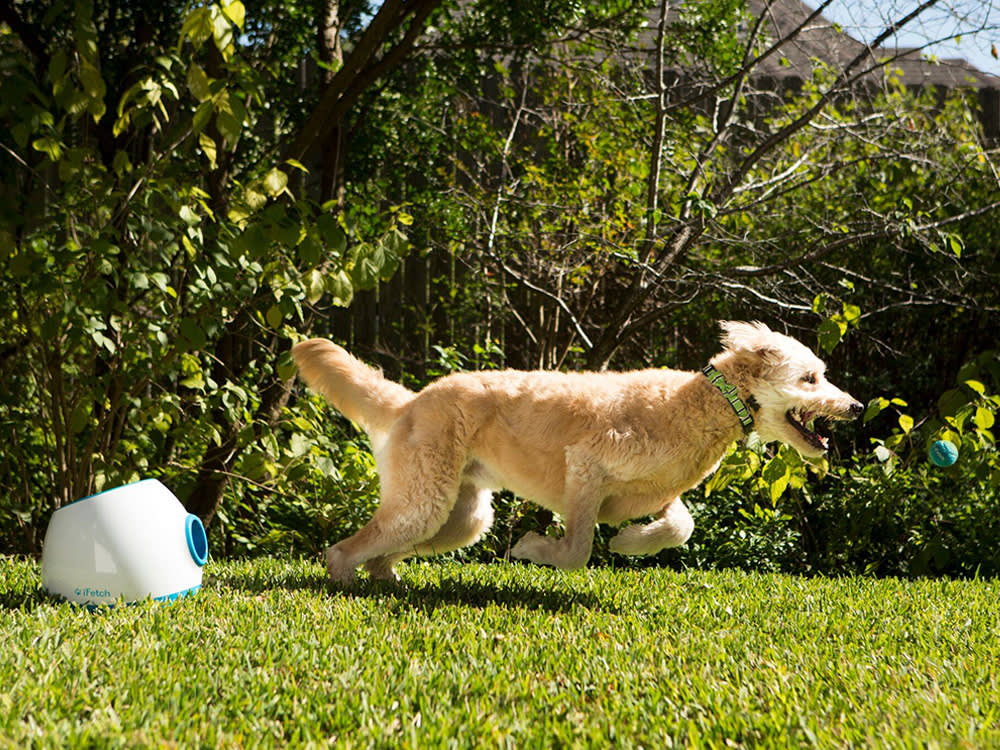
Most gadgets are born in a lab or a boardroom. The iFetch was born out of a boy trying to do his math homework while a miniature poodle stood at his feet, dropping a ball in his lap and barking until he threw it. Again. And again.
That poodle was named Prancer, and the exasperated kid was Grant Hamill, who finally turned to his grandfather with the question that would reorganize a family’s life: could they build a machine that throws the ball so he could actually get his homework done? The grandfather happened to be Denny Hamill, and Denny happened to be exactly the wrong person to ask if you wanted a small answer.
The right idea landing on the right desk
Denny was closing in on retirement after a career of more than 25 years as an executive at 3M, and he held a PhD in physics, which is not a bad résumé for reverse-engineering the physics of a thrown tennis ball. Pair that with a grandson who loved taking things apart to understand how they worked, and you had a genuinely well-matched team. Denny would later describe it as the right idea arriving at exactly the right time.
The company that grew out of it stayed a family affair, with Grant credited as co-inventor alongside his grandfather, and Prancer effectively serving as chief inspiration. Denny took the title of owner, CEO, and co-inventor.
From Hot Wheels tracks to a real product
The earliest prototypes were held together with improvisation, Hot Wheels tracks and whatever else was lying around, as the two of them tinkered toward something that actually launched a ball reliably. When the concept firmed up, they hired a local industrial-design firm to shape how the launcher looked, settled on a final version, then handed the mechanical and electrical engineering to a product firm in Austin to ready it for manufacturing. Along the way they filed patents and trademarks. Denny, drawing on his corporate background, insisted on running the proper commercialization stages, concept, feasibility, development, and scale-up, which kept the launch relatively glitch-free but also, he admitted, made it take far longer than anyone expected. So many details.
The surprises that did surface were the kind you cannot predict from a spreadsheet. Two, specifically: slobber and sunlight. Prancer and the other early canine testers were not heavy droolers, so the team did not discover until later that a very slobbery dog could gum up the launch wheels and cause the ball to slip. Their fix was a slobber-proof ball built for the iFetch Too, a foam-and-rubber blend that launches consistently no matter how wet it gets. And because most testing happened indoors, nobody realized that direct sunlight could throw off the device’s optical sensor, a flaw they only caught when a Florida customer wrote in about it, prompting a component change. Getting a product out the door, as Denny put it, is not for the timid.
A small family of fetch machines
The original iFetch reached the market in 2014, using a mini tennis ball suited to small and medium breeds. Customer requests for a bigger-dog version led to the iFetch Too, built to launch a standard-size tennis ball, which began shipping in 2015. Both launchers were deliberately designed to release one ball at a time, because the Hamills wanted the toy to stay interactive rather than turn into an endless dispenser. While the Too was in production, they landed on another idea and moved fast on the iFetch Frenzy, released in 2016: a mini-tennis-ball brain game with no electronics at all. An interactive digging toy, the iDig, later joined the lineup. After that whirlwind of launches, the family took a deliberate breather from product development.
The Kickstarter chapter
The seed money came from Kickstarter, which in 2013 was a new idea in itself. The Hamills set a modest goal of $20,000 over 30 days, hoping mostly to gauge whether anyone actually wanted a machine like this. The response was humbling: around $90,000 raised from more than 1,200 backers. When they returned to the platform a year later to fund the iFetch Too, they pulled in over $100,000 from just under 1,000 backers, again in 30 days. Beyond the cash, the campaigns confirmed the market existed and gave them a community of early adopters, along with the very real pressure of fulfilling those orders through some early manufacturing delays.
The “lazy owner” myth
There is one bit of press that clearly still stings. Denny pushes back hard on the idea that an automatic ball launcher is a crutch for the lazy dog owner, and he has a point worth sitting with. Using an iFetch is not a hands-off proposition. You have to teach your dog to nudge the ball into the launcher’s chute to set it off, and plenty of families end up with a human, often a delighted kid, as the designated dropper anyway. Even a dog who never masters the drop still has to figure out how to hang back a safe distance from the opening so they do not get beaned by the launch, then retrieve the ball and bring it back. Every one of those steps asks the dog to think. The whole design philosophy, the Hamills say, is to engage a dog’s mind as much as their body, which is what actually keeps a dog healthy and content.
What’s new since this was written
More than a decade on, the story has a happy epilogue: iFetch is still a family-owned company based in Austin, and its ball launchers remain widely available. The iFetch Too for medium and large dogs now runs on a built-in rechargeable battery and lets you set the throw to roughly 10, 25, or 40 feet, or a random distance, at the push of a button, and it ships with standard-size tennis balls. The original iFetch for small to medium dogs is still around too, using the mini balls it launched with. Current products carry a one-year warranty and are sold both through major retailers and the company’s own site.
If there is a lesson in the update, it is that the interactive philosophy held up. The lineup that started as one kid’s workaround for homework has outlasted a lot of flashier pet tech, largely because it always asked the dog to participate.
References
- iFetch, official company site and product information. https://goifetch.com/
- Amazon product listings for the iFetch and iFetch Too automatic ball launchers.
Marcus Webb writes about the gear, gadgets, and everyday choices that make life with a pet easier. His coverage runs from product picks to training and the causes worth paying attention to, always with an eye on what actually earns a place in your home.
Meet our experts ↗Keep reading
 LivingA Dog Invented the Booty Call. Now Science Is Building the Dog PhoneJames Okafor · 4 min
 Product PicksDog Trackers, Decoded: Match the Technology to Where You Live (10 Picks)Marcus Webb · 16 min
 TrainingAn AI Box Can Drill Your Dog. It Can't Do the Part That Matters.Marcus Webb · 6 min
 Product PicksYour Dog Isn't Bored. They're Underemployed. 8 Puzzles That Fix It.Tom Hadley · 11 min
 Product PicksThe Funny Dog Toy Is a Dead Genre. FurryFolks Didn't Get the Memo.Nina Vasquez · 6 min
 Product PicksHalf of a Dog's Birthday Haul Is for Your Camera Roll. Here Are the 12 Your Dog Actually Cares About.Nina Vasquez · 7 min