


Your 'Hyper' Dog Might Just Be Exhausted. 7 Signs You're Reading It Wrong.
Sleep-deprived dogs don't act sleepy, they act wired, clumsy, and cranky. Here are 7 signs your dog needs more rest, and why owners keep mistaking it for a training problem.

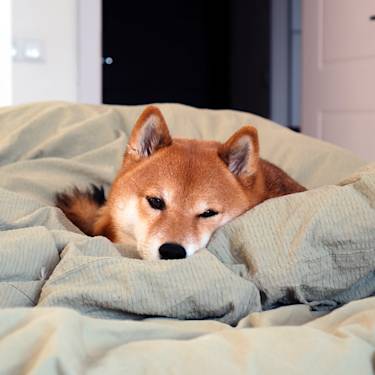
Here’s a scene most owners know: the dog is bouncing off the walls at 9 p.m., grabbing shoes, ignoring every cue, generally acting like a menace. The natural conclusion is that the dog is under-exercised, or under-trained, or just being difficult. So you add another walk, sign up for another class, and the chaos continues.
There’s a possibility that rarely makes the list, and it’s the whole point of this piece: your “hyper” dog might be exhausted. Sleep deprivation in dogs doesn’t look like drowsiness. It looks like the opposite, a wired, clumsy, short-fused animal that reads as a behavior problem. Miss that, and you spend months treating a training issue that was really a sleep issue all along. Dogs need a genuinely large amount of rest, roughly 12 to 14 hours a day for a healthy adult, and far more for puppies and seniors. When they don’t get it, it shows up in their body, their brain, and their mood. Here are seven signs you might be misreading.
1. They act like an overtired toddler
You’d expect a tired dog to be calm. Often it’s the reverse. Sleep-deprived dogs frequently get more frantic, pacing, barking, and chewing things they know better than to touch, exactly like a kid who missed a nap and is now vibrating. This is the single most misread sign, because it looks identical to pent-up energy, which sends owners toward more activity when the dog actually needs to crash.
2. They get clumsy
Coordination runs on a well-rested brain. When a dog is short on sleep, its motor control slips, and a normally graceful dog starts missing catches, tripping over its own feet, and moving a little less smoothly than usual. If your sure-footed dog suddenly seems uncoordinated, chronic under-sleeping is worth considering.
3. Their memory and learning stall
Sleep is when the brain consolidates what it learned during the day, in dogs as in people. A tired dog struggles to retain new skills and to perform ones it already knows. Training sessions fall flat, cues seem to bounce off, and it can look like your dog is ignoring you. Usually it isn’t defiance; the tired brain simply can’t process or store anything new right then.
4. They get moody and withdrawn
Think about how you feel after a bad night, irritable, flat, quick to snap. Dogs seem to experience something similar. Some sleep-deprived dogs turn cranky and more prone to reactive or even aggressive responses. Others go the other direction and act depressed, losing interest in play, other dogs, and even in you. Both are mood changes driven by exhaustion, not personality.
When a dog’s behavior changes and nothing else in its life has, sleep is one of the first things I want ruled out. An exhausted brain regulates emotion poorly, so the same dog that shrugged off a doorbell last week is suddenly barking itself hoarse. People reach for a training fix when what the dog needs is a better night’s rest.
5. Their stress tolerance craters
A rested dog can absorb small stressors; a tired one can’t. Sleep deprivation compounds anxiety, so a dog that’s short on rest tends to overreact to triggers, a loud noise, a change in routine, a dreaded nail trim, that it would normally take in stride. You may also see stress behaviors surface, like obsessive licking or spinning, and a lower tolerance for pain and discomfort. If your anxious dog seems to be getting worse, check whether it’s actually sleeping.
6. They can’t seem to settle, even when quiet
Beyond the daytime chaos, watch how the dog handles downtime. A well-rested dog flops and switches off. A sleep-deprived one may stay keyed up, unable to fully relax even in a calm room, restless in a way that feeds on itself, tired but unable to power down. That inability to settle is both a symptom and an engine of the problem.
7. Their health quietly suffers
This is the sign you can’t see, and the most important. Chronic under-sleeping sets off a cascade of physiological changes: increased appetite and weight gain, a weakened immune system that leaves a dog more prone to illness and infection, and elevated blood pressure that, over time, can strain the heart. Sleep isn’t a luxury layered on top of health; it’s part of the machinery that keeps a dog healthy, which is why quality rest is non-negotiable.
How to set your dog up for better rest
Good sleep is largely something we set up for our dogs. A few things reliably help.
Build a routine, especially at night. A predictable wind-down, a little play, a last potty break, then some grooming or cuddling, cues the body that sleep is coming. Provide enough exercise and mental work during the day so your dog is genuinely tired, but avoid intense activity right before bed, which winds a dog up rather than down.
Then give them a real place to rest, ideally more than one. The spot should be calm, comfortable, quiet, and out of the household’s foot traffic, so the dog can nap without feeling it has to stand guard. Vigilance is the enemy of rest. Some dogs are fine near a window; others can’t switch off with the outside world in view and make patrolling it their full-time job. If yours is a window-watcher, move the bed.
When it’s time to call the vet
Sometimes better routines aren’t enough, and that’s a signal, not a failure. If your dog can’t settle, wakes repeatedly, or turns newly restless at night despite adequate exercise, book a vet visit. Pain is a common hidden cause, arthritis in particular robs older dogs of deep sleep. So is canine cognitive dysfunction, a dementia-like condition that scrambles day-night rhythms in senior dogs. And in flat-faced breeds, breathing disorders can fragment sleep the way apnea does in people. Persistent sleep trouble deserves a medical look, not just a new dog bed.
What’s new since this was written
Sleep science in dogs has grown into a real field, and it keeps confirming how much rest matters. Researchers using non-invasive EEG, notably a Hungarian group studying sleeping dogs in the lab, have shown that dogs cycle through sleep stages much as we do and that a nap after a training session measurably improves how well they retain what they learned. That’s direct evidence behind sign No. 3: skimp on sleep and you’re literally erasing part of the training you just did.
Other recent work has tied poorer, more fragmented sleep to more behavior problems, and better sleep to calmer, more trainable dogs. The practical takeaway is encouraging: protecting your dog’s rest isn’t just about comfort, it’s one of the more overlooked levers you have for behavior, learning, and long-term health. Sometimes the best thing you can do for a “bad” dog is let it sleep.
References
- Kis, Anna, et al. “The interrelated effect of sleep and learning in dogs (Canis familiaris); an EEG and behavioural study.” Scientific Reports, vol. 7, 2017, 41873. https://www.nature.com/articles/srep41873
- Bódizs, Róbert, et al. “Sleep in the dog: comparative, behavioral and translational relevance.” Current Opinion in Behavioral Sciences, vol. 33, 2020, 25–33. https://www.sciencedirect.com/science/article/pii/S2352154619301469
- American Kennel Club. “How Much Do Dogs Sleep?” Accessed June 2026. https://www.akc.org/expert-advice/health/how-much-do-dogs-sleep/
Common questions
Can a dog really be hyperactive from lack of sleep?
Yes. Counterintuitively, an overtired dog often looks wired rather than drowsy, pacing, barking, and getting into things, much like an overtired toddler who won't settle.
When should sleep problems prompt a vet visit?
If your dog can't settle, wakes frequently, or seems newly restless at night despite enough exercise, see your vet. Pain, canine cognitive dysfunction, and breathing disorders in flat-faced breeds can all disrupt sleep.
Not a substitute for your vet. Our guidance is educational. For urgent symptoms, contact a vet or emergency clinic right away. Editorial standards
Dr. Park is a board-certified emergency and critical care specialist. She reviews our health and safety content for clinical accuracy and contributes guides on recognising urgent conditions. Her focus is helping owners act quickly and correctly when it matters most.
Meet our experts ↗Keep reading
 Health & WellnessYour Dog's Breed Is a Remix. The Family Tree Explains the Quirks and the Risks.Dr. Ravi Mehta · 7 min
 TrainingYour Dog Isn't Peeing on His Friend. He's Peeing on the Message Underneath Him.Dr. Amara Solis · 8 min
 Health & WellnessYour Dog's Tongue Is a Dashboard. Most Owners Never Learn to Read ItDr. Amara Solis · 6 min
 Health & WellnessYour Dog Owns the Dark. Here's the Price They Paid for It.Dr. Ravi Mehta · 8 min
 Health & WellnessA Longer Walk Won't Fix This. 7 Signs Your Dog Is Under-Exercised.Dr. Amara Solis · 9 min
 TrainingYour Dog's Sleeping Position Is Mostly a Thermostat. One Pattern Isn't.Dr. Nina Kohl · 6 min