


Your Dog Isn't Smiling. Here's What All Those Teeth Actually Mean.
A dog baring its teeth can mean 'I adore you' or 'back off,' and the two look shockingly alike. A behaviorist breaks down the five toothy expressions and how to read the difference before you get it wrong.

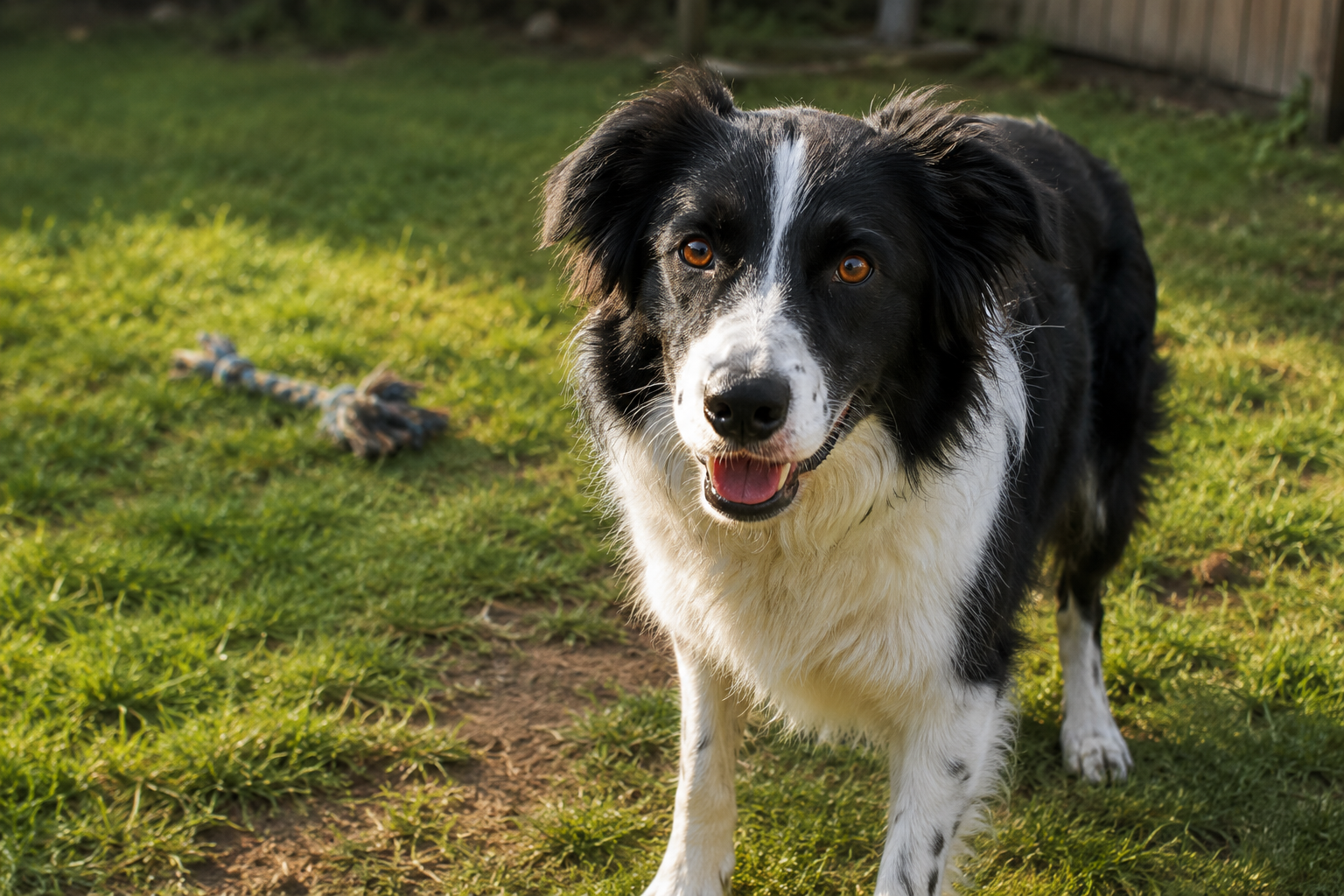
A young couple once brought a dog to a behavior consult convinced they had a serious problem. Every time they carried their new baby into the room, their gentle family dog “showed his teeth.” They were terrified it meant aggression. It did not. The dog was, in the truest sense, smiling at the baby, thrilled to see her. The couple had misread one of the friendliest signals a dog can offer as one of the scariest.
That mix-up is at the heart of a genuinely confusing corner of dog language. Dogs bare their teeth in at least five different expressions, and they do not all mean the same thing. Some are pure affection. Some are a warning you ignore at your peril. And the one that looks most like a human smile is not even called a smile. If you want to actually read your dog, you have to stop treating “teeth” as a single message.
The happy grin (what most people call a smile)
Start with the expression you already think you know. That open-mouthed, relaxed, jolly face, lower jaw hanging loose, corners of the lips pulled gently back, tongue often lolling out, is what people mean when they say their dog is “smiling.” Technically it is a grin, and it is one of the best things you can see on a dog. It shows up when they are comfortable, at ease, and content, and it can last for minutes at a stretch.
One trap: a grin and a pant look nearly identical. A dog with its mouth wide and tongue out after a hard run, or on a hot afternoon, is probably cooling off, not beaming. A panting dog can be perfectly happy too, but the open mouth alone will not tell you. Read the situation around it.
The true smile (rarer, and easy to misjudge)
Now the expression that actually earns the word smile, and it is not the grin. A genuine dog smile is a quick retraction of the lips that flashes the front teeth, top and often bottom. Because it superficially resembles a threat, it spooks people. It shouldn’t. It is a friendly, deferential signal, an appeasement gesture, most often aimed at a beloved person, especially after time apart.
Behaviorists have a more precise name for it: the submissive grin. And it has deep roots. The expression appears to descend from a primate signal, the silent bared-teeth display that monkeys and apes use to communicate “I mean no harm.” Over evolutionary time, a gesture that started as nervous deference softened into something closer to warmth. That is why a smiling dog often pairs the flashed teeth with a lowered head, ears held back, a squint, and a whole-body wiggle. It can even read as slightly conflicted, part joy, part “please don’t be mad,” which is exactly what an appeasement signal is.
The submissive grin is one of the most misread signals in dogs, because it looks like a snarl and means the opposite. I tell people to trust the body over the teeth. A wiggling, loose, squinty dog flashing its front teeth is saying ‘I love you and I’m no threat,’ full stop.
Smiles are fast, often lasting less than a second, which is why they are so hard to catch on camera and so easy to miss in person.
The play face (teeth, but everyone’s having fun)
Watch two dogs wrestle and you will see plenty of open mouths and exposed teeth. That is the play face: a relaxed, open mouth that shows up during roughhousing, especially the mouthy games dogs call bitey-face and jaw-sparring. Frozen in a photo it can look alarming, all teeth and gums. In motion, with loose bodies and taking turns, it is just dogs delighting in each other. The tell is that the teeth are on display but not being used to hurt.
The fear grimace (a warning, not a smile)
Here is where reading the body becomes essential. In a fear grimace, the corners of the mouth, the commissures, are pulled sharply back and taut, and many teeth show, but nothing about it is happy. The mouth is tight, the lips pull back rather than up, and the whole dog looks tense, with no hint of play or ease. The classic “Beware of Dog” image of a snarling, teeth-baring dog is often, ironically, a terrified animal, not a confident guardian.
The tooth display (an actual threat)
The most serious of the five is the tooth display, an offensive warning. The dog retracts its lips to reveal the front teeth, sometimes only the uppers, and, crucially, does it with a stiff, still body and a slow, deliberate movement that can hold for several seconds. When an owner describes their dog “lifting a lip” at them, this is usually what they’re seeing. It often signals a dog pushed past its limit, guarding something valued, or in pain and asking to be left alone. A wrinkled nose on top of it suggests higher arousal and thinner emotional brakes, which makes the dog harder to read. This is the expression to respect and give space.
The one rule that ties it together
Teeth are not the message. The body is. Friendly expressions, the grin, the smile, the play face, ride on loose, wiggly, soft-eyed posture. The warnings, the fear grimace and the tooth display, ride on tension, stillness, and a hard face. Same bared teeth, opposite meanings, and the difference is written all over the rest of the dog. Learn to read the body first, and those “scary” teeth stop being a mystery.
References
- American Veterinary Society of Animal Behavior. “How to Understand Canine Body Language.” https://avsab.org/resources/
- Bekoff, M. “The Play Face and Social Communication in Canids.” Behaviour, journal literature on canine play signals. https://www.jstor.org/
- Waller, B. M., et al. “The evolution of the silent bared-teeth display in primates and its relevance to appeasement signaling.” American Journal of Primatology. https://onlinelibrary.wiley.com/journal/10982345
Common questions
Is my dog smiling or panting?
Look at the context. A wide-open mouth with a lolling tongue right after exercise or on a hot day is usually panting, not joy. A relaxed, loose-bodied dog with a softly open mouth in a calm moment is more likely a happy grin. Panting and happiness can also overlap, so read the whole body, not just the mouth.
Why does my dog show teeth when I come home?
If it comes with a wiggly body, a wagging tail, and soft eyes, that is almost certainly a friendly submissive grin, an appeasement signal that says 'I'm thrilled and I'm no threat.' It looks alarming but means the opposite of aggression. Watch the body: loose equals happy, stiff equals warning.
How do I tell a happy grin from an aggressive snarl?
The body gives it away. Friendly expressions come with loose, wiggly posture, soft eyes, and often a lowered head. A genuine threat comes with a stiff, still body, a hard stare, and frequently a wrinkled nose. Same teeth, opposite message.
Dr. Kohl is a board-certified veterinary dentist with a particular interest in preventive oral care. She reviews all dental health content at The Pet Times and contributes practical guides on home dental routines, professional cleaning, and oral disease prevention.
Meet our experts ↗Keep reading
 TrainingThe Belly Flop Is a Consent Form, Not a CommandDr. Lena Park · 5 min
 TrainingYou're Not Reading Your Dog. You're Reading the Room Behind Him.Dr. Ravi Mehta · 7 min
 TrainingYou Can't Quiet a Bark You Haven't DecodedDr. Lena Park · 7 min
 TrainingYour Dog Ignores Its Name. Maybe It's Time to Let Them Pick a New One.Dr. Mara Chen · 5 min
 TrainingThe 'Guilty' Side-Eye Your Dog Gives You Is Actually a WarningDr. Mara Chen · 6 min
 TrainingYour Dog Is Fluent in Play. You're the One Who Can't Read the RoomDr. Nina Kohl · 5 min