


The 'Guilty' Side-Eye Your Dog Gives You Is Actually a Warning
That sideways look with a crescent of white showing has a name, whale eye, and it's one of the clearest stress signals dogs have. Reading it right can head off a bite. Reading it wrong gets people hurt.

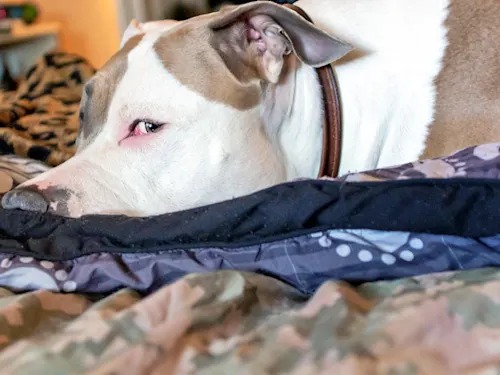
Dogs don’t speak our language, but they absolutely have one, and most of it is written on their bodies. We spend years teaching dogs to understand our words. We spend almost no time returning the favor. One of the most misread lines in a dog’s vocabulary is a look you’ve definitely seen: the sideways glance, head still, a sliver of white showing at the corner of the eye. People love to caption it “guilty” or “sassy.” It usually means something closer to “I am not okay right now.”
That look has a name, whale eye, and learning to read it correctly is one of the highest-value skills a dog owner can pick up, because it often shows up as an early warning, a chance to defuse a situation before it becomes a snap or a bite. Miss it, or misfile it as cute, and you skip past the exact signal your dog offered to keep everyone safe.
What whale eye actually is
When a dog gives you the side-eye, they turn their gaze without turning their head, which exposes the sclera, the white of the eye, in a distinct crescent shape. The nickname comes from whales, whose whites become more visible when they’re stressed or alarmed. The parallel holds: a dog flashing that crescent is typically feeling uneasy, tense, or hyper-alert.
It’s a quiet signal, which is exactly why it matters. A dog showing whale eye is often trying to communicate discomfort before resorting to anything louder, no growl, no bark, just a look. In many situations it functions as a warning, a request for space that a dog would rather you honor now than after they’ve had to be clearer about it.
Reading it right means reading the whole dog
Here’s the catch that trips people up: whale eye isn’t a single fixed message. The eyes are one word in a longer sentence, and the rest of the body finishes the thought. The same sideways glance can mean very different things depending on what the tail, posture, and ears are doing.
Stress or fear is the most important version. When a dog is rattled by a loud noise, a stranger, or another dog, whale eye may come bundled with a lowered body, a tucked tail, a stiff freeze, or panting. This is the warning flavor. A frightened dog will often give whale eye and then try to retreat if they can, choosing escape over confrontation, which is precisely why noticing it lets you intervene before things escalate.
Play is the opposite. During a game of tug or a mock-tussle, a dog might flash the same sideways look with a wagging tail and a loose, bouncy body. Here it’s just a dog mid-fun, not a dog in distress. Seniors do this as readily as puppies.
Curiosity and mischief round it out. Sometimes your dog side-eyes you simply because they’re tracking what you’re doing, ears perked, body relaxed, especially around mealtime or when you’re opening a package. And sometimes it’s the classic “I’m about to make off with your sock” look, paired with a playful, wiggly posture.
The rule is simple to state and worth tattooing on your brain: read the body, not just the eyes. A relaxed tail and loose frame say playful. A stiff body, tucked tail, and hard freeze say stressed, back off.
Whale eye is one of the most honest things a dog can show you, and one of the most misread. People see the white of the eye and think guilt, but dogs don’t do guilt. What they’re usually saying is I’m uncomfortable, please give me room. If you answer that by backing off instead of leaning in, you’ve just prevented the bite that was three steps down the road.
The medical side-eye
Most whale eye is emotional, but not all of it, and a few versions point at the body rather than the mood. If your dog gives you frequent, out-of-context side-eye, it’s worth ruling out physical causes.
Pain is one. A dog may side-eye rather than turn their head if turning hurts, and it can be their way of saying don’t touch that spot or don’t touch me at all. Watch for company it keeps, whining, limping, changes in sleep or appetite, or excessive licking of one area.
Vision trouble is another. Persistent side-eye can mean a dog is relying on their peripheral vision because their central vision is failing. Cataracts, glaucoma, and retinal disorders all occur in dogs, and some breeds, like Collies and Australian Shepherds, are more prone to eye disease. Bumping into furniture, struggling in low light, or general disorientation alongside the side-eye warrants an eye exam.
The rarest and most serious is neurological. Excessive side-eye that comes with seizures, head tilting, or wobbly, uncoordinated movement can signal a neurological problem, and it’s more common in senior dogs. That combination is a same-day vet call, not a wait-and-see.
What to do when your dog side-eyes you
Your response should match the cause, and the rest of the body will tell you which one you’re dealing with.
If it’s fear or anxiety, build safety. Keep your dog’s environment calm and predictable, reassure them with a steady voice and gentle handling, and lean on positive experiences, walks, play, familiar routines, that strengthen their confidence over time. Calming aids like pheromone diffusers can help during known stressors like fireworks. Pair that with patient training and gradual, rewarded socialization so new situations stop feeling threatening.
One hard rule: never punish a dog for whale eye, no matter the trigger. That look is your early-warning system. Punish the warning and you don’t fix the underlying stress, you just teach the dog to skip the warning next time and go straight to the growl or the snap. Punishment makes a stressed dog more stressed and a fearful dog more dangerous.
And if the side-eye is frequent and paired with any sign of pain, vision loss, or neurological trouble, keep a short journal of when it happens and what else you notice, then take it to your vet. Some causes are behavioral, but the ones that aren’t tend to reward early diagnosis.
The bottom line
Side-eye, or whale eye, is your dog moving their gaze without moving their head, and it’s a real message, not a mood you can ignore. Most often it means stress or discomfort, and it’s frequently an early, polite request for space that can prevent a bite if you catch it. Occasionally it’s a medical flag. Learn to read it in the context of your dog’s whole body, respond to the feeling behind it instead of the “guilty” caption, and you’ll both be safer for it.
References
Common questions
What does it mean when a dog gives you side-eye?
A dog side-eye, or whale eye, is when a dog looks sideways without turning its head, showing a crescent of the white of the eye. It most often signals stress, unease, or high alertness, and can be an early warning before a dog escalates.
Is dog whale eye always a bad sign?
No. Context decides. Paired with a stiff body, tucked tail, or frozen posture, it signals stress. Paired with a loose, wiggly body during play, the same look can just be a dog mid-game. Read the whole dog, not only the eyes.
Dr. Chen is a small-animal veterinarian who leads health and safety coverage at The Pet Times. She writes and reviews the bulk of our illness, condition, and safety content, translating clinical guidance into clear, practical advice owners can act on at home.
Meet our experts ↗Keep reading
 TrainingWhen Your Dog Turns to Stone on a Walk, Don't Pull. Read It.Dr. Amara Solis · 6 min
 TrainingYour Dog Flunked the Mirror Test. That Says More About the Test.Dr. Mara Chen · 8 min
 TrainingYour Dog Doesn't Just Smell Your Stress. They Catch ItDr. Mara Chen · 6 min
 TrainingYour Dog Really Does Have a Best Friend. The Science Backs It.Dr. Amara Solis · 6 min
 TrainingStop Handing Your Dog a Boring Kong. Stuff It Like This.Dr. Amara Solis · 7 min
 TrainingYes, Dogs Get Tired of Barking. Waiting Them Out Still Won't Work.Dr. Nina Kohl · 6 min