


Your Dog Doesn't Just Smell Your Stress. They Catch It
The headline finding isn't that dogs can smell stress, it's that the scent of your stress measurably shifts your dog's mood toward pessimism. That makes your calm a welfare tool.

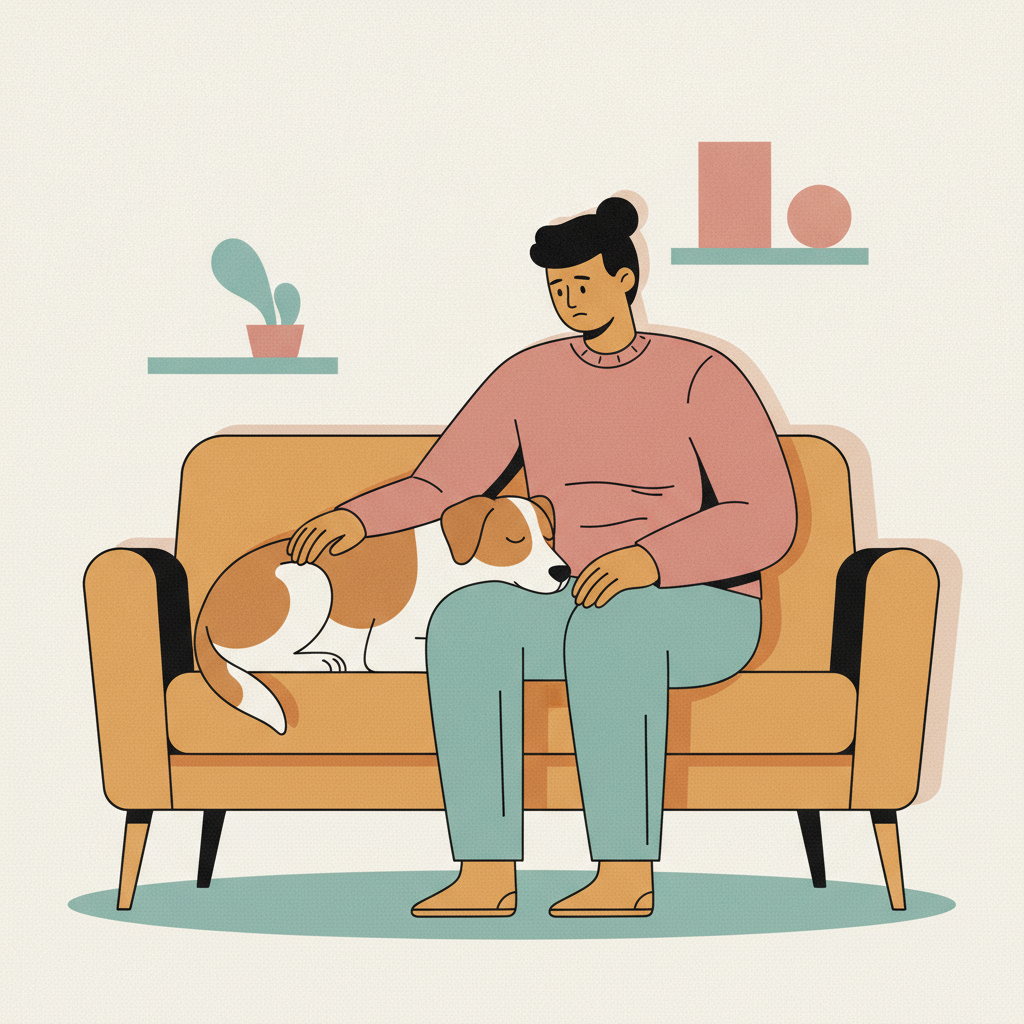
That dogs can smell things we cannot is not news; a dog who finds the cookie crumb in your sweater fold has already made the point. So when headlines announced that dogs can smell human stress, the impressive-but-abstract version of the story went wide: nice trick, remarkable nose. But that framing buries the finding that actually matters to you as a dog owner. The newest research does not just show that dogs detect stress. It shows that the smell of your stress changes how your dog feels, tipping their mood toward pessimism. Your stress, in other words, is contagious across the leash. And that turns your own calm into something closer to a tool for your dog’s welfare.
The finding that reframes everything: emotional contagion
A 2024 study led by researchers at the University of Bristol, with Cardiff University and the charity Medical Detection Dogs, set out to test something more consequential than detection. The question was whether the mere odor of a stressed human could nudge a dog’s emotional state.
The design was elegant. Eighteen dogs each learned a simple rule: a bowl in one spot always held a treat, a bowl in another spot never did. Once that was locked in, researchers placed a bowl in a new, ambiguous middle spot, a genuine mystery, and timed how fast each dog approached. A quick, eager approach reads as optimism; a slow, hesitant one reads as pessimism. Then came the variable: during the trials, dogs were exposed to sweat and breath samples from people who were either calm or stressed.
The result is the whole story. When dogs caught the scent of a stressed human, they grew noticeably more hesitant to approach the ambiguous bowl. The smell of stress made them more pessimistic. This is emotional contagion, plain and measured: your internal state does not stay yours, your dog can pick it up through the air and shift with it.
This is the part that changes how I counsel owners. We already knew dogs read our faces and our tone. What this shows is that even the chemistry of a bad day reaches them, below the level of anything you’re consciously doing. Your dog isn’t just reacting to how you act when you’re stressed, they’re reacting to how you smell.
The groundwork: dogs really can tell stressed from calm
The 2024 mood study only makes sense because an earlier study nailed down the underlying ability. In 2022, a team publishing in PLOS ONE asked whether a dog could distinguish two scent samples from the same person, one taken before stress and one after.
Thirty-six volunteers gave a calm baseline: a swipe of gauze across the neck, sealed in a vial, plus a breath sample. Then researchers stressed them, memorably, by making them count backward from 9,000 in steps of 17, out loud, for three minutes, with mistakes called out and correct answers met with silence. (If that revives the panic of a timed math test, you are exactly the flavor of stressed they were inducing.) A second sample followed.
Ordinary pet dogs, trained to freeze or sit at the target scent, then had to pick the post-stress sample out of a lineup that also held the person’s calm baseline and a blank vial. By chance alone they should have been right about a third of the time. They hit it 93.75 percent of the time. The only difference between the two real samples was a psychological stress response occurring minutes apart, and the dogs read it almost every time.
Why this is more than a fun fact: service-dog training
The practical door this opens is significant. Many psychiatric and PTSD service dogs are currently trained to respond to visual signs of distress, the things a dog can see their handler doing. But if stress has a detectable scent that precedes the visible signs, dogs could be trained to respond to the odor itself, reacting at the very onset of a stress response rather than minutes later when it shows on the outside. That head start could make an alert meaningfully faster and more useful.
What would a scent-triggered response look like? A trained dog might answer the smell of stress by nudging for contact, leaning in, initiating play, or prompting a walk, each a soothing behavior that interrupts a spiral before it deepens. Researchers are candid that this is early work, and that untangling how dogs distinguish stress from fear from excitement is the next frontier. But the direction is set.
The everyday takeaway: your calm counts
Strip away the labs and here is what it means at home. Your dog is tracking your inner state on a channel you cannot see, not just your voice and posture but your actual body chemistry. That cuts both ways. On a hard day, your stress can genuinely weigh on your dog and tilt them toward a worse mood. But the flip side is just as real: your steadiness can settle them.
That is not a call to perform false cheer for your dog, they’d likely smell through it anyway. It is a reason to take your own regulation seriously, because it is quietly doing double duty. A few slow breaths, a real decompression walk, or simply not carrying the day’s tension into the room is not only self-care. It is one of the more direct, evidence-backed things you can do for your dog’s emotional welfare, too.
References
- Parr-Cortes, Z., et al. “The Odour of an Unfamiliar Stressed or Relaxed Person Affects Dogs’ Responses to a Cognitive Bias Test.” Scientific Reports, 2024. https://www.nature.com/articles/s41598-024-66147-1
- Wilson, C., et al. “Dogs Can Discriminate Between Human Baseline and Psychological Stress Condition Odours.” PLOS ONE, 2022. https://journals.plos.org/plosone/article?id=10.1371/journal.pone.0274143
Dr. Chen is a small-animal veterinarian who leads health and safety coverage at The Pet Times. She writes and reviews the bulk of our illness, condition, and safety content, translating clinical guidance into clear, practical advice owners can act on at home.
Meet our experts ↗Keep reading
 TrainingYour Dog Is Chasing Your Laugh. Science Says It's No Accident.Dr. Nina Kohl · 4 min
 LivingYou're Not Soft for Loving Your Dog This Much. You're Wired for It.Dr. Mara Chen · 6 min
 TrainingBaby-Talking Your Dog Isn't Silly. It's Science.Marcus Webb · 5 min
 TrainingYour Dog Sniffs You at the Door Because You're the Evening NewsLeila Torres · 5 min
 LivingYour Dog Probably Doesn't Want to Be in Your WeddingNina Vasquez · 8 min
 TrainingYour Dog Can't Catch You in a Lie. It Can Decide You're Not Worth Trusting.Dr. Priya Nair · 6 min