


Your Dog Flunked the Mirror Test. That Says More About the Test.
Dogs don't recognize themselves in a mirror, and for years that was read as a knock on their smarts. It isn't. Dogs just run self-recognition through their nose, and newer research shows they clearly know where their own body ends.

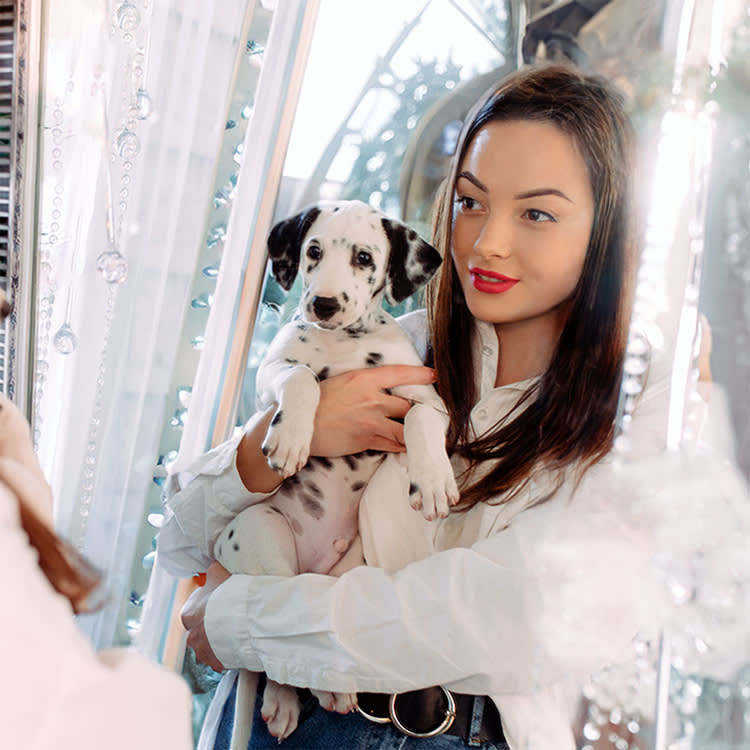
There is a durable little myth that you can measure how smart an animal is by holding up a mirror. Chimpanzees pass. Dolphins pass. Dogs, famously, do not, and somewhere along the way that turned into a quiet insult, as if your dog were failing an intelligence exam every time they trotted past the hallway mirror without a flicker of recognition.
Here is the part the myth leaves out. The mirror test isn’t a general intelligence test. It’s a vision test wearing an intelligence test’s clothes. And when you build the test around the sense a dog actually lives by, the “failure” disappears. Your dog knows exactly who they are. They just don’t look for the answer in a pane of glass.
Where the mirror test came from
The standard way scientists probe self-recognition is the mark test. An animal gets a spot of dye or a sticker somewhere it can’t see directly, like the forehead, and then meets a mirror. If it reaches for the mark on its own body rather than pawing at the reflection, that counts as evidence it understands the image is itself. Great apes and dolphins do this. Human toddlers start doing it somewhere around eighteen months to two years.
Because the result is so clean in those species, the mark test got treated as a bright line: pass it and you have a “sense of self,” fail it and you don’t. Dogs were an obvious candidate to try, and plenty of people expected them to sail through. They didn’t. Put most dogs in front of a mirror and they treat the reflection as a stranger, or a nothing, and move on.
Why the glass is the wrong instrument for a dog
A test only measures what it’s built to measure, and the mark test is built for animals that navigate by sight and fuss over their own appearance. Dogs are neither.
Start with the obvious: dogs experience the world primarily through smell, and a mirror is completely silent to the nose. A reflection that looks like a dog but carries no scent isn’t a puzzle to solve, it’s an unsettling glitch, and some dogs react with alarm rather than calm curiosity. Add to that the fact that dogs don’t groom themselves the way primates do. A chimp notices and picks at a strange mark because grooming is part of its behavioral repertoire. A dog with a dot of dye on its head has no built-in reason to care. So even a dog that fully understood the reflection might do nothing about the mark, and the test would score that as a fail.
There’s a wider lesson here that behavior researchers have learned the hard way across many species: when an animal flunks a cognition test, you can’t assume the animal lacks the ability. Sometimes the test failed the animal. Designing a fair test means starting from how that species naturally behaves, not from what’s convenient for a human with a mirror.
A mirror asks a dog to prove what it knows using the one sense it barely relies on. Score them on smell instead and the picture flips completely. The dog isn’t confused about who they are. We were just asking in a language they don’t speak.
The nose is the real mirror
Once researchers stopped insisting on glass, the evidence for canine self-recognition started showing up in the medium dogs care about: urine.
The first clue came from biologist Marc Bekoff, who spent four winters tracking how his own dog reacted to “yellow snow,” urine-marked snow he moved from spot to spot. His dog paid far less attention to his own urine than to other dogs’ and rarely bothered to mark over it, while staying keenly interested in everyone else’s. One dog isn’t proof of anything species-wide, but it pointed somewhere useful: a dog that finds its own scent boring may already know that scent is theirs.
Cognitive scientist Alexandra Horowitz built a sharper version of the idea, which she calls the olfactory mirror test. In the visual mark test, the reflection carries something that doesn’t belong, the mark. In her version, the urine carried something that didn’t belong, a bit of added anise oil. Dogs normally sniff their own urine only briefly. But when their own urine was “marked” with the extra odor, they investigated it longer, as if the change to their own signature was worth checking, exactly the response the visual test looks for. And when the dogs were offered the anise odor by itself, they weren’t especially interested, so plain novelty didn’t explain it. The reaction was specifically about their own smell being altered.
It isn’t a perfect one-to-one match with the mirror test, and Horowitz is careful about that. But it moves the question onto ground where dogs actually operate, and there the answer looks a lot like a yes.
What newer research adds
The nose isn’t the only place dogs show self-awareness, and the past few years have pushed the story further, away from the mirror entirely and toward the body.
In a 2021 study in Scientific Reports, researchers tested whether dogs understand their own body as a physical object that can get in the way. Dogs stood on a small mat and were asked to pick up and hand over a toy. In the key condition the toy was fastened to the mat the dog was standing on, so the only way to lift it was to step off first. Dogs left the mat more often and more quickly in that condition than when the toy was attached to the ground instead. That’s a recognizable form of body awareness: understanding that your own weight is the problem.
A follow-up line of work found dogs also seem to track their own size. Faced with openings of different widths, dogs tended to detour around gaps too small for their bodies rather than trying to squeeze through, suggesting they carry a rough internal sense of how much space they take up. None of this is the mark test. All of it is self-knowledge.
What this means for you and your dog
Practically, none of this changes your Tuesday. But it changes how you read your dog. The next time they walk past a mirror without a second glance, resist the old story that they’re too simple to recognize themselves. They’re doing something more interesting: relying on the sense that has never once let them down, and largely ignoring an instrument that tells them nothing.
It’s also a good general reminder for anyone who loves a dog. When a dog seems to “fail” at something we find easy, the honest first question isn’t “why is my dog bad at this,” it’s “am I even asking in a way that makes sense to a dog.” Usually, once you do, they turn out to be paying closer attention than you thought.
References
- Gallup, Gordon G. “Chimpanzees: Self-Recognition.” Science, vol. 167, no. 3914, 1970, pp. 86–87. https://www.science.org/doi/10.1126/science.167.3914.86
- Bekoff, Marc. “Observations of Scent-Marking and Discriminating Self from Others by a Domestic Dog (Canis familiaris): Tales of Displaced Yellow Snow.” Behavioural Processes, vol. 55, no. 2, 2001, pp. 75–79. https://www.sciencedirect.com/science/article/abs/pii/S0376635701001425
- Horowitz, Alexandra. “Smelling Themselves: Dogs Investigate Their Own Odours Longer When Modified in an ‘Olfactory Mirror’ Test.” Behavioural Processes, vol. 143, 2017, pp. 17–24. https://www.sciencedirect.com/science/article/abs/pii/S0376635717300104
- Lenkei, Rita, et al. “Dogs (Canis familiaris) Recognize Their Own Body as a Physical Obstacle.” Scientific Reports, vol. 11, 2021, article 2761. https://www.nature.com/articles/s41598-021-82309-x
Common questions
Do dogs recognize themselves in a mirror?
No. When researchers run the classic mark test, where a mark is placed somewhere the animal can only see in a mirror, dogs don't treat the reflection as themselves. But that failure is mostly about the test favoring vision. Dogs read the world by smell, don't groom off odd marks, and can be spooked by a scentless 'dog' in the glass, so a mirror is a poor instrument for measuring what they know about themselves.
How do we know dogs have any sense of self, then?
Through smell and through their bodies. Dogs spend less time sniffing their own urine than another dog's, and they get more interested in their own urine when a researcher adds a foreign odor to it, an 'olfactory mirror' result. Separately, dogs act as if they understand their own body is a physical object, stepping off a mat to lift something attached to it and routing around gaps too small for their frame.
Does failing the mirror test mean my dog isn't smart?
Not at all. The mirror test measures one narrow, vision-based skill that a handful of species pass. Dogs solve problems, read human gestures, learn hundreds of words, and track their own body in space. The mirror simply isn't the tool that shows it.
Why does my dog bark at or ignore mirrors?
A young dog may react to the reflection as if it were another dog, then lose interest once it never smells like one or responds normally. That habituation is itself a small clue: the dog has worked out the reflection is not a real animal worth engaging, even without recognizing it as themselves.
Dr. Chen is a small-animal veterinarian who leads health and safety coverage at The Pet Times. She writes and reviews the bulk of our illness, condition, and safety content, translating clinical guidance into clear, practical advice owners can act on at home.
Meet our experts ↗Keep reading
 TrainingThat 'Fight' Was Probably a ConversationDr. Priya Nair · 8 min
 TrainingStop Refereeing the Dog Park by Folklore. Read the Dogs InsteadSasha Ford · 10 min
 LivingYour Dog Has a Love Language. You're Probably Speaking the Wrong One.Leila Torres · 7 min
 TrainingThat's Not Your Dog's Eye. It's Their Third EyelidDr. Nina Kohl · 8 min
 TrainingYour Dog Is Bored, Not Heartbroken. Build These 7 Activity Stations.Dr. Nina Kohl · 7 min
 TrainingNo, Your Dog Isn't Faking Sick. But They Did Learn One Sneaky Trick.Dr. Mara Chen · 5 min