


The Belly Flop Is a Consent Form, Not a Command
Most dogs love belly rubs for a real, well-mapped reason involving specialized nerve fibers and oxytocin. But the same rolled-over pose can also mean 'please stop,' and learning to tell the two apart is the whole skill.

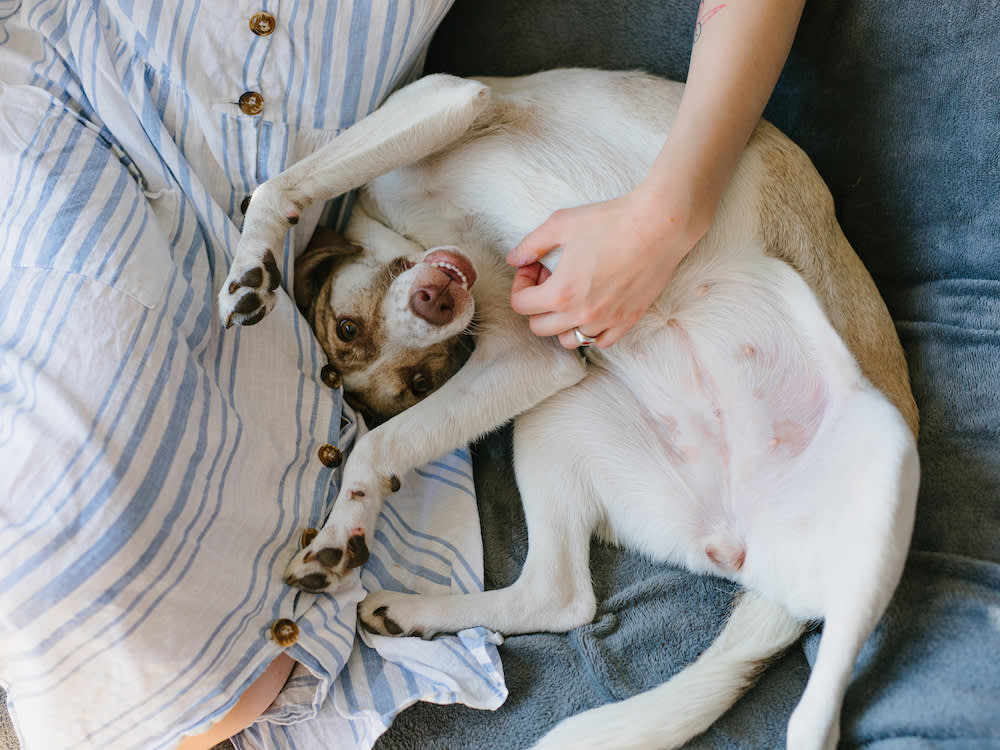
Watch a dog melt into a good belly rub and it is almost impossible not to feel it too. The goofy face, the lolling tongue, the total surrender of a soft underbelly to someone they trust. It is one of the most disarming things dogs do.
But here is the thing that turns a nice moment into an actual skill: that rolled-over pose is not always a request for a belly rub. Sometimes it is the opposite. The pleasure and the “please back off” can look nearly identical from across the room, and the difference between a dog who adores you and a dog who is quietly overwhelmed comes down to reading which one you are looking at. So let’s do both halves: why the belly rub feels so good, and how to know when the belly is not on offer.
Why it feels that good, biologically
Dogs are not being dramatic. The pleasure is wired in, and researchers have mapped a surprising amount of it.
Hairy skin, the kind covering a dog’s belly, contains a special class of nerve fibers called C-tactile afferents. These fibers are tuned almost eerily precisely: they fire hardest in response to slow, light stroking at roughly the speed you’d naturally pet an animal, a few centimeters per second. Stroke faster or harder and they quiet down. This is why a slow, gentle belly rub lands differently than a brisk pat, and it is the same system that makes affectionate touch feel good to humans.
Those fibers do not just register “nice.” They feed into a calming cascade. Gentle stroking at that pace triggers the release of oxytocin, the bonding hormone, and pushes the body toward its rest-and-relax state. In studies of dogs interacting calmly with their owners, heart rates fell substantially over the course of a long, quiet session, dropping from an anxious clip toward a slow, settled rhythm. A belly rub is, chemically, a small dose of “you’re safe here.”
There is a bonus layer, too. A dog cannot reach their own belly, so this is pleasure they physically cannot self-supply, and the extra blood flow to a rubbed area can be soothing, sometimes even easing a gassy or unsettled stomach.
“The reason a slow belly rub works is that it speaks the body’s own language. Those touch fibers are tuned to a specific gentle pace, and when you match it, you’re not just petting the dog, you’re nudging their whole nervous system toward calm,” says Dr. Nina Kohl.
The pose that looks the same but isn’t
Now the part that matters most. A dog on their back is not automatically inviting a belly rub. The same rollover can be an appeasement signal, a dog making themselves small and exposing a vulnerable area to say “I’m no threat, please give me space.” A stressed dog and a blissed-out dog can hold nearly the same shape.
The tells are in the rest of the body. A dog offering their belly for a rub is loose. Soft eyes, a relaxed open mouth, a wagging or still-but-easy tail, a body that stays put and maybe paws at you for more when you stop. A dog using the rollover to cope looks tight instead: a closed mouth or tense lips, a tucked tail, whites of the eyes showing, a stiff frozen posture, or a slow creep away from your hand. If you rub and the dog goes rigid or slips off, that was never a yes.
The reliable move is a consent test, and it takes three seconds. Rub for a moment or two, then stop and take your hands away. A dog who wanted it will re-engage: shift closer, paw at you, roll back into your hand, open the posture wider. A dog who is done, or who never wanted it, will hold still, get up, or move off. Let their answer decide whether round two happens.
How to give a belly rub worth asking for
Assuming you have a genuine yes, technique still matters, because dogs have preferences the way people do.
Start slow and light, in keeping with how those touch fibers work. Try long strokes, then small circles, with and without a little fingernail, and a few gentle pats, and watch which one earns a sigh versus a squirm. Keep checking in with the three-second stop. The best belly rub is a conversation, not a routine you run the same way every time.
And respect the dogs who simply are not belly dogs. Some feel too vulnerable exposing their underside, some are ticklish, some had a bad experience. That is not a problem to fix. If your dog would rather have a chest scratch, an ear rub, or a scratch at the base of the tail, give them that instead. Forcing a belly rub on a dog who does not want one, whether it is your dog or a stranger’s, teaches them that your hands do not listen, which is the opposite of what a belly rub is supposed to build.
Why it’s good for you too
The bonding runs both directions. That oxytocin loop is mutual: petting a dog you love lowers your blood pressure and stress along with theirs, and the more you connect through calm, consensual touch, the more both of you produce the hormones that make you feel closer. A belly rub given well is one of the cheapest, most reliable good moments available to a person and a dog, which is reason enough to learn to read it right.
What newer research adds
The touch science has firmed up in recent years. The C-tactile system, once studied mostly in humans, is now understood to be a general feature of mammalian hairy skin, which helps explain why slow gentle stroking calms so many species and why stroking speed, not just pressure, changes how pleasant touch feels. Newer work continues to trace the pathway from those skin fibers up to oxytocin-releasing neurons in the brain.
The oxytocin-in-dogs picture is more nuanced than the tidy “cuddling releases the love hormone” headline suggests. Some studies find a clear rise in dogs after positive interaction and some do not, which likely reflects how much the individual dog and the specific situation matter. The safe, evidence-based takeaway is unchanged: calm, consensual, slow touch with a dog who wants it is good for both of you, and reading the dog’s yes is what makes it work.
References
Dr. Park is a board-certified emergency and critical care specialist. She reviews our health and safety content for clinical accuracy and contributes guides on recognising urgent conditions. Her focus is helping owners act quickly and correctly when it matters most.
Meet our experts ↗Keep reading
 TrainingThat Big Dramatic Sigh Isn't Sadness. It's Punctuation.Dr. Lena Park · 6 min
 TrainingYou're Petting Dogs Wrong. Here's How to Ask FirstDr. Nina Kohl · 6 min
 TrainingFeeling Great? Then Your Dog Looks Miserable. That's You, Not Him.Dr. Amara Solis · 6 min
 TrainingIt's Not Why Your Dog Licks Your Legs. It's How Long.Dr. Mara Chen · 7 min
 TrainingYour Dog Curls Its Lip and Chatters Its Teeth. It's Reading a Smell You Can't.Dr. Priya Nair · 5 min
 TrainingYour Dog Doesn't Hate Your New Partner. They Hate That Their Life Got WorseDr. Lena Park · 6 min