


Feeling Great? Then Your Dog Looks Miserable. That's You, Not Him.
New research out of Arizona State found that when people are put in a good mood, they rate dogs as sadder. Not neutral. Sadder. We aren't reading our dogs at all. We're reading ourselves, then flipping the answer.

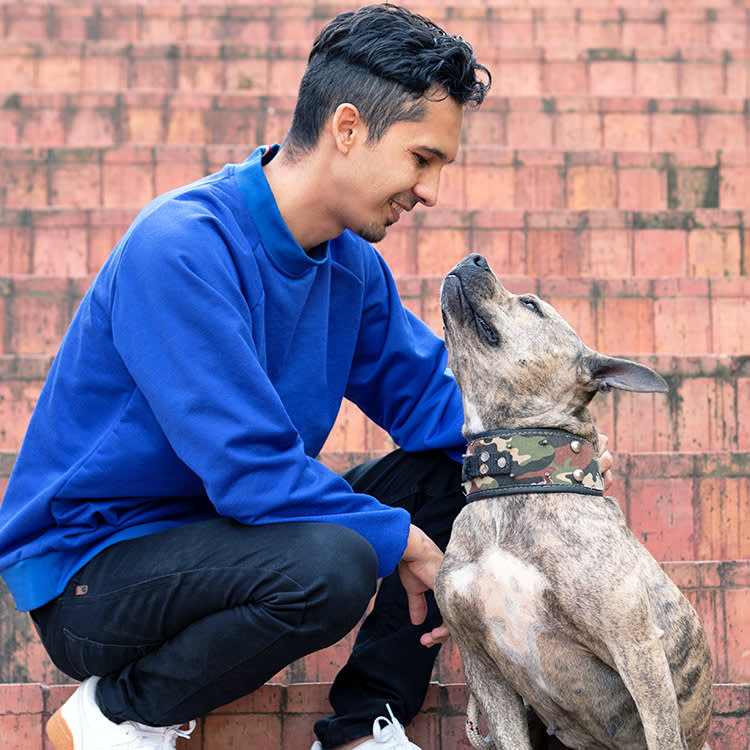
You had a good morning. You slept, you worked out, the coffee was correct. Then you glance down at the rug, and the dog lying on it has the face of an animal who has received terrible news.
You have probably filed that under dogs are dramatic. A team at Arizona State University has a less charitable explanation, published in PeerJ in December 2025: the sadness you’re seeing is being manufactured by your good mood. Put people in a cheerful state and they don’t rate dogs as cheerful. They rate them as sadder. Make people sad and the same dogs suddenly look happier.
That is not a small perceptual wobble. It is an inversion, and it means the confidence you have in reading your own dog’s face is worth considerably less than you think.
What they did, and the false start that makes it interesting
The setup was deliberately clean. Researchers filmed three dogs reacting to good and bad moments in their actual lives. Oliver, a 14-year-old mixed breed, got treats. Canyon, a one-year-old Catahoula Leopard Dog, got a toy. Henry, a three-year-old French Bulldog, got the word “Grandma,” which is, in fairness, the most efficient joy-delivery mechanism in the study. For the negative reactions, Oliver got a cat, and Canyon and Henry got the vacuum cleaner.
The footage was then edited onto a plain black background, stripping out every contextual cue, so that a viewer had nothing to go on but the dog.
Then came the mood manipulation. Three hundred undergraduates viewed images from the Nencki Affective Picture System, a standardized image set psychologists use to reliably push people into positive, neutral, or negative moods. Only then did they see the footage, and their job was to score each animal on a happy-to-sad scale.
And nothing happened. The participants’ moods had no measurable effect on how they rated the dogs. A null result.
Most teams would shrug and move on. This one had a theory about why: the mood-priming images were full of people, and maybe a mood built out of human faces doesn’t transfer to judging an animal. So they ran it again with 300 fresh participants, this time priming mood exclusively with photographs of dogs. Happy dogs: a puppy in a teacup, a dog racing around a park. Sad dogs: a dog behind bars, a dog abandoned at the roadside.
The priming worked. The participants’ moods shifted as intended. And then the effect appeared, pointing exactly the wrong way.
Participants coming off the joyful images scored the filmed dogs as sadder. Participants coming off the miserable images scored those very same clips as happier.
Why this breaks the rule you thought you knew
Here is what makes the result genuinely strange rather than merely surprising.
When people judge other humans, mood works the way intuition says it should. Research on emotion perception has consistently found that happy people are more likely to read other people as happy. Your mood leaks into your reading, and it leaks in the same direction. It is a smear, not a flip.
With dogs, the smear runs backward. Study co-author Clive Wynne, a psychology professor and director of ASU’s Canine Science Collaboratory, told Phys.org that this domain keeps surprising him, and that the field feels like it’s barely scratching the surface of something large. Coming from someone who has spent a career on canine cognition, that is a fairly loud admission.
There is a plausible mechanism, and it’s a contrast effect: after a screen full of ecstatic golden retrievers, an ordinary dog just standing there looks a bit flat by comparison. After a screen full of abandoned dogs, that same ordinary dog looks like he’s having a lovely time. Your brain isn’t reading the dog. It’s grading him against the last dog it saw. But that’s a hypothesis about why, not a rescue of the reading itself. The reading is still wrong.
One more thing they found, which is nicer
Buried in the results is a detail worth keeping: participants’ own emotional states improved simply from watching the dogs. Happy dogs, sad dogs, doesn’t matter. The dogs made people feel better either way.
So the exchange, roughly, is that a dog reliably improves your mood, and you reliably misjudge his in return. There is a joke in there about relationships, and we will leave it alone.
What to do instead of trusting your read
The takeaway is not that you can never know how your dog feels. It’s that his face, filtered through your mood, is a bad instrument, and you have better ones. Holly Molinaro, one of the study’s authors and a senior animal welfare scientist at Animal Wellbeing Solutions, has spent years demonstrating exactly how leaky human perception of dog emotion is. The practical fix is to stop reading vibes and start reading the body.
Watch the whole animal, not the eyebrows. Ears, mouth, tail, weight distribution, and speed together carry far more signal than the face alone. A dog whose weight is shifted back, whose mouth is closed and tight, and whose tail is low is telling you something no amount of soulful eye contact will contradict.
Ask what just changed. Emotion tracks events. If nothing happened in the last ten minutes, and he ate, and he’s stretched out on the cool floor, your sense that he’s despondent is coming from inside your own head.
Check behavior, not expression. Is he eating normally? Does he still want the ball? Does he greet you at the door? Is he sleeping the usual amount? Those answers are hard to fake and hard for your mood to distort.
Notice your own state before you diagnose his. If you are elated, be suspicious of the thought that your dog is depressed. If you are low, be suspicious of the thought that he is fine.
What newer research adds
This study did not arrive out of nowhere. It sits on top of earlier work showing that when you swap the background behind a dog, people rate the dog’s emotion based on the scenery rather than the animal. Show the same dog against a vacuum cleaner and people call him stressed; put him in front of a leash and they call him thrilled. Same dog. Same face.
Line the two findings up and the picture is uncomfortable but clear. We read the room. We read our own state. We read the last dog we saw. Somewhere down the list, well below all of that, we read the actual dog.
Humans and dogs have shared space for more than ten thousand years, and we are still bad at this. The purpose of research like this isn’t to make you feel like a fraud in your own living room. It’s to move you from I can just tell to let me look properly, because a dog whose signals you actually read gets a better life than a dog whose signals you assume.
Every owner I meet is certain they can read their dog. The ones whose dogs are genuinely doing well aren’t the ones with the strongest intuition. They’re the ones who bothered to check whether the intuition was right.
References
- Molinaro, H. G., Wynne, C. D. L., et al. “Human mood influences perception of dog emotion.” PeerJ, 2025. peerj.com/articles/20411
- Arizona State University / Phys.org. “When you’re happy, your dog looks sad, study reveals,” December 2025. phys.org
- Newsweek. “Feeling happy makes your dog seem sad,” December 2025. newsweek.com
- Marchetti, A., et al. “Mood congruence in emotion recognition of human faces.” Aging, Neuropsychology, and Cognition, 2018. doi.org/10.1080/13825585.2018.1438584
- Marchewka, A., Żurawski, Ł., Jednoróg, K., Grabowska, A. “The Nencki Affective Picture System (NAPS).” Behavior Research Methods, vol. 46, 2014, pp. 596–610. doi.org/10.3758/s13428-013-0379-1
Dr. Solis is a board-certified veterinary dermatologist with over twelve years of clinical experience. She advises on skin conditions, allergies, and grooming practices that affect coat and skin health. All dermatology and allergy content at The Pet Times is reviewed by her team before publication.
Meet our experts ↗Keep reading
 LivingHis Dog Walks Into the Office at 5 P.M. and Ends the WorkdayJames Okafor · 6 min
 TrainingThat 'Guilty Look' Isn't Guilt. It's a Read on You.Dr. Nina Kohl · 7 min
 LivingYour 'Dog Type' Is a Mirror, Not a PreferenceDr. Nina Kohl · 6 min
 TrainingYour Dog Sniffs You at the Door Because You're the Evening NewsLeila Torres · 5 min
 LivingStuck Inside With a Wired Dog? 9 Ways to Wear Them Out Without a WalkJordan Ellis · 5 min
 TrainingYour Dog's Toy Stash Is Adorable. The Growl Over It Isn't.Marcus Webb · 7 min