


That 'Guilty Look' Isn't Guilt. It's a Read on You.
Your dog's tucked tail and averted eyes after the trash tips over feel like a confession. The science says it's something else entirely, and it points back at you.

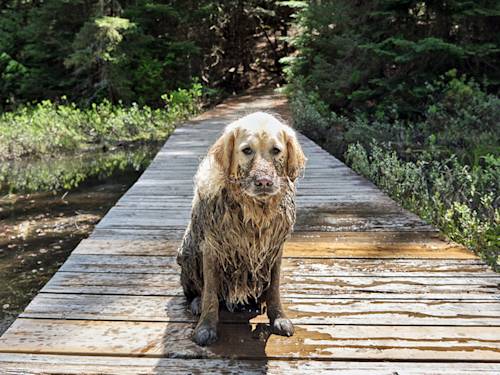
You come home, the trash is fanned across the kitchen floor, and there is your dog: ears flat, tail tucked, sliding away from you with that unmistakable I know, I know expression. It reads like a confession. It feels like proof that your dog knows exactly what they did and feels terrible about it.
Here is the uncomfortable, oddly freeing twist: that look is not guilt. It is your dog reading you. And once you understand what is really happening, the whole dynamic, and how you fix the behavior, flips. The problem you have been trying to shame out of your dog is one you have been accidentally teaching.
What the research actually found
The classic experiment on this is worth knowing because it is so clean. Researchers set up situations where dogs either had or had not eaten a forbidden treat, then watched what happened when owners scolded them. The “guilty look” did not track with whether the dog had actually done anything wrong. It tracked with one thing: whether the owner scolded. Dogs who were scolded looked guilty whether or not they were innocent. Dogs who were not scolded skipped the guilty look even when they had raided the food.
In other words, the display is a response to your behavior, not to the dog’s memory of a crime. Follow-up work has only reinforced this. Studying animal emotions is genuinely hard, because we cannot ask a dog what it feels and must infer everything from behavior and physiology. But the weight of the evidence points the same way: dogs do not appear to experience secondary, self-conscious emotions like guilt the way we do. What they are exquisitely good at is predicting and responding to us.
So what is that look?
It is appeasement. Dogs are masters at reading human emotion, and they use a well-worn set of signals to de-escalate tension: avoiding eye contact, lowering the body, flattening the ears, tucking the tail, lifting a paw, offering a submissive squint. This is social diplomacy, not a plea for forgiveness. Your dog senses that you are upset, or anticipates that you are about to be, and offers a gesture that says, roughly, let’s not fight about this.
The timing is the tell. Plenty of dogs produce the “guilty” display the instant you walk in, before you have seen the mess or said anything. They are not reacting to the trash. They have learned that this particular scene, you plus scattered garbage, reliably comes with an angry human, and they are getting ahead of it.
The thing owners miss is that the guilty look often appears before any scolding, which is the giveaway that it’s prediction, not conscience. The dog has learned that a certain situation forecasts your frustration, so it starts appeasing preemptively. It’s a social smoothing behavior, and we drape a human story of remorse over the top of it.
Why we get this so wrong
Because we are wired to. Attributing human feelings to animals is one of the most natural things people do, and a tucked tail plus averted eyes maps neatly onto our own experience of shame. But mapping is not evidence. There is no scientific basis for reading a moral emotion into those signals, and doing so leads us to exactly the wrong response: we scold harder, convinced the dog “knows better,” which only cranks up the appeasement and the anxiety without changing the underlying behavior at all.
The fix starts with you, not the dog
If the look is a response to your reaction, then the first thing to adjust is your reaction. This is not permissiveness; it is aim. Scolding a dog after the fact does not teach them not to tip the trash. It teaches them that your arrival is unpredictable and stressful, which is how you end up with a dog that grovels the moment you walk in.
Uncouple your dog’s behavior from your own sense of right and wrong. If you walk in and your dog looks guilty, the useful question is what your body is doing, not what your dog is confessing. Punishing a dog for a mess it made an hour ago just teaches it that you are frightening to come home to.
Two moves do the real work. The first is teaching clear, positive cues, things like “down” and “stay,” so your dog understands what you actually want instead of just learning what makes you angry. Reward the behavior you like and it will crowd out the behavior you do not.
The second, and the one people skip, is management. Prevention beats correction every time, because a dog that never gets to rehearse the unwanted behavior never learns it. If your dog counter-surfs while you cook, gate them out of the kitchen. If they raid the garbage, get a can with a locking lid. It feels less satisfying than “training the dog to know better,” but it works, and it does not cost your dog a shred of trust.
Common signals that look like guilt (and aren’t)
You will recognize most of these. Reframed as appeasement rather than confession, they make a lot more sense:
- Hiding or avoidance. Retreating or refusing eye contact is an attempt to exit a tense moment, not an admission.
- Low body posture. Shrinking toward the ground is a classic calming signal aimed at you.
- “Puppy eyes.” Those big soft eyes are a communication tool, often a request for reassurance, not remorse.
- A lifted paw. A gesture of uncertainty or submission when a dog is unsure how you will react.
- Tucked tail. A sign of fear or anxiety, tucked to signal I’m no threat.
- Ears pulled back. Anxiety or appeasement, flattening to look smaller and less confrontational.
The bottom line
Your dog’s guilty face is real, it just does not mean what you think. It is a socially fluent animal reading your mood and trying to keep the peace, sometimes before you have even reacted. That is not a character flaw to be corrected; it is a signal to check your own behavior and to fix the actual problem through training and prevention. Stop asking your dog to feel sorry, and start making it easy for them to get it right.
References
- Horowitz, Alexandra. “Disambiguating the ‘Guilty Look’: Salient Prompts to a Familiar Dog Behaviour.” Behavioural Processes, vol. 81, no. 3, 2009, pp. 447-452, https://doi.org/10.1016/j.beproc.2009.03.014.
- Hecht, Julie, et al. “Behavioral Assessment and Owner Perceptions of Behaviors Associated with Guilt in Dogs.” Applied Animal Behaviour Science, vol. 139, no. 1-2, 2012, pp. 134-142, https://doi.org/10.1016/j.applanim.2012.02.015.
- Ostojić, Ljerka, et al. “Are Owners’ Reports of Their Dogs’ ‘Guilty Look’ Influenced by the Dogs’ Action and Evidence of the Misdeed?” Behavioural Processes, vol. 111, 2015, pp. 97-100, https://doi.org/10.1016/j.beproc.2014.11.010.
Common questions
Do dogs actually feel guilt?
Current research says probably not, at least not the complex, self-aware guilt humans feel. The 'guilty look' shows up in response to a person's disapproval, not to the dog's own understanding of a misdeed.
Why does my dog look guilty when I come home?
Your dog is reading your face, voice, and body language and offering appeasement signals to defuse tension. Often they've learned to do this before you've even said a word, because they can predict your reaction.
Does my dog know it did something wrong?
Dogs learn that certain actions are followed by your displeasure, which is not the same as understanding right and wrong. They respond to consequences and to your mood, not to a moral sense.
Can dogs feel embarrassed?
The behaviors that look like embarrassment, avoiding eye contact or slinking away, are more likely appeasement responses to your reaction than the complex human emotion of embarrassment.
Dr. Kohl is a board-certified veterinary dentist with a particular interest in preventive oral care. She reviews all dental health content at The Pet Times and contributes practical guides on home dental routines, professional cleaning, and oral disease prevention.
Meet our experts ↗Keep reading
 LivingYour Dog Isn't Upset When You Argue. They're Trying to Stop You.Jordan Ellis · 6 min
 LivingYour Dog Isn't a Character Judge. But Their Cold Shoulder Still Means Something.Sasha Ford · 6 min
 Training'Imprinting' Is the Wrong Word for What Your Dog FeelsDr. Ravi Mehta · 8 min
 LivingA 160-Pound Ranch Dog Found a Lost Toddler. His Breed Was Built for Exactly This.Dr. Nina Kohl · 6 min
 TrainingYour Tears Stress Your Dog Out. A Pet Pig Wouldn't Care.Dr. Nina Kohl · 5 min
 LivingA Dog With No Nostrils Became Philadelphia's Most Famous RescueLeila Torres · 6 min