


A Dog With No Nostrils Became Philadelphia's Most Famous Rescue
Sadie Dupuis has fostered dogs since 2007. The one who stayed was found starving in a park with her face destroyed, needed her nostrils rebuilt, and now gets recognized on the street more often than the rock star who adopted her.

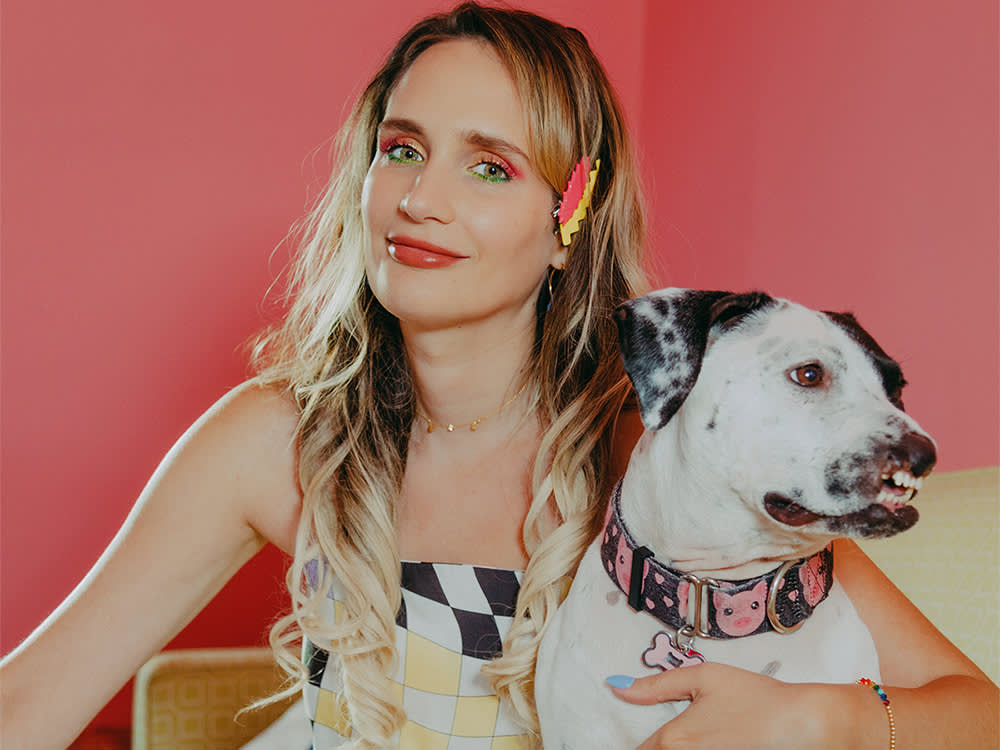
There is a version of the rescue story that gets told a lot, where a person saves a dog and the dog saves them back and the whole thing wraps up in a warm bow. Then there is what actually happens, which is fifteen years of foster placements, a shelter warning you that this particular dog can never live with another dog, a trainer appointment you make because you do not believe them, and a slow, unglamorous acclimation process that either works or does not.
Sadie Dupuis has done the second version. She fronts the Philadelphia bands Speedy Ortiz and Sad13, she writes poetry, and she has been fostering dogs since 2007. Her household is two rescue dogs, Buster and Lavender, plus her partner, Dylan Baldi of Cloud Nothings.
Lavender is the one people know. Strangers on the street in Philadelphia, by Dupuis’s own account, are considerably more likely to recognize the dog than the musician holding the leash.
How a dog gets that famous
Lavender turned up starving in a Philadelphia park, her face destroyed. Much of the lip was gone. The nose was gone. What she did not have, functionally, was a working set of nostrils, which is exactly as grave as it sounds, since a nose is most of how a dog reads the world and a good deal of how a dog breathes.
Somebody had done this to her. She was a local news story before she was anybody’s dog.
Then a friend of Dupuis’s, who worked at the Pennsylvania SPCA, made a phone call. Surgery to rebuild the nostrils was coming, and in the meantime the dog needed somewhere to live. Would Dupuis take her? Dupuis, ten years into fostering by that point, said yes.
The PSPCA’s foster coordinator suggested setting up social media accounts for her, not for fame but for the two things shelters actually need: fundraising for a very expensive surgery, and a pipeline of adopters. Baldi made her Instagram. Dupuis made her Twitter. There was, by then, already a long list of people hoping to adopt the dog from the news.
She stayed.
The Instagram took off in a way that Dupuis, who uses social media professionally as a working musician, describes with a certain rueful amusement: her dog’s videos routinely out-perform anything either she or Baldi has ever posted about their own music. There is an ongoing domestic disagreement about whether to monetize it. Baldi wants to keep the account pure. Dupuis has pointed out, reasonably, that the dog destroys toys at an unsustainable rate and a sponsored sweater would not be the worst thing.
The part the shelter got wrong
Here is the detail that should stay with anyone who has ever been handed a warning label with a dog.
The shelter told them Lavender could never be around other dogs. Her prey drive, they said, was too high. She stalked.
Dupuis did not buy it, and, crucially, she did not simply ignore it either. She booked a trainer straight away. Doubting a label and testing a label are two different responses, and only the second one is safe.
The DNA test told the rest of the story. Lavender is a Border Collie mixed with Staffy and Bull Terrier. The stalking is not aggression. It is herding. Collies stalk, freeze, and stare, and to an untrained eye it reads as a dog about to attack rather than a dog running a genetic subroutine. The talkativeness, the constant low-level herding of her own household, all of it snapped into place once the breed did.
A behavioral label written in the intake chaos of a shelter is a hypothesis, not a diagnosis. Lavender was very nearly barred from a normal life by one.
Introducing her to Buster
Buster, now 12, is a Pit Bull who arrived as a four-month-old foster puppy and never left. Dupuis has watched him move through every life stage there is. For years he adored the dog park and got on with everybody. Then, somewhere around the age of seven or eight, he quietly retired from putting up with other dogs at all, which is an extremely normal thing for a middle-aged dog to do.
Which made bringing Lavender home a genuine risk. Lavender loves everyone and does not comprehend a creature who does not want to be hugged by her. Buster had aged out of patience.
So they did a slow acclimation. Not an introduction, an acclimation, over time, on the dogs’ schedule rather than the humans’. It worked. They became best friends. Buster, at 12, plays with her nonstop like a puppy, which is not a thing that was supposed to happen and is the sort of change that makes a decade of fostering feel worth it.
Pit Bulls, and why she keeps ending up with them
Dupuis did not set out to be a Pit Bull person. She learned about the breed by fostering, because when she lived in New York, Pit Bull mixes were overwhelmingly the dogs in urgent need of foster care. Every dog she has ever fostered has been a Pit Bull mix of some kind. She describes them as snugglers, sweet, and friendly, and she is now, by her own account, a little obsessed.
That is not a coincidence of temperament. It is a fact of shelter math. In most American cities, the dogs sitting longest, the dogs euthanized most often, and the dogs hardest to place into housing are bully-type mixes. Foster long enough and that is who you get, which is precisely how a person becomes a Pit Bull person without ever choosing to.
Her interest in dogs is not new. Her mother’s boyfriend, for most of her childhood, was a dog trainer with as many as ten dogs at a time, many with severe behavioral issues, and she watched him work miracles on them. That was the whole world she grew up inside.
The mental health part, said honestly
Asked whether her dogs inspire her creative work, Dupuis gives an answer that is more useful than the one that question usually gets.
Not really, is roughly the shape of it. What the dogs do is keep her functioning enough to make things at all. During harder stretches of depression or anxiety, the desire to be creative is the first thing to go, and it becomes very easy to sink into a couch and stay there. A dog who has to be woken up for, walked, played with, and cared for is a structure that does not permit that. The routine is the intervention.
That is a more honest account of what a dog does for a person’s mental health than most of what gets said about it. Not muse. Scaffolding.
The one direct creative contribution, she has said, is a technical one. Lavender objects to being separated from her while she works. If Dupuis is tracking guitar in the house, the dog can be heard in the background making what Dupuis calls her Chewbacca sounds. She ended up recording ten minutes of it and layering it into a song, which means the dog has a credit.
What’s new since this was written
The record Dupuis was tracking with an unhappy dog in the background arrived. Speedy Ortiz released Rabbit Rabbit, their fourth album, on September 1, 2023, through Wax Nine. Her second poetry collection, Cry Perfume, came out on Black Ocean.
And the foster shortage that made Lavender’s story possible has not gone away. Foster placement remains the single biggest bottleneck for medical-hold animals at most shelters, because a dog awaiting reconstructive surgery cannot recover in a kennel, and a shelter that cannot find a foster home often cannot green-light the surgery in the first place. Lavender got her nostrils because somebody said yes to a temporary dog.
That is the whole ask. Temporary is enough. Sometimes it stops being temporary, and that is allowed too.
References
- Pennsylvania SPCA. Foster a pet.
- ASPCA. Pit Bull Myths and Facts.
- American Veterinary Society of Animal Behavior. Position Statement on Puppy Socialization.
- Speedy Ortiz. Rabbit Rabbit, Wax Nine, 2023.
Leila Torres leads our Living coverage, from home life and travel to the products and rescue stories that come with sharing a life with animals. She edits and writes across the section, with a soft spot for pieces about the bond between people and their pets.
Meet our experts ↗Keep reading
 LivingA 'Soul Dog' Isn't Magic. It's Fluency, and You Can Build It.Jordan Ellis · 8 min
 First DaysThe 3-3-3 Rule Is Two-Thirds Made UpDr. Mara Chen · 10 min
 LivingShelter Temperament Tests Are Barely Better Than a Coin Flip. Good Dogs Die for It.Dr. Ravi Mehta · 7 min
 LivingThe Shelter Dog Everyone Called 'Aggressive' Just Needed a PlaygroundDr. Mara Chen · 8 min
 LivingThe Dire Wolf Fantasy Is Filling Shelters With Real HuskiesMarcus Webb · 6 min
 LivingYou're Not Soft for Loving Your Dog This Much. You're Wired for It.Dr. Mara Chen · 6 min