


The Real Test of Your Dog's Self-Awareness Isn't the Mirror. It's You.
Dogs 'fail' the famous mirror test, and for years that was read as a limit on their minds. But the awareness that actually runs your dog's life is social: they track their own body, their own scent, and, most of all, you.

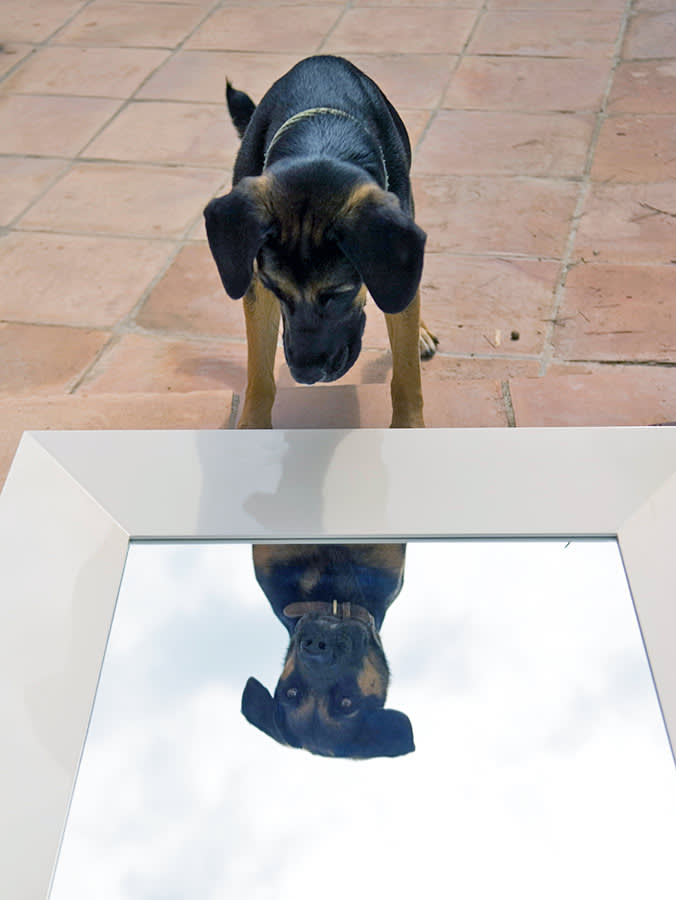
Every dog owner eventually wonders what’s actually happening behind those eyes. Does your dog know she’s a dog? Does she know where she ends and the couch begins? Does she know you, specifically, or would any hand that fills the bowl do just as well?
For a long time, science answered the first question with a shrug and a knock: dogs don’t recognize themselves in a mirror, so, the thinking went, they must not be especially self-aware. That conclusion is now looking backward. Self-awareness isn’t one thing you either have or don’t. It’s a stack of separate abilities, and dogs quietly pass most of the ones that matter to a dog. The most interesting of those abilities, it turns out, points straight at you.
Your dog knows the shape of her own body
Start with the least glamorous kind of self-awareness: knowing how much space you take up. Dogs are remarkably good at this. Faced with a gap, a dog will size it up against her own body and take the long way around if she decides she won’t fit, rather than wedging herself in and hoping.
Researchers have pushed this further with a clever setup. A dog was taught to pick up an object and hand it to a person. When that object was tethered to a mat the dog happened to be standing on, the dog had to step off the mat to lift it, and dogs did exactly that far more often than when the object was fixed to the floor beneath the mat. In other words, the dog recognized that her own weight was the obstacle. That is a genuine, testable form of self-representation.
Dogs also seem to keep a running estimate of what their body can do. Most of us have watched a dog pause at the base of a jump, clearly calculating, before committing or backing off. They don’t always get it right, but the deliberation itself says they’re weighing their own limits.
The mirror was never the right instrument
So why the mirror failure? The classic mirror self-recognition test, designed in the 1970s, marks an animal’s body and watches whether it inspects the mark more once a mirror appears. Great apes, dolphins, and orcas tend to pass. Dogs generally don’t.
But the mirror is a vision test, and vision isn’t a dog’s headline sense. Smell is. When researchers built a scent-based version, an “olfactory mirror,” dogs spent longer investigating their own odor when it had been subtly altered than when it was left alone, which suggests they notice when their personal scent signature is off. Dogs also largely ignore their own urine marks while paying close attention to other dogs’, a tidy sign that they know which smells are theirs. The upshot is simple: a dog can flunk a test built for a primate and still have a firm sense of self, just routed through the nose instead of the eyes.
The awareness that runs your dog’s life is social
Here’s where it gets genuinely moving. The richest form of your dog’s self-awareness is relational, and it’s aimed at the people she lives with.
The question owners ask me is usually ‘does my dog know herself.’ The better question is how well she knows the people around her, because that’s the awareness dogs are truly built for. They are tracking us far more closely than we track them.
Dogs form real attachment bonds with their people, the kind that show up as distress when you leave, elaborate greeting rituals when you return, and a pull toward you when they’re frightened. Behavioral scientists have found these bonds resemble the attachment styles between a young child and a parent, not the looser affiliations you see in many other species.
They also read our emotional weather. Dogs pick up on human crying and distress, and they’ll work harder and faster to reach a person who sounds upset, especially a person they know. That last part is the tell: a dog’s concern is not evenly distributed. Your dog cares more about your bad day than a stranger’s, which is about as clear a sign of a specific, personal relationship as you could ask for.
Then there’s imitation. Dogs watch familiar humans for cues and will copy how a person accomplishes a task, even mimicking an obviously inefficient method, a kind of social learning that’s common between closely bonded individuals and strikingly rare in many other animals, including great apes. Social structure matters to them, and you are near the center of it.
The flip side of that bond is separation anxiety. Some dogs unravel when apart from the person they’re attached to, spiraling into stress, destruction, or self-injury. It’s a hard problem, but it grows out of the same root as all the sweeter behaviors: a dog who is deeply, specifically aware of you.
What newer research adds
Recent work keeps sharpening the picture of dogs as socially tuned animals rather than self-absorbed ones. A 2024 study looking at how dogs respond to unfamiliar people in distress found that empathy-like helping isn’t reserved only for their owners, though the bond with a familiar person still runs deeper. And ongoing debate over the olfactory mirror is a healthy sign, not a weakness: scientists are actively trying to design tests that measure what matters to the animal being studied instead of what matters to us.
That’s really the throughline. When we test dogs on our terms, they look limited. When we test them on theirs, tracking their bodies, their scent, and above all their people, they look aware in exactly the ways that let them share a life with us.
So does your dog know herself? By every measure that fits a dog, yes. And she almost certainly knows you better than you know her.
References
- Lenkei, Rita, et al. “Dogs recognize their own body as a physical obstacle.” Scientific Reports, vol. 11, 2021. nature.com
- Pongrácz, Péter, et al. “Body size awareness matters when dogs decide whether to detour an obstacle or opt for a shortcut.” Scientific Reports, vol. 13, 2023. nature.com
- Horowitz, Alexandra. “Smelling themselves: Dogs investigate their own odours longer when modified in an ‘olfactory mirror’ test.” Behavioural Processes, 2017.
- Rivera, Micael M., and Julia E. Meyers-Manor. “Beware of Strangers: Dogs’ Empathetic Response to Unknown Humans.” Animals, vol. 14, no. 14, 2024. doi.org
- Payne, Elyssa, et al. “Current perspectives on attachment and bonding in the dog–human dyad.” Psychology Research and Behavior Management, vol. 8, 2015. ncbi.nlm.nih.gov
- Huber, Ludwig, et al. “Would dogs copy irrelevant actions from their human caregiver?” Learning & Behavior, vol. 46, 2018.
Dr. Chen is a small-animal veterinarian who leads health and safety coverage at The Pet Times. She writes and reviews the bulk of our illness, condition, and safety content, translating clinical guidance into clear, practical advice owners can act on at home.
Meet our experts ↗Keep reading
 TrainingYour Dog Is Listening Even When You're Not Talking to ThemDr. Mara Chen · 4 min
 TrainingYou're Not Breaking Up a Fight. You're Interrupting a Conversation.Dr. Nina Kohl · 9 min
 TrainingYour Dog Isn't Standing Guard. They're Just Not All the Way Asleep.Dr. Nina Kohl · 7 min
 TrainingYour Dog Doesn't Need a Bad Memory to Be Terrified of the VacuumDr. Priya Nair · 9 min
 TrainingThe Dog Park Isn't for Every Dog. 9 Signs Yours Would Rather Be Anywhere Else.Dr. Amara Solis · 6 min
 TrainingThe 'World's Smartest Dog' Title Is Setting You Up to FailDr. Mara Chen · 6 min