


The Senior-Dog Symptoms Everyone Writes Off as "Just Old Age" (and Shouldn't)
Cushing's disease is one of the most under-caught conditions in older dogs, because every early sign looks exactly like normal aging. Here's how to tell them apart, and why catching it early changes the outcome.

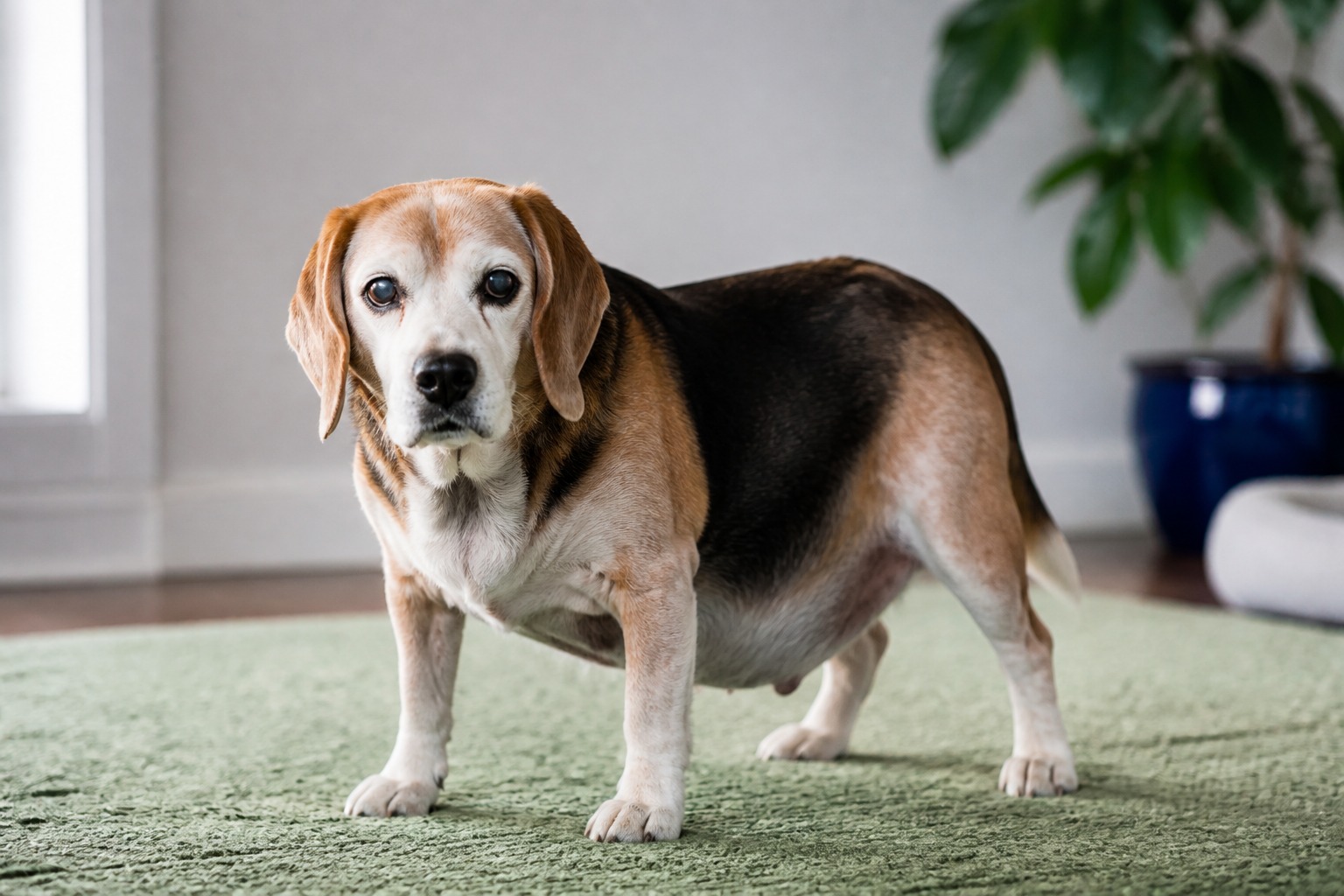
Your senior dog is drinking more, the belly is getting rounder, the coat looks a little thin, and they seem hungry all the time. It is the easiest thing in the world to file all of that under “getting old” and move on. That instinct is exactly why Cushing’s disease so often goes uncaught for months, and why this article leads with the symptoms instead of the science. Cushing’s is a case where the disease disguises itself as aging so convincingly that the diagnosis usually hinges on whether an owner trusts the feeling that something is off.
When someone tells me their older dog is suddenly drinking gallons of water and developing a pot belly, that is the moment my radar goes up. None of those signs are dramatic on their own. Together, in a senior dog, they are a pattern worth testing for.
So let us start where you actually are, watching your dog, before we get to what is happening inside them.
The cluster of signs that should prompt a vet visit
Cushing’s disease produces a wide range of clinical signs, and any one of them, in isolation, is easy to explain away. The tell is the cluster. Watch for a group of these appearing together in an older dog:
- A real jump in thirst and urination. The most common and earliest sign. The water bowl empties faster, bathroom trips multiply, and a previously house-trained dog may start having accidents.
- A bigger appetite than usual. A hearty appetite reads as good health, which is exactly why this one slips past owners. In this context it is a symptom, not reassurance.
- A pot-bellied, sagging appearance. The abdomen looks distended even as the dog may be losing muscle elsewhere.
- A thinning, dull coat and thin skin. Hair grows back slowly or not at all, and the skin can look papery.
- Skin changes. Blackheads, or a darkening of the skin, and sometimes recurrent skin infections.
- Muscle weakness or loss. Less stamina, a harder time on stairs, a generally weaker frame.
Because these arrive gradually, the human brain smooths them into a story about age. Push back on that story. If you can check several of these boxes, an exam is warranted, and the reason it is worth the trip is what untreated Cushing’s can lead to: advanced or unmanaged disease raises the risk of bladder stones, diabetes, and dangerous blood clots in the lungs. Early is genuinely better here.
What’s actually going wrong: too much cortisol, three ways
Cushing’s disease, known formally as hyperadrenocorticism, is a hormone imbalance caused by too much cortisol circulating over a long stretch of time. Cortisol comes from the adrenal glands, two small glands perched on top of the kidneys, and in a healthy dog it surges during stress to fuel a fight-or-flight response and then recedes. In Cushing’s, the body is bathed in cortisol nearly all the time, and that chronic exposure is what slowly breaks things down.
The cause matters, because each of the three types is managed differently.
A pituitary tumor (about 85 percent of cases). The pituitary is the brain’s master gland. It normally senses when cortisol is dropping and sends a chemical signal, ACTH, telling the adrenals to make more, then shuts that signal off once levels are restored. In pituitary-dependent Cushing’s, a small, almost always benign tumor keeps the pituitary stuck in the “make more” position, ordering the adrenals to overproduce cortisol even when there is already far too much. This is the form most dogs have.
An adrenal tumor (about 15 percent of cases). Here the problem is the adrenal gland itself, where a tumor drives it to pump out steroids on its own, ignoring the pituitary’s signals to stop. These tumors are usually larger and often visible on ultrasound, and they can be benign or cancerous. A side effect: the pituitary, sensing all that cortisol, stops sending ACTH, so the dog’s other, healthy adrenal gland shrinks from disuse.
Iatrogenic Cushing’s (from medication). The third form is not a disease inside the dog at all. It results from long-term use of steroids or steroid-containing medications. Over time the pituitary reads the incoming drug as the body’s own cortisol and stops signaling; the adrenals power down and shrink, temporarily losing the ability to make cortisol on their own. That is precisely why a vet has you taper steroids rather than stopping cold, the glands need weeks to months to wake back up, and an abrupt stop can trigger a dangerous crash.
Getting a diagnosis is deliberately careful
Cushing’s is not diagnosed on a hunch, because its signs mimic so many other conditions. Your vet will start with history, a physical exam, and baseline bloodwork, then move to confirmatory hormone tests and, ideally, an abdominal ultrasound. Several specific tests are usually needed, not just to confirm the disease but to pin down whether the source is the pituitary or an adrenal gland, since that distinction dictates treatment. It is a multi-step workup on purpose; a false diagnosis here means putting a dog on a powerful drug they do not need.
Treatment, and the one FDA-approved drug behind it
This is where a bit of current, concrete information helps, because “there is treatment” is vaguer than it needs to be.
For the common pituitary-dependent form, the medication is trilostane, sold as Vetoryl, and it is the only FDA-approved drug for canine Cushing’s disease in the United States. It works by dialing down the adrenal glands’ cortisol production, and it is given daily, usually for life. Adrenal tumors are a different conversation: a single benign one may be a candidate for surgical removal, which can be curative, while cancerous or spread tumors are managed based on the individual case. Iatrogenic Cushing’s is “treated” by carefully tapering off the offending steroid.
The part owners underestimate is monitoring, and it is worth understanding because it shapes your vet visits. A dog starting trilostane is not simply dosed and sent home. Per the drug’s labeling, follow-up bloodwork and an ACTH-stimulation test are done about 10 to 14 days after starting, again at 30 and 90 days, and every three months after that, and critically, the test is timed for 4 to 6 hours after the pill, when cortisol is at its lowest, so the vet can catch any over-suppression before it becomes dangerous. Many specialists now supplement or lean on a simpler “pre-pill” cortisol reading paired with a close home diary of the dog’s symptoms, which tracks day-to-day control well and spares some of the cost and hassle of repeated stimulation tests. The practical takeaway for you: expect regular rechecks, and keep notes on thirst, appetite, and energy between them, because your observations are part of the dosing decision.
What the outlook actually is
The prognosis depends on the type and the response to treatment, and for the common form it is more hopeful than the diagnosis sounds. Pituitary-dependent Cushing’s generally carries a good prognosis; with appropriate therapy, typical survival is around two years, and at least 10 percent of dogs live four years or more. That reads better once you remember these are usually dogs already 10 to 12 years old at diagnosis, so treatment often buys a good stretch of comfortable senior life rather than a cut-short one. Dogs with benign adrenal tumors tend to do very well, and even those with contained cancerous tumors can have a fair to good outlook, which is the whole argument for catching it early.
The single most important thing to carry away is the one you started with: when an older dog’s thirst, appetite, body shape, or coat shift noticeably, resist the reflex to call it age. Get it checked. Cushing’s is very manageable when it is caught and monitored well, and the earlier that clock starts, the more good time it tends to buy.
References
- Behrend, E.N., et al. “Diagnosis of Spontaneous Canine Hyperadrenocorticism: 2012 ACVIM Consensus Statement (Small Animal).” Journal of Veterinary Internal Medicine, vol. 27, no. 6, 2013, pp. 1292–1304. doi.org/10.1111/jvim.12192
- U.S. Food and Drug Administration. “VETORYL (trilostane) Capsules, Freedom of Information Summary and Label.” fda.gov
- “Trilostane for Dogs With Hyperadrenocorticism.” Today’s Veterinary Practice. todaysveterinarypractice.com
Common questions
What's the first sign of Cushing's disease in a dog?
Usually a noticeable jump in thirst and urination, a dog suddenly draining the water bowl and needing more bathroom trips or having accidents. Because that creeps in gradually and looks like aging, it's the sign most often dismissed. A pot-bellied appearance, increased hunger, and a thinning coat commonly follow.
How is Cushing's disease treated in dogs?
The most common pituitary-dependent form is treated with trilostane (brand name Vetoryl), the only FDA-approved medication for canine Cushing's, given daily and adjusted with periodic bloodwork. Adrenal tumors may be candidates for surgery. Treatment is about controlling cortisol and keeping the dog comfortable, with regular monitoring to avoid over-suppression.
Not a substitute for your vet. Our guidance is educational. For urgent symptoms, contact a vet or emergency clinic right away. Editorial standards
Dr. Mehta is a board-certified veterinary nutritionist who evaluates pet food formulations, ingredient quality, and the science behind dietary trends. He writes and reviews all nutrition content at The Pet Times, including our food rankings and feeding guides.
Meet our experts ↗Keep reading
 Health & WellnessYou'd Expect Giant Breeds to Get the Most Cancer. A Big Study Says It's the Middle.Dr. Mara Chen · 6 min
 Health & WellnessThat Red Rash on Your Dog's Belly Is Trying to Point SomewhereDr. Nina Kohl · 6 min
 Health & WellnessThere's No One Drug for Dog Arthritis. Here's the Whole Menu.Dr. Ravi Mehta · 9 min
 Health & Wellness"Kennel Cough" Isn't a Disease. That's Why Every Outbreak Feels Like the End of the World.Dr. Ravi Mehta · 8 min
 Health & WellnessA Dog Who Eats Rocks Can Be in Surgery by TomorrowDr. Ravi Mehta · 7 min
 Health & WellnessYour Dog's Lip Lick Means Nausea or 'Please Back Off.' Learn to Tell.Dr. Priya Nair · 7 min