


Most Dog Sneezes Are Nothing. Three Are a Same-Day Vet Visit.
A dog's nose is a filter running twenty-four hours a day, so sneezing is mostly just the filter working. Here's how to sort the harmless from the eight real causes, and the three patterns that mean you go today.

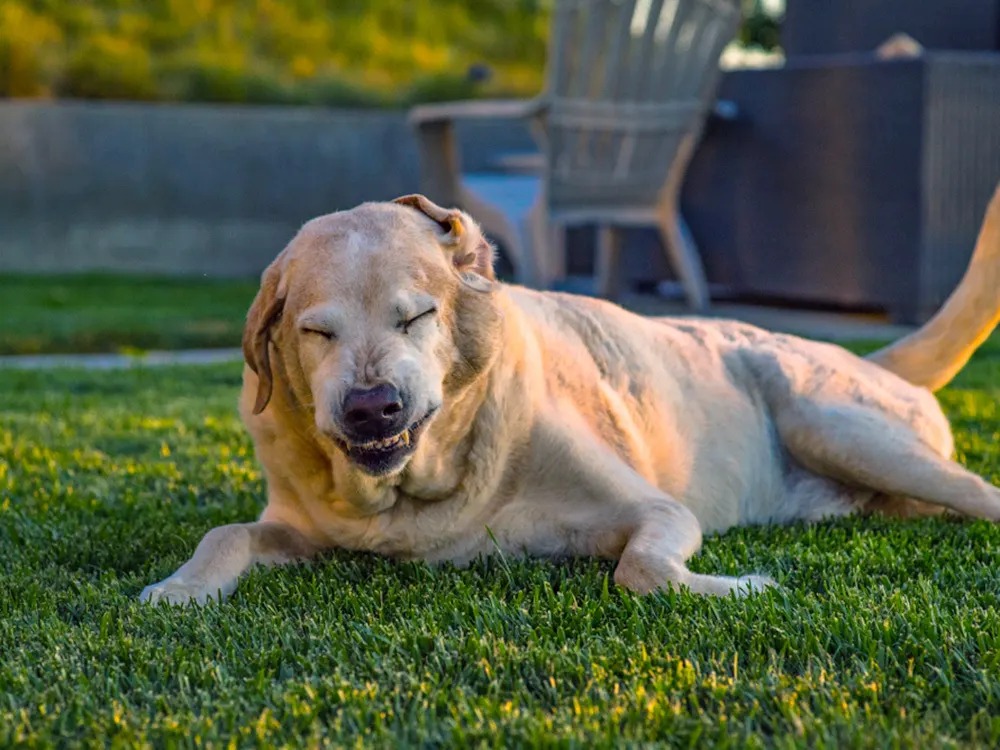
Your dog spends the day with their nose in things. Grass, dirt, other dogs, the underside of the sofa, whatever that was on the sidewalk. The nose is a filter running constantly, and a sneeze is the filter clearing itself.
Which is why almost all dog sneezing is nothing, and why the standard advice — “sneezing can be a sign of a serious problem, see your vet” — is technically true and practically useless. It leaves you unable to tell the difference between a dog who inhaled a bit of leaf and a dog with a grass awn migrating toward their brain.
So let’s sort it properly. Here is what causes the sneezing, and then, at the end, the three specific patterns where you stop reading and pick up the phone.
What a sneeze is doing
A sneeze is an expulsion. Something is irritating the nasal lining, and the body fires a high-pressure blast of air to eject it.
For most triggers, this works on the first or second try. A crumb of dirt, a seed head, pollen, a strong smell, dust, cigarette smoke, perfume, a cleaning product, or a lungful of water from the bath — the dog sneezes, the irritant leaves, the dog forgets it happened.
A “sneezing attack” is what you get when the irritant won’t clear: a run of hard, persistent sneezes, during which the dog stays alert and responsive but cannot stop. Sometimes the offending object shoots out. Sometimes you just get a fine mist of dog snot on a surface you liked.
The key intuition to carry forward: sneezing that stops usually means the problem left. Sneezing that stops after a very violent fit, with no object recovered, sometimes means the problem went the other way.
The eight causes, from harmless to serious
1. Play-sneezing
The little snort your dog fires off mid-wrestle. This isn’t really about the nose. It appears to be communication — a signal to the other dog that this is a game and nobody is being serious. Small dogs do it more. You will also see it during zoomies, apparently out of sheer joy. Nothing to do here except enjoy it.
2. Reverse sneezing
The one that sends people to the emergency room. It is not a sneeze at all; the dog snaps their head forward, extends their neck, and makes a rapid series of violent honking inhales. Vets call it inspiratory paroxysmal respiration. It’s a spasm of the soft palate and throat, the airway narrows, and the noise is genuinely alarming the first time you hear it.
Most episodes last under a minute and end on their own. It’s triggered by many of the same things as a normal sneeze — excitement, pulling on a collar, irritants, allergens. It is generally harmless. What warrants a look is a dog whose episodes are getting longer, more frequent, or newly frequent in adulthood, because something may be irritating the back of the throat.
3. Plant material, and specifically foxtails
This is the cause that punches above its weight and the reason I’d rather you finished this article.
A foxtail is a dried grass awn, and it is shaped like a fishhook: barbed, so it moves in exactly one direction, which is forward. A dog who snuffles one up sneezes furiously for a few minutes and then stops. The universal human reaction is relief: they got it out.
Often they did. Sometimes the sneezing stopped because the awn has traveled further in, and it will keep traveling. Foxtails migrate. They get into sinuses, into the brain, into the chest cavity, into the lungs. They do not dissolve and they do not come back out.
Tells: a violent sneezing fit that starts right after a walk in dry summer grass, a dog pawing at one side of their face, and sometimes a single spot of blood at the rim of one nostril. Do not try to fish around in there yourself — it’s painful, it’s ineffective, and the dog won’t let you. Go in. The longer it sits, the deeper it goes and the worse the retrieval.
The sneezing stopping is not the same as the problem stopping, and with grass awns that distinction can cost a dog an eye or worse. If the fit was violent and it happened in dry grass, I would far rather look and find nothing than have you come back to me in three weeks with an abscess.
4. Allergies
Dogs get environmental allergies to pollen, grass, dust mites, mold, and household chemicals, and sneezing is one of the milder ways it shows up. What’s distinctive about canine allergy is that it tends to come out through the skin and ears more than the nose — an allergic dog usually itches, licks their paws, and gets recurrent ear infections, with the sneezing as a side note. If the sneezing is seasonal and accompanied by itching, allergy is a reasonable bet, and there are good treatments now.
5. Infections
Viral, bacterial, and fungal. Canine distemper and parainfluenza both increase nasal discharge and sneezing. Bordetella, the kennel cough bacterium, can produce sneezing alongside the honking cough. Aspergillosis is a fungal infection of the nasal cavity, contracted from inhaling Aspergillus spores from soil and dust, and it is a nasty one: it destroys the tissue inside the nose, and its calling card is chronic sneezing with a thick, often bloody discharge, usually starting on one side.
The pattern to notice with infections: the sneezing is persistent and it produces something — mucus, pus, blood — and the dog is often off in other ways.
6. Nasal mites
Uncommon and easy to miss. Pneumonyssoides caninum is a mite about a millimetre long that lives in the nasal passages and sinuses. Dogs who dig with their faces pick them up from soil. They are intensely irritating, they cause chronic sneezing, reverse sneezing, and nosebleeds, and they’re contagious between dogs. They’re treatable, but they need to be identified, which requires a vet who thinks to look.
7. Nasal cancer
The one nobody wants to read. Nasal tumors make up roughly 1 to 2% of canine cancers, and about 80% of them are malignant. Long-nosed breeds are the most susceptible — Collies, Dachshunds, and other dolichocephalic dogs — and both genetics and environmental exposure, including second-hand cigarette smoke, are implicated.
The presentation is a middle-aged or older dog with chronic sneezing that is getting worse, plus one or more of: nosebleeds, discharge from one nostril, noisy or difficult breathing, new loud snoring, facial swelling or asymmetry, and in advanced cases, seizures. The one-sided discharge and the nosebleed are the flags. A dog who has been sneezing for weeks and now has blood coming out of one nostril needs imaging, not a wait.
8. Dental disease
Genuinely counterintuitive, genuinely common. The roots of the upper carnassial teeth sit right up against the nasal cavity, separated by a thin plate of bone. An abscessed or badly infected upper tooth can erode through it, opening a channel into the nose. The result is a runny nose and sneezing that no amount of allergy treatment fixes, because the problem is a tooth.
If a dog has bad breath, tartar, and a persistently drippy nose, look in the mouth.
Breeds that just sneeze
Structure matters. Brachycephalic dogs — Bulldogs, Pugs, French Bulldogs, Boston Terriers — have had their nasal passages compressed into a skull that was never built for it, and the resulting snorting, snuffling, snoring, and sneezing is a baseline for them.
It is worth being clear-eyed about what that means. Brachycephalic obstructive airway syndrome is not a charming quirk; it’s a welfare problem, and it exists on a spectrum from mildly noisy to genuinely unable to breathe under exertion. If your flat-faced dog’s noise is escalating, or they’re struggling in heat or during exercise, that is a surgical conversation, not a “they’ve always sounded like that.”
The three that go today
Everything above is the map. Here’s the shortcut.
One. A violent sneezing fit that starts right after a walk in dry grass, especially in summer, especially if it stopped as suddenly as it started. Assume foxtail until proven otherwise.
Two. Blood, or thick coloured discharge, coming from one nostril. One-sided is the word that matters. Both nostrils suggests something systemic and generally less sinister. One nostril suggests something is in there — a foreign body, a fungal infection, or a tumor.
Three. Sneezing alongside laboured breathing, facial swelling, collapse, or a dog who is clearly unwell — lethargic, feverish, not eating. The sneeze in that case is a footnote to a bigger problem.
Beyond those, call if the sneezing is new and persistent, if it’s getting worse over weeks, or if it’s paired with nosebleeds, loss of appetite, coughing, or a change in the dog’s breathing noise. Chronic, worsening, and one-sided are the three adjectives worth taking seriously.
Everything else is very likely a dog whose nose was somewhere it shouldn’t have been. Which is, after all, the job.
References
- Nasal Mites in Dogs — Merck Veterinary Manual.
- Nasal Tumors in Dogs — American College of Veterinary Surgeons.
- Foxtails: A Seasonal Hazard for Dogs — UC Davis School of Veterinary Medicine.
- Sinonasal Aspergillosis in Dogs — Merck Veterinary Manual.
- Brachycephalic Obstructive Airway Syndrome — Royal Veterinary College VetCompass.
Common questions
Why does my dog sneeze when we play?
That's play-sneezing, and it's a communication signal rather than a nasal event. Dogs appear to use it to punctuate rough play with a message along the lines of 'this is a game, I'm not serious.' It's most common in smaller dogs, it happens mid-romp, and it needs no treatment at all.
What is reverse sneezing, and is it dangerous?
Reverse sneezing is a spasm at the back of the throat that produces a violent, honking inhale. It sounds appalling and is usually harmless, and most episodes resolve in under a minute on their own. Frequent or lengthening episodes should be checked, because they can point to something irritating the back of the throat or nasal passages.
My dog inhaled a foxtail. Will they sneeze it out?
Often not, and this is the trap. A dog who inhales a grass awn typically sneezes hard for a few minutes and then stops, which people read as success. Sometimes it means the awn has migrated deeper. Foxtails have barbs that only allow one direction of travel, and they can migrate into the sinuses, the brain, or the chest. If you think one went up the nose, go to the vet the same day.
When is dog sneezing an emergency?
Go the same day for: a sudden violent fit after a walk in dry grass, bloody or one-sided discharge from a single nostril, and sneezing paired with labored breathing, facial swelling, or collapse. Those three are the ones that don't wait.
Not a substitute for your vet. Our guidance is educational. For urgent symptoms, contact a vet or emergency clinic right away. Editorial standards
Dr. Mehta is a board-certified veterinary nutritionist who evaluates pet food formulations, ingredient quality, and the science behind dietary trends. He writes and reviews all nutrition content at The Pet Times, including our food rankings and feeding guides.
Meet our experts ↗Keep reading
 Health & WellnessThe 'Miracle' Antibiotic for the Mystery Dog Illness Isn't a Cure. It's a Last Resort.Dr. Lena Park · 6 min
 Health & WellnessYour Dog's Squint Isn't a Smile. Count the Eyes.Dr. Mara Chen · 7 min
 Health & WellnessEye Gunk Is Normal. The Color and the Count Tell You When It Isn't.Dr. Ravi Mehta · 9 min
 Health & WellnessWhen an Old Dog's Bark Goes Hoarse, It's Rarely Just a Sore ThroatDr. Lena Park · 7 min
 Health & WellnessThat Goose-Honk Cough Is a Warning. Here's What a Collapsing Trachea Really Needs.Dr. Ravi Mehta · 9 min
 Health & WellnessBlood in Your Dog's Pee: What the Color, Timing, and Stream Are Telling YouDr. Amara Solis · 9 min