


Your Dog's Squint Isn't a Smile. Count the Eyes.
A soft, half-closed gaze can mean your dog is blissed out, or it can mean the cornea is ulcerating. The difference is visible in about four seconds, and almost nobody looks for it.

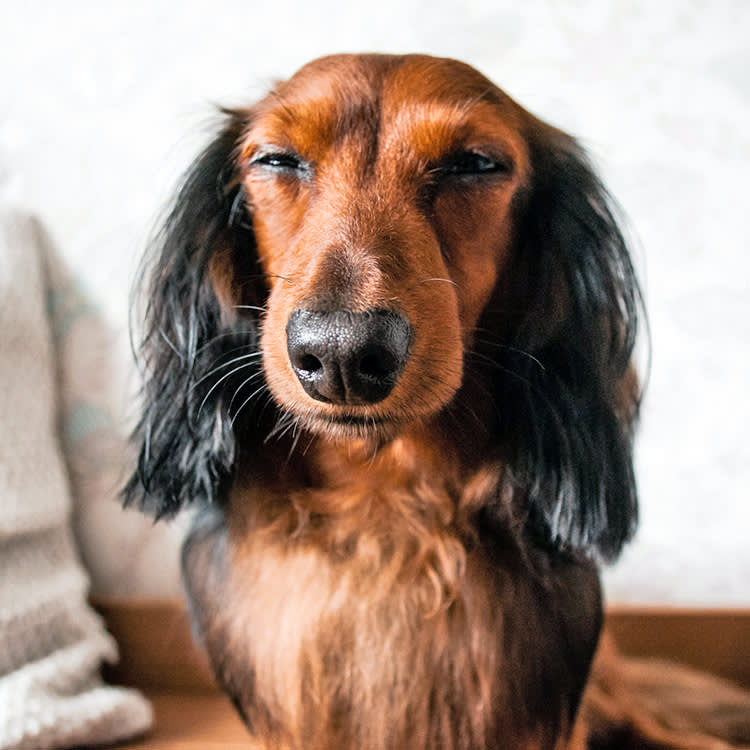
Your dog looks up at you with soft, half-closed eyes and you feel it in your chest. That’s love, right there.
Maybe. It might also be the first sign of a corneal ulcer, and the reason so many of them are caught late is that a hurting eye and a happy one make almost the same face.
Here’s the thing nobody tells new dog owners: the eye is the one organ where a real emergency wears the costume of a cute expression. Dogs don’t grimace, they don’t clutch their face, and they don’t tell you. They squint. So the useful question isn’t “what does my dog’s squint mean.” It’s “which kind of squint am I looking at,” and you can answer it in four seconds without touching anything.
Count the eyes
Almost everything you need is in this one check.
A contented squint is symmetrical. A painful squint usually isn’t.
Stand where your dog can see you and look at both eyes together, not one at a time. A relaxed dog narrows both eyes evenly, the same amount, and the rest of the face comes along for the ride: smooth brow, loose mouth, ears at ease. It’s a whole-body softness that happens to include the eyes.
A dog in eye pain does something different. One eye closes harder than the other, or one shuts completely while the other stays open. The lid may flutter. The brow above that eye tenses instead of relaxing. And it doesn’t come and go with mood.
Which leads to the second half of the test.
Try to interrupt it. Pick up the leash, open the treat drawer, say the word. A happy squint evaporates instantly, because it was never about the eye. A painful squint survives the distraction, because the eye is still hurting whether or not there’s cheese involved.
The five signs that turn a squint into a phone call
Any one of these, on its own, means you call the vet rather than watch and wait:
- One eye, not two. Asymmetry is the single loudest signal.
- Pawing or face-rubbing. Dogs rub an eye against carpet, furniture, or their own leg when it burns. This is also how a small problem becomes a big one.
- Light avoidance. Turning away from a sunny window, ducking under the coffee table, flinching at a lamp.
- Any color change. Redness in the whites, a bluish haze or cloudiness across the surface, a yellow or green tint, or discharge that isn’t clear.
- A visibly changed eye. One eye that looks bigger, bulgier, or duller than the other.
“The squint is the dog’s only word for it, so people read it as a mood and give it a week,” says Dr. Amara Solis. “By the time an owner tells me the eye also looks a little cloudy, we’re not treating an irritation anymore. If one eye is doing something the other one isn’t, that is not a personality trait. That’s a symptom.”
Why the eye earns this much paranoia
Because the clock runs fast on it.
Corneal ulcers are the common villain here, and they are not rare. Roughly one in every hundred dogs is treated for a corneal ulcer in a given year, and the risk is wildly unevenly distributed. Flat-faced dogs sit at the deep end: research from the Royal Veterinary College’s VetCompass program found brachycephalic breeds are around 20 times more likely to develop corneal ulcers than dogs with longer muzzles, with Pugs the most affected breed of all. It is a design problem. A shallow eye socket, big exposed eye, and an incomplete blink leave the cornea both more exposed and less lubricated.
An ulcer is an abrasion on the clear front window of the eye. Shallow ones often heal in days with the right drops. Deep ones can perforate. The gap between those two outcomes is frequently measured in how long the owner waited, which is why a squint you’d have shrugged off on a Labrador is a same-day call on a Pug, a Shih Tzu, a Boston Terrier, or a Frenchie.
Two other conditions worth knowing by name:
Dry eye (keratoconjunctivitis sicca) is chronic under-production of the watery part of tears. It looks like a dog who squints on and off, has thick gunky discharge, and whose eyes seem perpetually irritated. It’s manageable, and it gets worse without treatment.
Glaucoma is pressure building inside the eye, and it is genuinely an emergency. It is intensely painful, it can blind an eye in a day or two, and it often shows up as a squinting, red, cloudy eye in a dog who suddenly wants nothing to do with the world. If the eye also looks enlarged, go now, not tomorrow.
The thing you must not do
Do not reach for the eye drops left over from the last problem. If those drops contain a steroid and there’s an ulcer on the cornea, you can turn a scrape into a hole. Steroids suppress the healing of an ulcerated cornea and let infection dig deeper. This is one of the most common ways a treatable eye becomes a lost eye, and it’s always well-intentioned.
Saline flush is the only thing safe to reach for without a vet, and only if you suspect debris.
What actually prevents this
Most eye trouble arrives through the front door, so the prevention is boring and effective.
- Check the eyes after every outdoor session. Ten seconds. You’re looking for symmetry, clarity, and anything stuck. Grass seeds and burrs are relentless.
- Flush with pet-safe sterile saline, not tap water, if you see dust or debris. Rinse gently from the inner corner outward.
- Supervise rough play with sticks and branches. A huge share of corneal trauma is a stick to the face during a joyful moment.
- Get a real baseline. Ask your vet what your dog’s normal tear production looks like, especially for breeds prone to dry eye. You cannot spot a change you never measured.
- Consider dog goggles for the high-risk dogs. They look ridiculous. They also work, and for a flat-faced dog who rides with their head out the window or hikes in brush, they’re cheap insurance.
What newer research adds
The most useful recent shift is that the risk is now well quantified rather than folk wisdom. Large-scale primary-care data has replaced the vague sense that “flat-faced dogs get eye problems” with numbers: the VetCompass work put brachycephalic dogs at roughly 20 times the corneal ulcer risk of other dogs, and separate case reviews have found flat-faced dogs are also more likely to end up with the complicated, slow-healing kind of ulcer rather than the simple kind.
There’s also growing interest in surgery as prevention rather than repair. A 2025 study looked at medial canthoplasty, a procedure that narrows an over-large eye opening, and measured whether it reduced tear-film problems and ulcers in flat-faced dogs afterward. That is worth knowing if you have a Pug or a Frenchie who has already had one ulcer, because a second one is likelier than a first, and “wait and see” is not the only option on the table.
None of this changes what you do at home. It just changes how fast you should do it.
The short version
A soft, symmetrical, interruptible squint is your dog enjoying being alive next to you. Enjoy it back.
One eye squinting harder than the other, surviving distraction, with pawing, light avoidance, redness, or cloudiness, is an eye asking for help in the only language it has. Count the eyes. It takes four seconds and it’s the whole diagnosis.
References
- O’Neill, D.G., et al. “Corneal ulcerative disease in dogs under primary veterinary care in England: epidemiology and clinical management.” Canine Genetics and Epidemiology, 2017. VetCompass, Royal Veterinary College
- “Evaluation of corneal ulcer type, skull conformation, and other risk factors in dogs: A retrospective study of 347 cases.” Frontiers in Veterinary Science, 2023. PMC
- “Understanding and Addressing Brachycephalic Ocular Syndrome.” Today’s Veterinary Practice. todaysveterinarypractice.com
- “Managing Canine Corneal Ulcers.” Today’s Veterinary Nurse. todaysveterinarynurse.com
- “Effects of Canthoplasty in Preventing Secondary Ocular Surface Lesions in Brachycephalic Dogs.” Veterinary Sciences, 2025. MDPI
Common questions
My dog squints at me when I talk to them. Should I worry?
Usually not. Dogs narrow their eyes while reading a face, the same way you do when you're listening hard. Look for the rest of the picture: a loose body and a relaxed mouth mean they're concentrating, not hurting.
How long can I wait before calling the vet about a squint?
If one eye is squinting, it is held tighter shut than the other, or your dog is pawing at it or hiding from light, do not wait at all. A soft, symmetrical, relaxed squint that comes and goes with mood needs no appointment. Anything in between gets a call within 24 hours.
Can I use old eye drops from a previous problem?
No. If those drops contain a steroid and the cornea is ulcerated, you can make a shallow scrape into a deep one. Never reuse ophthalmic medication without a vet looking at the eye first.
Not a substitute for your vet. Our guidance is educational. For urgent symptoms, contact a vet or emergency clinic right away. Editorial standards
Dr. Chen is a small-animal veterinarian who leads health and safety coverage at The Pet Times. She writes and reviews the bulk of our illness, condition, and safety content, translating clinical guidance into clear, practical advice owners can act on at home.
Meet our experts ↗Keep reading
 Health & WellnessParvo in Dogs: Two Levers Decide Whether Your Puppy LivesDr. Priya Nair · 7 min
 Health & WellnessYour Puppy Just Threw Up. Here's How to Tell 'Wait and See' From 'Vet Now.'Dr. Lena Park · 7 min
 Health & WellnessMost Dog Shaking Is Harmless. Here's the Kind That Isn't.Dr. Amara Solis · 8 min
 Health & WellnessYour Dog's Red Eye: When to Treat It as an Allergy, and When to Assume the WorstDr. Amara Solis · 6 min
 Health & WellnessYour Dog Is Having a Seizure. Here's Exactly What to Do in the Next 90 SecondsDr. Mara Chen · 6 min
 Health & WellnessBlood From Your Dog's Rear: How to Read It in the First 60 SecondsDr. Priya Nair · 8 min