
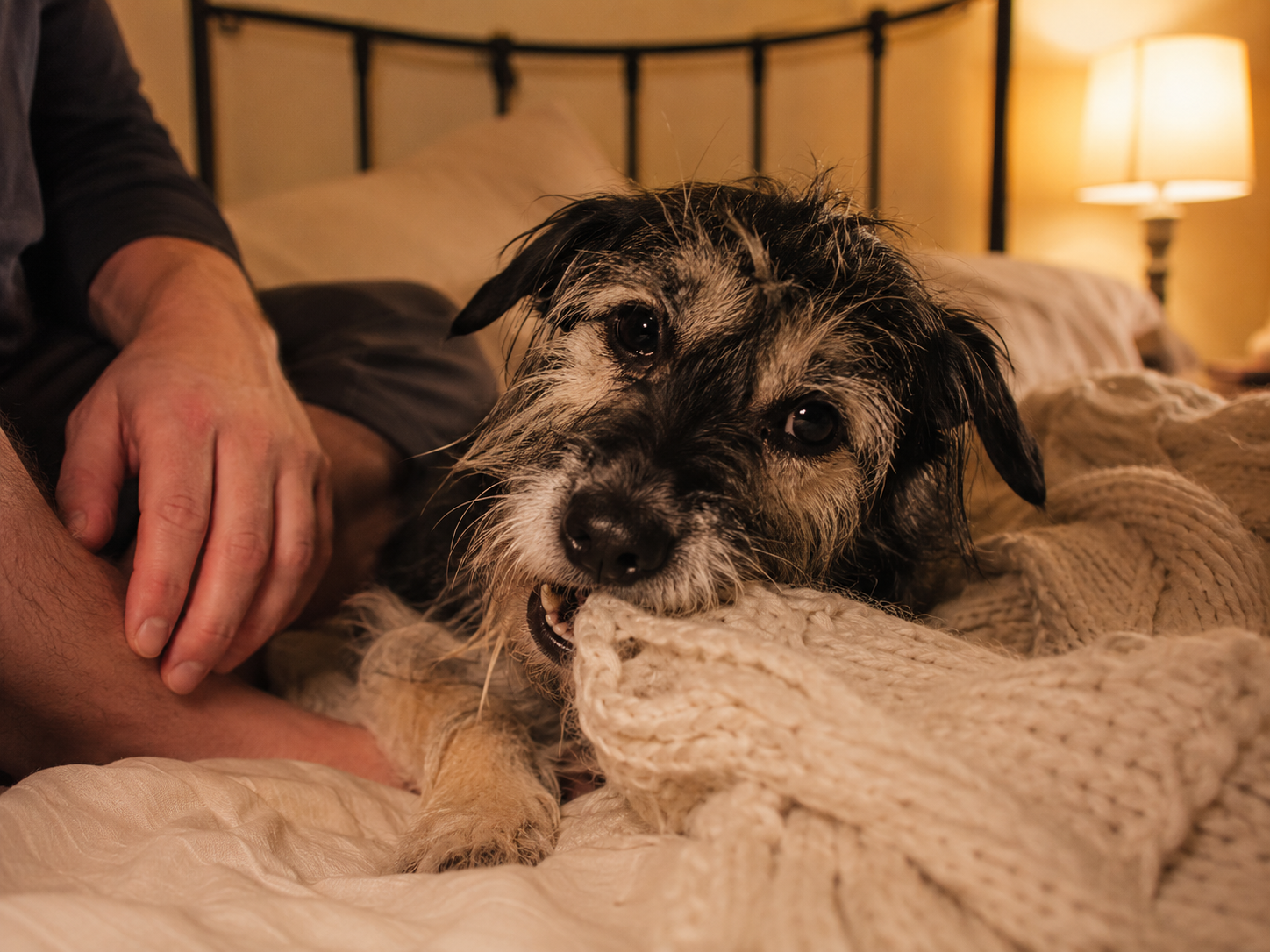
I am, by my own admission, a person with a blanket problem. It started as a love of textile design and grew into a habit of buying any quilt, comforter, or throw that caught my eye. My dog Leo has a blanket problem too, and his is directly related to mine. Every time I bring home something gorgeous, he chews a crater right through the middle of it, usually within twenty seconds of being left alone with it. Somewhere in the years of losing beautiful blankets to Leo, I learned a few things worth passing on.
The first and most important: Leo was never doing it to get back at me. Blanket chewing feels personal when it is your favorite quilt on the floor in pieces, but it is almost never spite. It is comfort-seeking, and once you understand that, the whole problem changes shape. The holes are the annoying part. The part that actually matters is whether the chewing ever crosses the line into eating the fabric.
Why blankets, of all things
Dogs are instinctive chewers who explore the world with their mouths, and blankets check several boxes at once. They are soft, they carry your smell, and the act of chewing on them does something chemically real.
“For a dog, gnawing on something soft is part stress ball, part toothbrush, part crossword puzzle. It lowers anxiety, works the teeth, and occupies a restless brain all at once,” says Dr. Lena Park. “In a teething puppy it also numbs sore gums. A blanket just happens to be the softest, most available target for an urge the dog already has.”
Put simply, dogs chew blankets as a boredom-buster, for stress relief, to soothe teething, for mental stimulation, and sometimes just because it feels good. None of those are misbehavior. They are needs. Which is why the goal is not to stamp the behavior out but to give it somewhere better to go, and to make sure it stays at “shredding” and never becomes “swallowing.”
The things that did not work (a cautionary tale)
I tried the obvious fixes first, and I will save you the trouble. Keeping Leo away from blankets worked for about a week; his talent for finding an unattended throw was almost admirable. Leave the bedroom door open for a minute to grab laundry, and there was a fresh hole. Doze off on the couch, and I would wake to a snowfall of down feathers.
I tried bitter deterrent spray next. The only creature it deterred was me, when my open mouth found a treated blanket mid-nap. Leo powered right through the taste. And my grand plan to redirect his devotion from blankets to toys mostly flopped too; unless the toy was something he could eat, like a bully stick or a stuffed Kong, his interest evaporated after twenty seconds.
The lesson buried in all that failure: you cannot really punish or gross a dog out of a comfort behavior. You have to work with the instinct, not against it.
What actually helps
Here is the approach that works, built around redirecting the urge rather than forbidding it. And a standing rule first: if the chewing ever turns into eating, skip straight to the vet, because swallowed fabric can cause a dangerous intestinal blockage.
Exercise, and then more exercise. A lot of destructive chewing is boredom wearing a costume. A well-exercised dog has less restless energy to pour into your linens. In Leo’s case he was already getting plenty, but for many dogs this alone dials the problem way down, and it is always the right starting point.
Give them a blanket of their own. Chewing is normal dog behavior, so trying to train against nature entirely is an uphill fight. One of the simplest fixes is to designate a specific blanket as theirs, one that is completely fine to gnaw and shred (assuming your dog shreds rather than eats). Yes, it will become a mess. But it will be their mess, and your good blankets stay intact.
Consider that it may be a phase. For some dogs, blanket chewing is an adolescent, teething-driven habit that eases with maturity. If your dog is young and still teething, a soft toy or a stuffie may be exactly the outlet they are reaching for.
Reach for a Kong. Few tools keep a dog as happily occupied as a stuffed, ideally frozen, Kong. It gives the chewing drive a legitimate, long-lasting job.
“Whatever you give them to chew, keep an eye on wear and tear,” says Dr. Lena Park. “Once a toy has been gnawed down to a size that could choke your dog or block their gut, take it away. And if your dog is biting off and swallowing chunks, that toy is not safe for them either.”
When to loop in your vet
Most blanket chewing is benign, but a few situations deserve a professional. Call your vet if the chewing is sudden and out of character, if it comes with signs of mouth pain or GI upset, if it only happens when your dog is left alone (a possible flag for separation anxiety), or, most urgently, if your dog is swallowing the fabric rather than just tearing it. When in doubt, a quick check-in beats an emergency.
What newer research adds
Veterinary behavior guidance has increasingly reframed chewing, blanket chewing included, as an enrichment need rather than a vice to correct. The current thinking is that dogs require daily outlets for chewing, foraging, and sniffing, and that destructive fabric-chewing often signals one of those needs going unmet, or, in some dogs, underlying anxiety. That is why so many trainers and vets now start with “what is this dog missing?” before reaching for any deterrent. The practical takeaway lines up with what Leo eventually taught me: give the urge a good home, watch that it never turns into swallowing, and make peace with sacrificing one designated blanket to keep the rest.
References
- American College of Veterinary Surgeons. “Gastrointestinal Foreign Bodies in Small Animals.” ACVS, www.acvs.org/small-animal/gastrointestinal-foreign-bodies.
- American Veterinary Medical Association. “Chewing and Destructive Behavior in Dogs.” AVMA, www.avma.org.