


Your Dog's Licking Is a Map. Here's How to Read What That Tongue Means
A dog who licks everything is not doing one thing, they are doing a dozen. Learn to read the licking by location and pattern so you can tell affection from allergy from anxiety, and know the line that calls for a vet.

Affiliate disclosure. This article contains affiliate links. We may earn a small commission if you buy through a link, at no extra cost to you. How we handle recommendations.
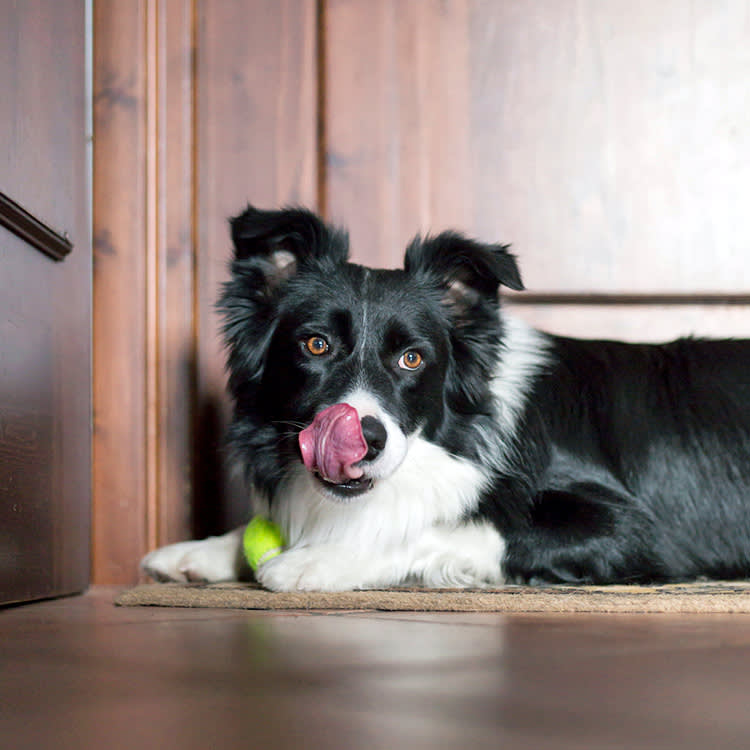
A dog who licks everything is not doing one thing over and over. They are doing a dozen different things that happen to look the same from across the room. The tongue that grooms a paw, greets your hand, explores the rug, and works at one itchy elbow is sending four separate messages, and the trick to living with a champion licker is learning to read them apart.
So before you try to stop the licking, get curious about it. Where is the tongue going, how often, and does it stop when you change something? Answer those and you usually have your answer, because in dogs, licking is location coded. The same behavior means affection in one spot, an upset stomach in another, and a developing skin problem in a third. Here is how to read the map.
The four jobs a tongue is built for
Dr. Amara Solis, a veterinarian who works with anxious and over-aroused dogs, likes to remind owners that licking is normal equipment doing normal work before it is ever a symptom.
“Before you treat licking as a problem, sort it into one of its real jobs,” Solis says. “A tongue gathers information, it grooms, it communicates, and it self-soothes. Most of what worries owners is one of those four behaving exactly as designed.”
The information job comes first. A dog’s tongue carries scent and taste molecules up to the vomeronasal organ, a chemical-reading patch on the roof of the mouth, which is why a dog will lick a patch of grass or your forearm and then stand there processing. That is reading, not misbehaving. The grooming job is the next most common: without hands, a dog uses the tongue to clean fur, and a dog who licks you may simply be folding you into that routine as a packmate.
The communication job is the one people most often misread. Puppies lick at their mother’s mouth to ask for food, and that early gesture matures into the social licking adult dogs use to greet, to defer to another dog, and to bond with their people. The fourth job, self-soothing, is where licking starts to drift toward trouble. The repetitive motion releases a small calming reward, much like a child’s thumb, so a bored or anxious dog can fall into licking simply because it feels good, and a behavior that feels good gets repeated until it becomes a habit.
Hold those four jobs in mind, because every spot your dog targets is one of them, plus the possibility of a fifth driver the jobs can mask: a physical problem.
The licking map: what each target usually means
This is the part that actually helps. Match the target to the likely message, then check it against the pattern test in the next section.
Hands, faces, and bare skin. Usually communication and taste. We are salty, we carry food residue and interesting scents, and licking us is both a greeting and a flavor. Dr. Solis notes it can also be a quiet deference signal, a dog telling you they are comfortable and not a threat. Worth a closer look only if a dog suddenly fixates on licking one person obsessively or licks at a wound, yours or theirs.
The floor. Most often a spill you cannot see, since a dog smells food particles long after you have wiped. But sudden, driven floor licking is one of the clearest stomach-trouble flags in dogs. Veterinary researchers studying dogs who compulsively licked surfaces found that a majority had an underlying gastrointestinal problem, and treating the gut resolved the licking in most of them. New, intense floor work deserves a vet’s ear, not a deterrent spray.
The air. A dog snapping or licking at empty air like a lizard is rarely random. Check for nausea, dental pain, a foreign object stuck in the mouth, focal seizures, or anxiety. Frequent air licking is a symptom to report, full stop.
Furniture, walls, and bedding. Texture, residual smell, and, when it turns repetitive, boredom. A couch holds the day’s odors no matter how clean your house is, so a sniff-and-lick pass is ordinary. A dog who works the same cushion for long stretches is usually under-stimulated.
Toys. Toys are flavored and textured to be licked, so this is often pure enjoyment. It can also be comfort licking, the canine version of holding a security blanket, especially at rest.
Other dogs. Social bonding, grooming, and hierarchy. Lower-ranking dogs often lick higher-ranking ones to keep the peace. Normal, unless one dog is fixating on another’s ears or eyes, which can mean an infection in the dog being licked.
Their own body, one fixed spot. This is the target that most often turns out to be medical. A paw, a flank, the base of the tail, the genitals: persistent licking of a single location points to allergy, irritation, pain, or infection far more often than to a mood.
The pattern test that sorts behavior from medicine
Location narrows it down. Pattern decides it. Run any worrying licking through three quick questions.
First, is there a trigger you can name? Behavioral licking usually has one, a guest, a toy, a quiet evening with nothing to do, and it stops when the trigger passes. Medical licking has no off switch tied to the environment.
Second, can you interrupt it and have it stay interrupted? If you redirect your dog and they settle, you are likely looking at a habit. If they resume within seconds, the way you would scratch an itch the moment a distraction ended, suspect a physical driver. As Dr. Solis puts it, an itch you cannot reach does not go away because someone said no.
Third, is it married to other signs? Stomach noise, drooling, gulping, scooting, head shaking, hair loss, or a raw patch all push the verdict toward medical. A relaxed dog with normal eating and a waggy disposition who licks the rug when bored is a different case from a dog who licks the floor and then refuses dinner.
When a habit becomes a wound
The reason a single-spot lick is worth taking seriously is that it can build its own injury. The cycle is mechanical. Constant friction and moisture break down the skin’s barrier, the raw skin itches and hurts, the discomfort prompts more licking, and the area thickens into a firm, often infected sore. Veterinarians call the result a lick granuloma, or acral lick dermatitis, and once it sets in it rarely resolves on its own.
“A lick granuloma is a loop, not a wound that simply heals,” Solis says. “You have to treat the skin and the reason the dog started, the allergy, the joint pain underneath, or the anxiety, or it comes right back the moment the bandage is off.”
That is why catching a fixed-spot lick early matters more than catching a floor-licker. The behavior is the same tongue, but the stakes are different.
When to call the vet
Use this as a threshold list. Any one of these earns a call.
- Licking that has worn down one spot to redness, thinning fur, or a raw or thickened patch.
- Sudden, intense licking of the floor, walls, or air that was not there before.
- Licking paired with drooling, lip smacking, gulping, or refusing food, which can signal nausea or dental pain.
- Licking one body area along with scratching, head shaking, scooting, or an odor, the allergy and infection picture.
- Licking you cannot interrupt, or that your dog returns to within seconds every time.
- Any air licking that happens often, especially with a glazed or absent look, which can be neurological.
How to redirect the licking that is just a habit
Once a vet has ruled out a medical cause, or for the everyday boredom licking that never crossed a threshold, the fix is to outcompete the behavior rather than punish it.
Start with output. A dog with enough physical exercise and mental work licks less, because the self-soothing reward matters most to an under-stimulated brain. Walks, training games, scent work, and food puzzles all spend the energy that would otherwise go into the carpet.
Then give the tongue a legal job. A long-lasting chew or a treat-loading toy channels the same motion somewhere useful, and you reward the swap the instant it happens. A frozen, fillable toy like the Woof Pupsicle is built for exactly this, since it turns licking into a slow, satisfying project instead of a nervous tic. Pair the redirection with a simple, consistent cue like “leave it,” and reward the calm that follows rather than scolding the lick.
For furniture and surfaces, a pet-safe bitter deterrent spray makes the target unrewarding, and for licking rooted in anxiety, calming aids such as pheromone diffusers or a snug pressure wrap can lower the baseline arousal that feeds the habit. If anxiety is clearly driving it, your vet can talk through whether medication belongs in the plan.
The bottom line
Stop thinking of your dog as a dog who licks everything, and start thinking of each lick as a labeled message. Affection lands on your hands. Boredom lands on the couch. An upset stomach lands on the floor or the air. And a real problem, the kind worth a vet’s time, lands on one fixed spot, over and over, with no off switch. Read the map and you will almost always know which message you are getting, and what, if anything, to do about it.
Frequently asked questions
When is my dog’s licking worth a vet visit?
Book a visit if your dog licks one spot on their body so persistently it causes redness, thinning fur, or a raw patch, or if licking of the floor, air, or lips comes on suddenly or pairs with drooling, gulping, or appetite changes. Those patterns can point to allergies, pain, nausea, dental disease, or a neurological issue.
How can I tell whether the licking is medical or behavioral?
Look at consistency and location. A behavioral lick usually has a trigger you can spot and stops when the trigger ends. A medical lick tends to fixate on one body spot or comes with other signs like itching, drooling, or stomach noise, and is hard to interrupt. When the pattern is fixed and hard to break, treat it as medical until a vet says otherwise.
What if my dog goes right back to licking the moment I stop them?
An itch you cannot reach does not go away because someone said no. A dog who resumes within seconds of an interruption is usually driven by a physical sensation or a compulsive loop, not a choice, and that is a reason to call your vet rather than keep correcting.
Could my dog be licking surfaces because they feel sick to their stomach?
Yes. Sudden, intense licking of floors, walls, or the air is a recognized sign of nausea and gastrointestinal discomfort in dogs. If it appears out of nowhere, mention it to your vet rather than treating it as a quirk.
Does licking always mean my dog is anxious?
No. Most licking is ordinary exploration, grooming, and affection. It only points to stress when it becomes repetitive and self-soothing, often paired with other anxious body language, and even then the location of the licking can reveal a physical cause instead.
References
- Bécuwe-Bonnet, Virginie, et al. “Gastrointestinal Disorders in Dogs with Excessive Licking of Surfaces.” Journal of Veterinary Behavior, vol. 7, no. 4, 2012, pp. 194-204.
- “Lick Granuloma (Acral Lick Dermatitis) in Dogs.” VCA Animal Hospitals, vcahospitals.com/know-your-pet/lick-granuloma-in-dogs.
- Overall, Karen L. Manual of Clinical Behavioral Medicine for Dogs and Cats. Elsevier, 2013.
Dr. Chen is a small-animal veterinarian who leads health and safety coverage at The Pet Times. She writes and reviews the bulk of our illness, condition, and safety content, translating clinical guidance into clear, practical advice owners can act on at home.
Meet our experts ↗Keep reading
 TrainingAggression Is Not Dominance. It's a Request for Distance That You Missed.Dr. Mara Chen · 11 min
 TrainingDog Anxiety Isn't One Thing. That's Why Treating It Like One FailsDr. Nina Kohl · 8 min
 TrainingYour Dog Follows You to the Bathroom. Here's How to Get Some Space BackDr. Mara Chen · 7 min
 TrainingReactive Dogs Have a Stress Budget. Spend It WiselyDr. Mara Chen · 8 min
 Training'Overprotective' Is Usually Fear Wearing a Nicer NameDr. Ravi Mehta · 8 min
 TrainingYour Dog Isn't Guarding the Fence. They're Practicing.Jordan Ellis · 7 min