


Anxiety Meds Won't Fix Your Dog. They Buy You the Room to.
The question isn't really 'does my dog need Prozac.' It's what medication can and can't do. Used right, it lowers the volume so training can finally land. Used as a standalone, it disappoints. Here's how vets actually decide.

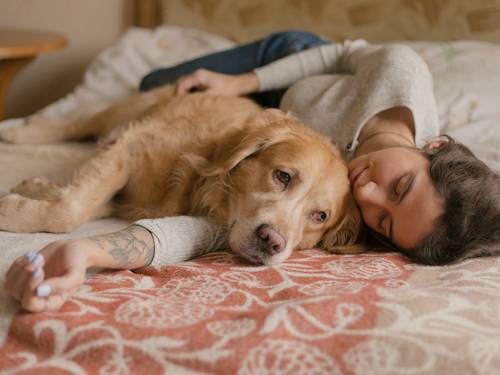
Our pets’ lives look enviable from the outside. We pay their rent, stock their snacks, and ask nothing in return but company. And yet dogs get anxious, sometimes severely, and no amount of cushiness fixes it. Trauma, thin early socialization, and plain old thunder can all leave a real mark on a dog’s nervous system.
So the question comes up in exam rooms constantly: does my dog need anxiety medication? The honest answer starts by correcting the question. Medication is not the fix. It is the thing that makes the fix possible. Understanding that distinction is the difference between a treatment that works and one that quietly disappoints.
First, know what you are looking at
Anxiety and depression in dogs can look surprisingly familiar. A withdrawn dog who loses interest in favorite things, whose appetite or sleep shifts, may be low. A dog who paces, pants excessively, trembles, whines, holds the tail down, licks at a paw until it is raw, has accidents despite being house-trained, or turns destructive is usually anxious.
Before I reach for any prescription, I want a full workup, because a dog who suddenly seems anxious or withdrawn might be in pain. Arthritis, a thyroid problem, or an illness can all masquerade as a mood change. Rule out the body first, then we talk about behavior.
That sequence is not optional. Trying to medicate away a behavior that is actually a symptom of arthritis will fail, and it wastes time the dog does not have.
What sets it off
Anxiety in dogs has a few reliable sources. Lack of socialization is a common one: the fewer novel people, places, and experiences a young dog banks, the more the world feels threatening later. A single bad encounter, a fight with another dog, can also seed a lasting fear. Then there are the big-ticket triggers, separation, when being left alone is the whole problem, and noise phobias, fireworks, thunder, a car backfiring.
Situational anxiety attaches to specific events: car rides, the groomer, the vet, storms, loud kids, being boarded. Depression is less common and less often medicated, but big household changes, a new pet, the loss of another pet, can flatten a dog for a while. Most bounce back on their own, and rewarding the return of playfulness speeds it along.
Behavior first, almost always
Here is where most good treatment plans start, and it is not the pharmacy. Vets typically recommend behavioral changes first to see whether they resolve the anxiety on their own.
For separation anxiety, that means teaching a dog to be alone in slices. Leave for a couple of minutes, come right back. Do not make a production of departures or arrivals. Slowly stretch the time away, and reward the calm, non-destructive dog who greets you. The goal is to make your absence boring instead of catastrophic.
For situational anxiety, removing the trigger is the obvious move when you can. When you cannot, fireworks are not going to stop, tools like a snug pressure wrap, calming pheromone products, and desensitization training can take the edge off. The long game, though, is always the training: patiently teaching the dog that the scary thing predicts good outcomes. That process runs weeks to months, not days.
Natural approaches belong here too. Reliable exercise is the simplest anxiety reducer there is, and an under-exercised dog is a jumpier dog. Add attention, engagement, mental work, even calming music, and some dogs improve meaningfully before medication ever enters the conversation.
When medication earns its place
If you have given prevention and training a fair run, roughly four to six weeks, and the anxiety still runs your dog’s life, that is when to talk to your vet about medication. The test is functional: is the fear interfering with the dog’s daily existence in a way training alone has not touched?
Anti-anxiety medications generally work by nudging brain chemistry, boosting neurotransmitters like serotonin, norepinephrine, dopamine, and GABA, either by increasing their production or slowing their reabsorption. Over time, that dampens the anxiety response and, critically, opens a window. A calmer dog can actually absorb the training. That is the whole point of the drug: not sedation, but access.
Vets choose from a real menu depending on the case, daily medications like fluoxetine (the drug many people know as Prozac) for baseline anxiety and separation, short-acting options for predictable events. Some human medications are FDA-approved for dogs, which is exactly why you must never share your own pills: the dosing is different, and getting it wrong can cause increased anxiety, an irregular heartbeat, and worse.
The side effects worth knowing
Most dogs handle these drugs without much trouble, which is not the same as handling them for free. Longer-acting drugs can bring sedation, dry mouth, reduced appetite, vomiting, or diarrhea; the SSRIs tend to have a lighter side-effect load, mostly some sedation, appetite dip, and behavior shifts. Short-acting event medications, used for storms or vet trips, can cause sedation or, in some dogs, restlessness. None of this is a reason to avoid medication when it is warranted. It is a reason to monitor, which is why a dog on daily medication should be getting bloodwork pulled on at least an annual basis.
This is a long-term commitment, not a quick fix. It can take a couple of weeks to reach a steady level, so dogs are usually given at least a few months to see how a drug is working. Some stay on it for life; others taper off once training takes hold. It depends entirely on the individual dog.
What newer research adds
The biggest recent development is a genuinely new option. In May 2026, the FDA approved Tessie (tasipimidine), the first drug cleared to treat both noise aversion and separation anxiety in dogs. It belongs to a different class than the SSRIs, an alpha-2 adrenoceptor agonist, and it works fast: given about an hour before a known trigger, fireworks, a departure, it dampens the fight-or-flight surge for that specific event rather than being taken every day. It joins earlier event medications and daily options, giving vets more ways to match the drug to the pattern of a particular dog’s fear.
None of it changes the core principle. Every current guideline still frames medication as one leg of a plan that also includes behavior modification, ideally with a trainer or veterinary behaviorist. The drug lowers the volume. The training changes the dog. You need both.
This article is for information, not a substitute for veterinary advice. Every dog is different, and decisions about medication should be made with your own vet.
References
- U.S. Food and Drug Administration. “FDA Approves First Drug to Treat Noise Aversion and Separation Anxiety in Dogs.” May 6, 2026. https://www.fda.gov/animal-veterinary/cvm-updates/fda-approves-first-drug-treat-noise-aversion-and-separation-anxiety-dogs
- Salonen, M., et al. “Prevalence, Comorbidity, and Breed Differences in Canine Anxiety in 13,700 Finnish Pet Dogs.” Scientific Reports, vol. 10, 2020, 2962. https://doi.org/10.1038/s41598-020-59837-z
- Sherman, B. L., and Mills, D. S. “Canine Anxieties and Phobias: An Update on Separation Anxiety and Noise Aversions.” Veterinary Clinics of North America: Small Animal Practice, vol. 38, no. 5, 2008, pp. 1081–1106. https://doi.org/10.1016/j.cvsm.2008.04.012
Common questions
How long before anxiety medication works?
Daily medications like fluoxetine can take a few weeks to reach a steady level, so vets usually give them a few months before judging results. Short-acting drugs for specific events, like a storm or a vet visit, work within hours of the dose.
Will my dog be on medication forever?
It depends on the dog. Some need long-term medication, while others can be weaned off once training and desensitization take hold. That is a decision to make with your vet, along with periodic bloodwork to monitor a dog on daily medication.
Not a substitute for your vet. Our guidance is educational. For urgent symptoms, contact a vet or emergency clinic right away. Editorial standards
Dr. Park is a board-certified emergency and critical care specialist. She reviews our health and safety content for clinical accuracy and contributes guides on recognising urgent conditions. Her focus is helping owners act quickly and correctly when it matters most.
Meet our experts ↗Keep reading
 Health & WellnessYour Dog's Anxiety Might Start in the Gut, Not the BrainDr. Mara Chen · 5 min
 Health & WellnessThe Haircut Is the Easy Part. The Best Groomers Are Reading Your Dog.Leila Torres · 7 min
 TrainingYour Dog Doesn't Need a Bad Memory to Be Terrified of the VacuumDr. Priya Nair · 9 min
 TrainingYour Dog Doesn't Need a Muzzle. Train Them for One Anyway.Dr. Mara Chen · 7 min
 Health & WellnessYour Dog Isn't Scared of Your Relatives. He's Scared of the Schedule.Dr. Nina Kohl · 8 min
 Health & WellnessThe 'Vagus Nerve Reset' for Anxious Dogs Is a Myth. The Nerve Is Not.Dr. Lena Park · 6 min