


Your Dog Isn't Scared of Your Relatives. He's Scared of the Schedule.
Holiday stress in dogs almost never comes from the noise or the strangers. It comes from a week where nothing happens when it's supposed to. Seven fixes, ranked by how much trouble they actually prevent.

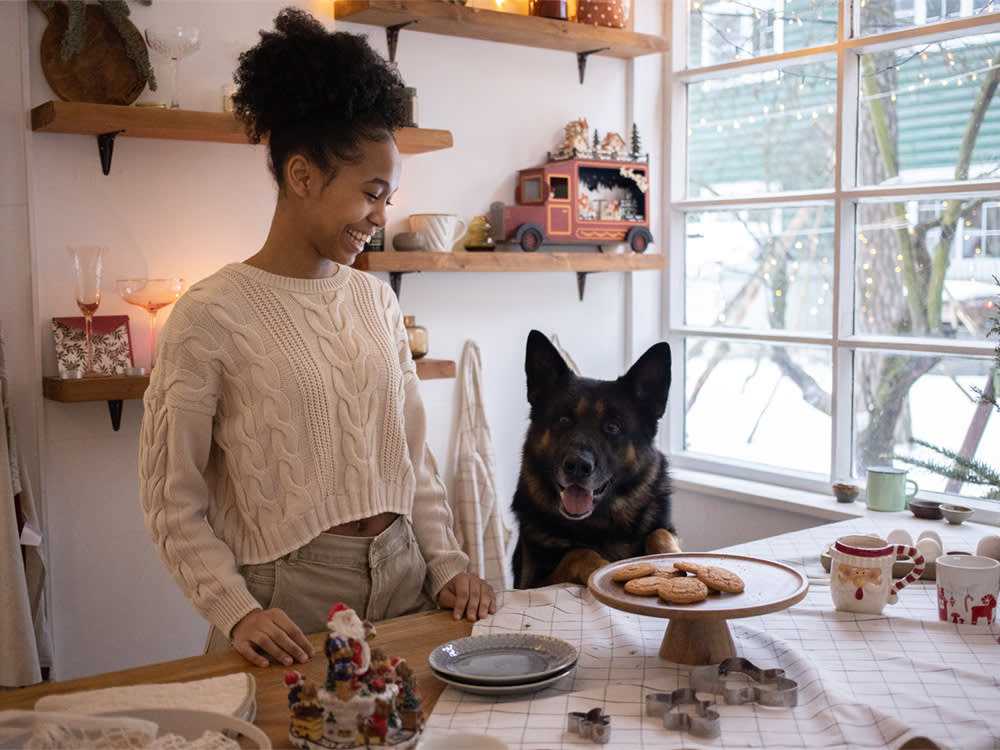
Everyone blames the wrong thing. Ask why dogs struggle at the holidays and you will hear: the doorbell, the kids, the noise, the strangers.
Those are the triggers. They are not the cause. The cause is that for one to three weeks, the structure a dog uses to predict his own day quietly dissolves. Meals slide. Walks get skipped. You are home when you are never home, then gone for eleven hours. Someone sleeps in his room. The furniture moves. A tree appears indoors.
A dog does not experience that as festive. He experiences it as a loss of information. And a dog with no information gets vigilant, and a vigilant dog is one bad moment away from the thing you were dreading.
So the intervention is almost never aimed at the dog. It is aimed at the calendar, the doors, and the food. What follows is ranked the way an emergency vet would rank it: by how much trouble each one actually prevents, not by how it feels to do.
1. Sweep the room at snout height
This is the one that generates the 2 a.m. phone call, so it goes first, ahead of every gentler thing on this list.
The ASPCA’s Animal Poison Control Center fielded over 450,000 calls in 2024, and the “chocolate holidays,” Valentine’s Day, Halloween, Thanksgiving, and Christmas, are reliably among the busiest stretches of its year. Two categories do most of the damage.
Fat. Gravy, drippings, pan sauces, stuffing, turkey skin, and every fatty scrap slipped under the table. High-fat food can set off pancreatitis, sometimes on a startlingly small amount. Nuts are the same problem with more oil, especially almonds, pecans, and walnuts. The classic picture is a dog who vomits, will not eat, and stands with his chest low and his rear end up, and it can put him on IV fluids for days.
The outright toxins. Chocolate. Xylitol, which means checking every sugar-free item on the table. Grapes and raisins, which hide in the fruitcake and the stuffing. Onions and garlic, which hide in almost everything savory. Alcohol, in the drinks people set down on the floor.
Then walk the room at his eye level and remove: tinsel and ribbon (a linear foreign body is surgery, not a stomach ache), glass ornaments on the lowest branches, lit candles at tail height, electrical cords, and any plant you cannot name.
Put the number in your phone before you need it: ASPCA Animal Poison Control, (888) 426-4435. There is a consultation fee. Pay it. It will be the cheapest part of that night.
“Almost every holiday emergency I see was preventable at snout height an hour earlier,” says Dr. Lena Park. “Nobody hands a dog a plate of turkey skin on purpose. They just leave it at the edge of a counter and turn around.”
2. Refuse to live in hope and fear
There is a specific misery a lot of people carry through the holidays, and it goes: I hope it will be fine, but I’m afraid it won’t.
Throw it out. It is not a plan, it is a mood. If you are worried about something, assume it will happen and remove the possibility.
Worried he will get into the cookies? The cookies move. Worried he will bolt through the door people keep propping open? You stand at the door, or you gate the hallway. Worried he will finally bite your niece the next time she grabs his ears? He will. Leash him, and get him away from any child who is harassing him, however loudly the room insists those kids are angels. You are not being uptight. You are the only person present with a plan.
3. Decide which events he simply should not attend
Half of holiday dog stress is solved before anyone leaves the house, by not bringing the dog.
Too loud, too crowded, too many small children, too much food at snout height, or a host who does not actually want him there. Any single one of those is reason enough to leave him home with a sitter or a friend. Choosing not to drag your dog to a party he would hate is a kindness, and it is the one people are most reluctant to extend, because it feels like exclusion. It is not. It is mercy.
4. Build one real decompression room
Most people improvise the safe spot on the day, and improvise it badly: a spare room, a hard floor, a shut door, and the party audible through it. Dogs learn that as a punishment, fast.
A decompression room takes ten minutes to set up and should contain, at minimum:
- His own bed or crate, moved from wherever it normally lives. Familiar smell does most of the work.
- Sound cover. A fan, a white noise machine, a radio. The point is not silence, it is masking the door-slams and the shrieking.
- A long-lasting chew, or a stuffed and frozen Kong. Chewing is self-soothing, not just entertainment.
- Water. Forgotten with astonishing consistency.
- Your face, on a schedule. Look in every 20 or 30 minutes, so that being in the room does not come to mean being abandoned in it.
- A sign on the door. Guests will open it. Children will absolutely open it.
If he is going to spend a few hours in there, it has to be a room he would pick himself. Test it a week early, not on the day.
5. Treat crates, pens, and closed doors as gifts
Whether you are hosting fifteen people or visiting relatives, know in advance where he goes the moment the room becomes impossible. A turkey on a low table and six under-fives at full velocity are the same problem with the same answer: the dog is elsewhere, safely enclosed, on purpose.
A crate is ideal. An exercise pen works. A shut door works. Plenty of dogs need practice before being closed away from the action feels tolerable, so build it in advance: hand over a Kong stuffed with something outrageous, put him in the quiet spot, and let him learn that the room is where the good thing happens. On the day, hand him the same treat and shut the same door. He is not being excluded. He is being spared.
6. Learn his stress signals before the party, not during it
Watch him, and be willing to change the situation instead of managing his reaction to it.
Early stress looks like: lip licking, yawning when he isn’t tired, sweaty paw prints on a hard floor, panting when it isn’t hot.
Fear looks like: a tucked tail, ears pinned flat, a lowered body, backing away, eyes gone big and dark, or a crescent of white showing at the side of the eye (whale eye).
The mistake is waiting for a growl. A growl is not the start of the problem. It is the end of a conversation your dog has been having with you for ten minutes.
7. Give him a break he did not have to ask for
Overstimulation compounds. Even the dog who is coping is spending energy to cope, and he will run out before the evening does.
So build the break in whether he requests it or not: an extra walk, twenty minutes in a back bedroom with only you, a chew in the crate while the party carries on without him. Some dogs want solitude and a bone. Others want contact and one-on-one attention. You know which one lives in your house.
And notice this: dogs who need no downtime at all on an ordinary Tuesday will often want it now, precisely because nothing else about the week is ordinary.
What’s new since this was written
Two things have changed the practical advice.
The first is that we now have a better picture of where holiday emergencies actually come from, and it is not the exotic stuff. The ASPCA’s own call breakdown puts over-the-counter human medications at the top of the list for dogs, ahead of the seasonal foods everyone frets about. So the highest-value thing you can do before guests arrive is not to audit the dessert table. It is to get every handbag, coat pocket, and overnight bag off the floor and behind a closed door. Ibuprofen, acetaminophen, sleep aids, and gummy supplements all travel in guests’ luggage, and dogs find them.
The second is that calming aids have multiplied, and most of them do less than the packaging implies. Pheromone diffusers and calming chews are, at best, a small nudge, and none of them can rescue a dog from a genuinely overwhelming environment. If your dog has a real noise phobia or a history of panic, the conversation to have is with your vet, weeks ahead, about actual anxiolytic medication. Situational medication given before the stress arrives works far better than anything you can do once he is already over threshold, and the appointment book fills up in December.
References
- ASPCA Animal Poison Control Center. aspca.org
- American Veterinary Medical Association. Thanksgiving pet safety. avma.org
- ASPCApro. 4 Harmful Thanksgiving Foods for Pets. aspcapro.org
- Cornell University Riney Canine Health Center. Pancreatitis. vet.cornell.edu
Not a substitute for your vet. Our guidance is educational. For urgent symptoms, contact a vet or emergency clinic right away. Editorial standards
Dr. Kohl is a board-certified veterinary dentist with a particular interest in preventive oral care. She reviews all dental health content at The Pet Times and contributes practical guides on home dental routines, professional cleaning, and oral disease prevention.
Meet our experts ↗Keep reading
 LivingA Wolfdog Is Not a Fluffier Husky. Nobody Can Tell You What You Actually Own.Dr. Ravi Mehta · 8 min
 TrainingBefore You Cut a Hole in Your House, Answer This: What Else Can Fit Through It?Marcus Webb · 8 min
 LivingDon't Teach Your Dog to Swim. Teach Them to Get Out.Dr. Priya Nair · 8 min
 LivingYour City Dog Isn't 'Reactive.' The Sidewalk Is Screaming at Them.Dr. Mara Chen · 8 min
 LivingTo Your Dog, the Elevator Feels Like an Earthquake. That Changes How You Should Ride It.Dr. Amara Solis · 6 min
 LivingYour Dog Doesn't Need a Longer Walk. They Need a Backpack.Marcus Webb · 6 min