


Your Dog Doesn't Need a Longer Walk. They Need a Backpack.
A pack turns a walk into work, and work is what most reactive, restless, under-employed dogs are actually missing. Seven reasons to strap one on, plus the load rules that keep it from wrecking their joints.

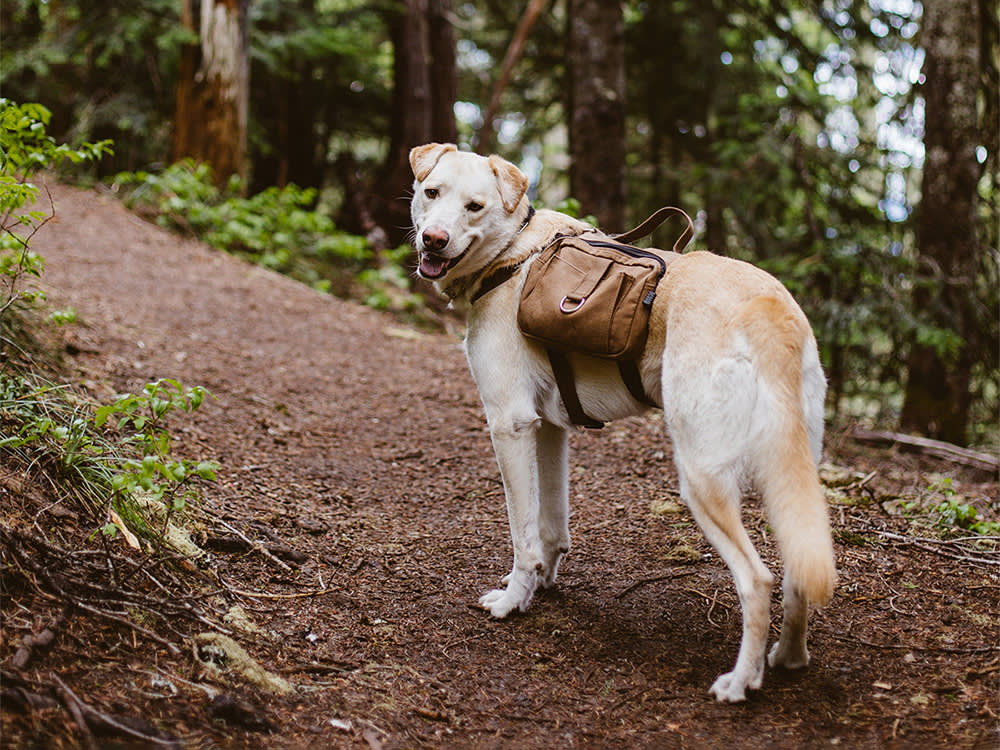
Walk a wired dog farther and you get a fitter wired dog. This is the trap most owners of high-energy, reactive, or generally unemployable dogs fall into: they treat the problem as a fuel surplus, add distance, and end up with an animal who now requires six miles to be tolerable instead of three.
The dogs are not asking for more mileage. They are asking for a task.
A dog backpack is the cheapest, dumbest, most effective way to hand them one. It is not a training program and it is not a cure, but strapping a job to a dog’s back changes what a walk is for them, and for a certain kind of dog it changes the walk completely. Here is what it actually does, and the part almost nobody tells you: how much weight is safe to put in it.
1. It gives them a job, and most dogs are unemployed
Working breeds are not a novelty category. A huge share of the dogs in American homes descend from animals bred to move stock, haul, retrieve, or patrol, and we have asked them to spend that inheritance on a couch and a 20-minute loop around the block.
Put a pack on a dog like that and the walk stops being a sensory free-for-all and becomes an assignment. Owners describe the same shift over and over: the dog stays closer, checks in more, pulls less, and moves with a kind of purpose that was not there the week before. Nothing about the walk changed except that the dog now has a role in it.
2. It can take the edge off a reactive dog (with an honest caveat)
Snug, steady pressure across the torso is the same principle behind anxiety wraps, and plenty of owners of car-scared, lunge-y, hair-trigger dogs report that a fitted pack takes the volume down a couple of notches.
Be honest about the evidence, though: research on pressure wraps is mixed, and the effect, where it exists, is modest and inconsistent. A pack is not a substitute for behavior work with a good trainer. What it can be is one more thing stacked on the useful side of the ledger, alongside counter-conditioning, distance from triggers, and a treat pouch you actually use. Some dogs settle noticeably. Some do not care at all. It costs you one walk to find out.
3. It carries your stuff, which is more useful than it sounds
Gloves, hat, phone, spare bags, a rain layer, a spare leash, the mail on the way home. Every one of those items is currently either in your pocket or in your hand, and the hand is the problem: the moment a squirrel appears, whatever is in your hand becomes litter.
A pack with two balanced side pockets and elastic webbing across the top solves a logistics problem you had stopped noticing because you had accepted it.
4. It carries their stuff
Nobody wants to talk about this and everybody knows what it means. Carrying a full bag by hand for the last mile of a walk is one of the small indignities of dog ownership. Tying it to the leash risks a tear. Clipping it to the collar is undignified for everyone involved.
Load it into a designated side pocket and it is out of your life until the trash can. On a multi-dog walk, one packed dog can carry the entire household’s output without registering a complaint. Use one pocket for their waste and the other for your things, and never confuse the two.
5. A working walk tires them out faster than a longer one
This is the one that changes people’s schedules. A dog carrying a light, balanced load is doing something mentally as well as physically: managing balance, tracking a body that now has different dimensions, staying next to you because the job requires it.
The result is that a 30-minute packed walk often lands like a 60-minute empty one. If your day cannot absorb more dog-walking, this is the lever.
6. It makes them easier to handle and easier to see
Most decent packs come built on a harness, with a padded top handle and reflective panels. That handle is genuinely useful: it is how you lift a dog over a fallen log, steady them on a rock scramble, or physically move them out of a bad situation on a narrow sidewalk. The reflective strips do real work on a dark winter walk. And there is room for a tag, a water bottle, and a folded copy of your number.
7. They look absolutely fantastic
I am not going to pretend this is not part of it. A dog in a well-fitted pack looks like a dog with somewhere to be, and that is a genuinely delightful thing to walk beside. Vanity is a legitimate reason to buy gear. We do it for ourselves constantly.
Now the part nobody puts in the listicle: load rules
A backpack is a piece of load-bearing equipment strapped to a skeleton. Get this wrong and the pack goes from enrichment to orthopedic injury.
- Cap the weight at 10 to 15 percent of body weight for a healthy adult dog. For a fit, conditioned, trail-experienced dog, some sources go to 18 percent, and the absolute ceiling cited for exceptionally fit working dogs is 25 percent. Nobody’s neighborhood walk needs to be near those numbers. Start at zero.
- Not on a puppy. Not on a young dog. Do not add weight until the growth plates have closed, which is usually somewhere around 12 to 18 months for most dogs and later for large and giant breeds, sometimes two years or more. An empty pack is fine for training the habit. Weight is not.
- Balance both sides. An unbalanced load makes the dog compensate through the spine and shoulders every single step.
- Build up. Empty pack for a few walks. Then something light and soft. Then a little more. You are conditioning a body, not filling a suitcase.
- Ask your vet first if there is any history at all. Hip dysplasia, back problems, arthritis, heart conditions, or a dog carrying extra weight already: get an opinion before you add cargo.
- Take it off for rest, water, heat, and play. A pack in hot weather is an insulating layer. On a warm day, keep the load minimal or leave it home.
- Fit it properly. You should be able to slide two fingers under every strap. Watch for rubbing at the armpits, which is where packs chafe first.
“The 10-to-15-percent figure is a ceiling, not a target,” says Dr. Priya Nair, a veterinarian on the Pet Times expert team. “Most of the benefit people describe comes from the pack being on at all, not from what’s in it. If you’re not sure, put in less than you think. An empty pack on a young dog is still a job.”
The honest summary
A backpack will not fix a reactive dog. It will not replace training, it will not undo whatever happened to a rescue before you met them, and it will not compensate for a dog who is chronically under-exercised and under-stimulated.
What it will do is give an under-employed animal a small, structured, portable role in a walk that was previously all input and no output, and for a startling number of dogs that turns out to be the missing piece. It costs $30 and one afternoon to find out whether yours is one of them.
References
- Backpacker. “How Much Weight Can My Dog Carry on the Trail?” https://www.backpacker.com/skills/how-to-safely-fit-load-dog-hiking-backpack/
- Orvis. “How to Train Your Dog to Wear a Pack.” https://www.orvis.com/how-to-train-your-dog-to-wear-a-pack.html
- Cottam, N., Dodman, N. H., & Ha, J. C. “The effectiveness of the Anxiety Wrap in the treatment of canine thunderstorm phobia: an open-label trial.” Journal of Veterinary Behavior, 2013. https://www.sciencedirect.com/science/article/abs/pii/S1558787813000208
Marcus Webb writes about the gear, gadgets, and everyday choices that make life with a pet easier. His coverage runs from product picks to training and the causes worth paying attention to, always with an eye on what actually earns a place in your home.
Meet our experts ↗Keep reading
 LivingYour Dog Doesn't Hate Fall. It Hates Your Calendar.Dr. Mara Chen · 8 min
 TrainingSending Your Dog to Its Crate as Punishment Ruins the One Room That's TheirsDr. Amara Solis · 7 min
 LivingYour City Dog Isn't 'Reactive.' The Sidewalk Is Screaming at Them.Dr. Mara Chen · 8 min
 LivingTo Your Dog, the Elevator Feels Like an Earthquake. That Changes How You Should Ride It.Dr. Amara Solis · 6 min
 TrainingYour Dog Isn't Shy at Your Party. Six Signs They Want Out.Dr. Lena Park · 8 min
 TrainingThe Christmas Songs Most Likely to Stress Out Your DogDr. Lena Park · 5 min