


Your Dog Isn't Shy at Your Party. Six Signs They Want Out.
A big party is loud, crowded, and long, which is three separate problems for a dog. How to tell excitement from distress, which dogs should never be at the party, and what the vet sees the next morning.

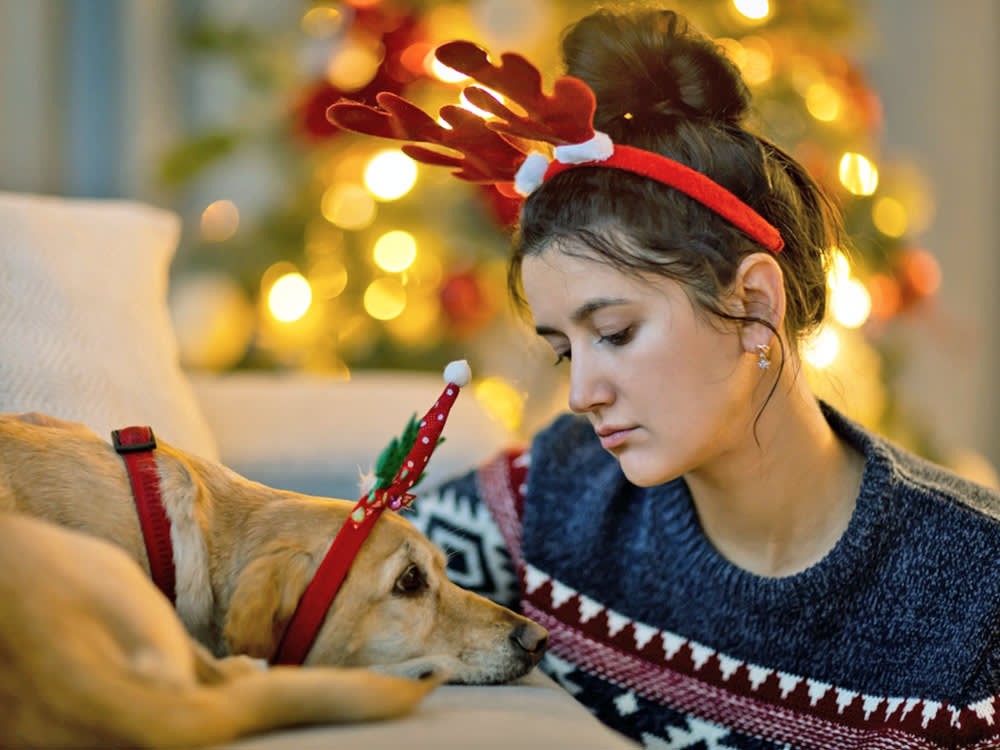
A party is not one problem for a dog. It is three, stacked.
It is loud, which is a sensory problem. It is crowded with strangers, which is a social problem. And it runs for four or five hours, which is an endurance problem. A dog can handle any one of those. The party asks them to handle all three at once, in their own house, with no exit, while the person who normally protects them is distracted and slightly tipsy.
Most dogs cope by shutting down quietly in a corner, which everyone reads as “he’s fine, he’s just chilling.” He is not chilling. Here is what to actually look for, and what to do about it before the invitations go out.
Six signs your dog wants out
1. The stress signals are stacking
Individually, these mean little. Together, and sustained, they are a dog asking to leave.
- Lowered head or body
- Lip licking
- Ears pinned back
- Panting when it is not hot and they have not been running
- A stiff body
- Wide eyes
- Growling, barking, or showing teeth
If you have watched your dog at gatherings before and seen this pattern, you already have your answer for the next one.
2. They duck away from hands
Avoiding interaction and pulling their head back from a reaching hand is one of the clearest tells there is. Add to that stress yawns, pawing, pacing, hiding, a tucked tail, and flattened ears. A dog who is physically retreating from your guests is not warming up. They are managing.
3. They cannot settle
A dog who is comfortable will eventually lie down. A dog who is overwhelmed keeps moving, often with a stiff body, orbiting the room, never landing. Constant pacing in a house full of people is not sociability. It is a dog who cannot find a place that feels safe enough to stop in.
4. They are hypervigilant
Jumping at noises, tracking every movement, watching everyone. Hypervigilance means the dog is holding an elevated state of alert, monitoring the whole room because they have not decided the room is safe. It looks like attentiveness. It is closer to a sentry shift.
5. They get loud, mouthy, or overreactive
Barking, jumping up, and getting mouthy when that is not their normal are signs of overwhelm, not high spirits. So is yawning in a room where nobody is sleepy. The dog is over threshold and their behavior is spilling.
6. They start doing odd, out-of-context things
This one gets missed constantly. A dog who suddenly stops mid-room to scratch, sniff the floor intently, shake off as if wet when they are dry, or lick a paw with unusual focus is often performing a displacement behavior: a normal action, done at the wrong moment, because the animal is in conflict. In a calm house it means nothing. In a loud room full of strangers, it is a stress readout.
Excitement or anxiety? The difference is the off switch
The hardest call at a party is a dog who is doing a lot. Wired, mouthy, spinning. Is that joy or panic?
Watch for two things.
Looseness. An excited dog is wiggly, not just wagging. Loose body, relaxed face. They choose to approach people rather than being cornered into it.
Intermittent settling. A happy dog comes down. They tear around, then flop, then get up again. Energy that never resolves, that stays intense for hours, is often anxiety wearing a party hat. Play itself can be a displacement behavior, which is why “he’s playing!” is not proof of anything.
Balanced, joyous, and able to stop: that dog is having a good time. Intense, escalating, and unable to stop: that dog needs to go somewhere quiet.
The dogs who should not be at the party at all
Some dogs are not candidates for a big gathering, full stop, and the guest list is not the place to find out.
A brand-new or unknown rescue. A dog who has been in your home for a few weeks does not need a party added to the pile. You also do not yet know what they do under pressure.
Any dog with a bite history. This one is not a judgment call. That dog should be elsewhere.
Diagnosed anxiety. A party brings strangers into the one place the dog considers safe. There is nowhere for them to go.
Puppies and seniors. Neither regulates stress well. Puppies have no coping skills yet, and seniors have often lost the ones they had, along with some hearing and some patience.
Dogs with chronic medical conditions. Heart disease, kidney disease, diabetes, arthritis, bronchitis, seizure disorders, or anxiety. These dogs can destabilize quickly in a crowded, chaotic environment, and the crash may not come until later that night.
What it costs the dog to push through
“He’ll be fine, he just has to get used to it” is a plan with a medical cost.
Overstimulation produces genuine physiologic stress: heart rate rises, blood pressure rises, breathing rate rises, body temperature rises, and stress hormones flood the system. Prolonged stress reliably worsens existing medical conditions, which is why the chronic-illness list above is a hard line rather than a suggestion.
The signs to watch for on the night:
- Trembling
- Panting
- Drooling
- Arched posture
- Vomiting
- Diarrhea
And then there are the emergencies a party generates all on its own, with no stress required. Chocolate and grapes get eaten. Rich, fatty scraps set off pancreatitis. Dogs swallow the things guests drop. Someone leaves a drink at nose height, or leaves the front door open. And an overstimulated dog bites, having spent hours warning a room that was not listening.
The dog who bites at a party is almost never a dog who gave no warning. They are usually a dog who spent three hours giving warnings that nobody in the room was trained to see.
Deciding: bring them, leave them, or hire a sitter
Five questions, answered honestly, before you commit.
- What is the running time, start to last guest?
- What is the travel distance, and how does your dog handle the car?
- Has your dog ever been in this space before?
- Do they know these particular people, or just people in general?
- Will they still listen to you in a room like that one?
Then apply the rule that clears most of the fog: anything short of certainty is a no. If you cannot say with confidence that your dog enjoys every kind of person, in any number, at any volume, they belong somewhere else that night. Sociability has a ceiling, and enough novelty will find it even in a friendly dog.
Leaving them home is fine for the standard few-hour party, with the usual exceptions for very young or medically needy dogs. Dogs do not get FOMO.
A sitter is the right call when the party is at your house. A sitter who takes dogs into their home is ideal, since it puts real distance between your dog and the noise. If your regular daycare boards, that works too. If your dog must stay home during the party, a sitter who sits with them in a genuinely separate room, far from the door and the speakers, is the next best thing.
A safe room is the minimum. Not a closed door in the middle of the action. A room on a different floor or at the far end of the house, with the dog’s bed, water, a long-lasting chew, white noise, and a sign on the door telling guests not to open it. Check on them.
What’s new since this was written
The party’s biggest documented risk is not the noise. It is the food.
The ASPCA Animal Poison Control Center fielded calls about more than 351,000 items and substances that pets were exposed to in 2023. Over-the-counter medications topped the list at about 16.8 percent of exposures, and chocolate accounted for roughly 13 percent. Both of those are party items: the purse on the floor with the ibuprofen in it, the dessert plate at coffee-table height, the guest who thinks a little chocolate is fine.
That reframes the safe room. It is not just a place to protect your dog’s nerves. It is the single most effective barrier between your dog and the most common toxin exposures in American homes, on the one night of the year when your house is full of unattended handbags and unattended dessert.
Loving your dog sometimes means spending the evening apart. Your guests will survive not being greeted at the door.
References
- ASPCA. “The Official Top 10 Pet Toxins of 2023.” aspca.org/news/official-top-10-pet-toxins-2023
- ASPCA. “Animal Poison Control Center.” aspca.org/pet-care/aspca-poison-control
- American Veterinary Society of Animal Behavior. “Position Statement on Humane Dog Training,” 2021. avsab.org/resources/position-statements/
- Merck Veterinary Manual. “Behavioral Problems of Dogs: Fear and Anxiety.” merckvetmanual.com
Common questions
How do I tell excitement from anxiety?
Excitement is loose and wiggly, involves the whole body, includes the dog choosing to approach people, and is punctuated by settling. Anxiety is intense, sustained, and does not switch off. If the energy never comes down, it is not fun.
Is it cruel to leave my dog home while I go to a party?
No. For a party lasting a few hours, most healthy adult dogs are fine alone. Dogs do not experience FOMO. The exceptions are very young puppies who need frequent breaks and seniors with medical needs.
Which dogs should definitely not be at a party?
A brand-new or unknown rescue, any dog with a bite history, and any dog with a chronic condition like heart disease, kidney disease, diabetes, arthritis, bronchitis, seizures, or diagnosed anxiety.
Can I just put my dog in a back room during the party?
Yes, if the room is genuinely quiet, far from the door, and someone checks on them. A dog behind a door in a house that is vibrating with noise is not actually away from the party.
Dr. Park is a board-certified emergency and critical care specialist. She reviews our health and safety content for clinical accuracy and contributes guides on recognising urgent conditions. Her focus is helping owners act quickly and correctly when it matters most.
Meet our experts ↗Keep reading
 LivingYour Dog Doesn't Hate Fall. It Hates Your Calendar.Dr. Mara Chen · 8 min
 Health & WellnessThe Hot Car Isn't What Gets Most Dogs. The Walk Is.Dr. Priya Nair · 9 min
 LivingTo Your Dog, the Elevator Feels Like an Earthquake. That Changes How You Should Ride It.Dr. Amara Solis · 6 min
 LivingYour City Dog Isn't 'Reactive.' The Sidewalk Is Screaming at Them.Dr. Mara Chen · 8 min
 TrainingYour Dog Isn't Reading Your Face. They're Reading Your Hand on the Leash.Dr. Lena Park · 8 min
 Training5 Reasons Your Dog Follows You Into the Bathroom (One Is Worth Watching)Dr. Nina Kohl · 6 min