


To Your Dog, the Elevator Feels Like an Earthquake. That Changes How You Should Ride It.
We'll never know exactly what a dog thinks a moving metal box is. But we know how it feels to them, and that single fact turns 'my dog hates the elevator' from a mystery into a fixable problem.

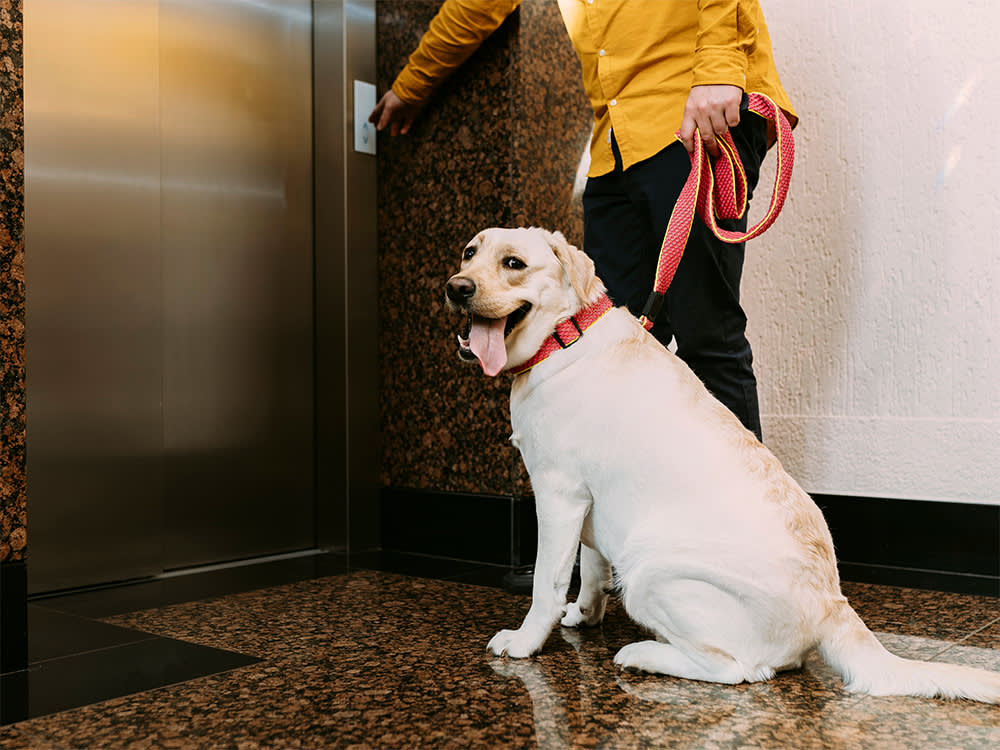
If you live in an apartment building, you’ve probably had this thought while your dog sits calmly beside you in the elevator: what on earth do they think is happening right now? From the dog’s side, they walk into a small room that smells like strangers, the doors seal shut, the floor trembles for a few seconds, and when the doors open, the world outside is somehow different from the one they left. Teleportation? Magic? An earthquake with a happy ending?
We can’t answer the philosophical version of that question. But there’s a far more useful version, and it has a clear answer that actually helps your dog.
The honest limit: we don’t know what they think
It would be wonderful to sit a dog on the couch and ask, “So, how’s the elevator experience for you? What are you seeing in there?” We can’t. Despite every attempt to read meaning into those soft, expressive faces, we don’t have that level of insight into a dog’s mind, and anyone who tells you they know exactly what your dog believes is happening is guessing.
So set the mind-reading aside. The question that matters isn’t “what does my dog think an elevator is.” It’s “how does an elevator feel to my dog,” because that’s the one we can answer, and it’s the one that leads to a fix.
The answer that changes everything: it feels like the ground betraying them
For a lot of dogs, riding an elevator feels something like standing through a small earthquake. They step onto what reads as solid, trustworthy ground, and then that ground starts to move. Unless a dog was introduced to the sensation early and gently, that’s a genuinely alarming experience, floors are not supposed to move, and their whole body knows it.
Now stack on the rest of the elevator: a cramped box, often packed with unfamiliar people and unfamiliar smells, with no exit for the duration. Take a dog who’s already unsettled by the moving floor and surround them with strangers in a space they can’t leave, and you have a recipe for real stress. A stressed dog may shut down, hunch away, or, in the worst case, become reactive, not because they’re “bad,” but because they’re trying to create space in a place that offers none.
Once you see the elevator as a mild earthquake rather than a curiosity, “my dog hates the elevator” stops being a personality flaw and becomes a fear you can work with.
Owners keep asking me what the dog thinks the elevator is, and it’s the wrong question. What matters is that the floor moves under a dog who trusted it to stay put. Once you treat that as a fear to unwind slowly, rather than a fact to force them to accept, most of these dogs get better.
Reading your dog: comfortable versus not
We can’t know the dog’s inner monologue, but their body tells us plenty. A comfortable dog is loose and relaxed. They’ll take a cue, accept a treat if you offer one, step on willingly, and won’t try to drag you out the instant the doors part. An uncomfortable dog goes stiff and tense. They tremble, wedge themselves into a corner, or press hard against your legs for reassurance. Watch for those signs, because they tell you whether you’re maintaining a calm routine or pushing a scared dog past its limit.
What actually helps
If you can, start young. The best insurance against elevator fear is early, positive exposure, so a puppy learns that moving floors are just part of life. Most people reading this, though, adopted an adult who never got that chance, and there’s a plan for you too.
Option one: skip it. Depending on how many flights you’re facing, the simplest fix may be to reframe the stairs not as an obstacle but as free exercise for both of you. A fearful dog and a few extra flights can be a genuinely good trade.
Option two: shrink the elevator into tiny steps. If the elevator is unavoidable, the rule is to break it into pieces small enough that your dog can succeed at each one. Call the elevator during a quiet stretch of the day when it’s unlikely to fill with people. Hold it on your floor for a minute and simply ask your dog to step in and out, in and out, with no ride at all. As they grow confident, add a short trip of a floor or two, and when the doors open, follow it with play or a treat so the whole sequence starts to predict good things instead of dread. You’re teaching the dog, at a pace it can handle, that the moving box is safe and even rewarding.
Avoid the crush, and never flood a scared dog. If your dog is reactive, deliberately dodge peak hours so you’re not forcing them into a packed car. And resist the most common mistake: the belief that enough repetition will “get them used to it.” Simply exposing a frightened dog to the thing that frightens it, over and over, without changing anything, doesn’t build tolerance. It confirms their worst fears, because every ride proves the scary thing is still scary. Progress comes from small, positive, controlled steps, not from grinding through the fear.
The bottom line
We may never know what a dog believes is happening between the closing doors and the opening ones. We don’t have to. What we know is that it can feel like the floor giving way, and that plenty of humans who fully understand elevators still can’t stand riding them either. Meet your dog where they are: be patient, go slow, and try to see the small moving room through their eyes. Then be kind about what you find there.
References
- American Veterinary Society of Animal Behavior. “Position Statement on Humane Dog Training.” avsab.org
- ASPCA. “Desensitization and Counterconditioning.” aspca.org
- Fear Free Pets. “Helping Fearful Dogs.” fearfreehappyhomes.com
Dr. Solis is a board-certified veterinary dermatologist with over twelve years of clinical experience. She advises on skin conditions, allergies, and grooming practices that affect coat and skin health. All dermatology and allergy content at The Pet Times is reviewed by her team before publication.
Meet our experts ↗Keep reading
 LivingYour Dog Doesn't Hate Fall. It Hates Your Calendar.Dr. Mara Chen · 8 min
 LivingYour Dog Doesn't Need a Longer Walk. They Need a Backpack.Marcus Webb · 6 min
 Health & WellnessThe Hot Car Isn't What Gets Most Dogs. The Walk Is.Dr. Priya Nair · 9 min
 LivingYour City Dog Isn't 'Reactive.' The Sidewalk Is Screaming at Them.Dr. Mara Chen · 8 min
 TrainingSending Your Dog to Its Crate as Punishment Ruins the One Room That's TheirsDr. Amara Solis · 7 min
 TrainingThe Christmas Songs Most Likely to Stress Out Your DogDr. Lena Park · 5 min