


Your Cat Invented a Private Language, and You're the Only Fluent Speaker
There is no universal cat dictionary, which is why translation apps and meow charts fall flat. A feline behavior specialist explains why the meow is aimed at you specifically, and a real method for decoding your own cat.

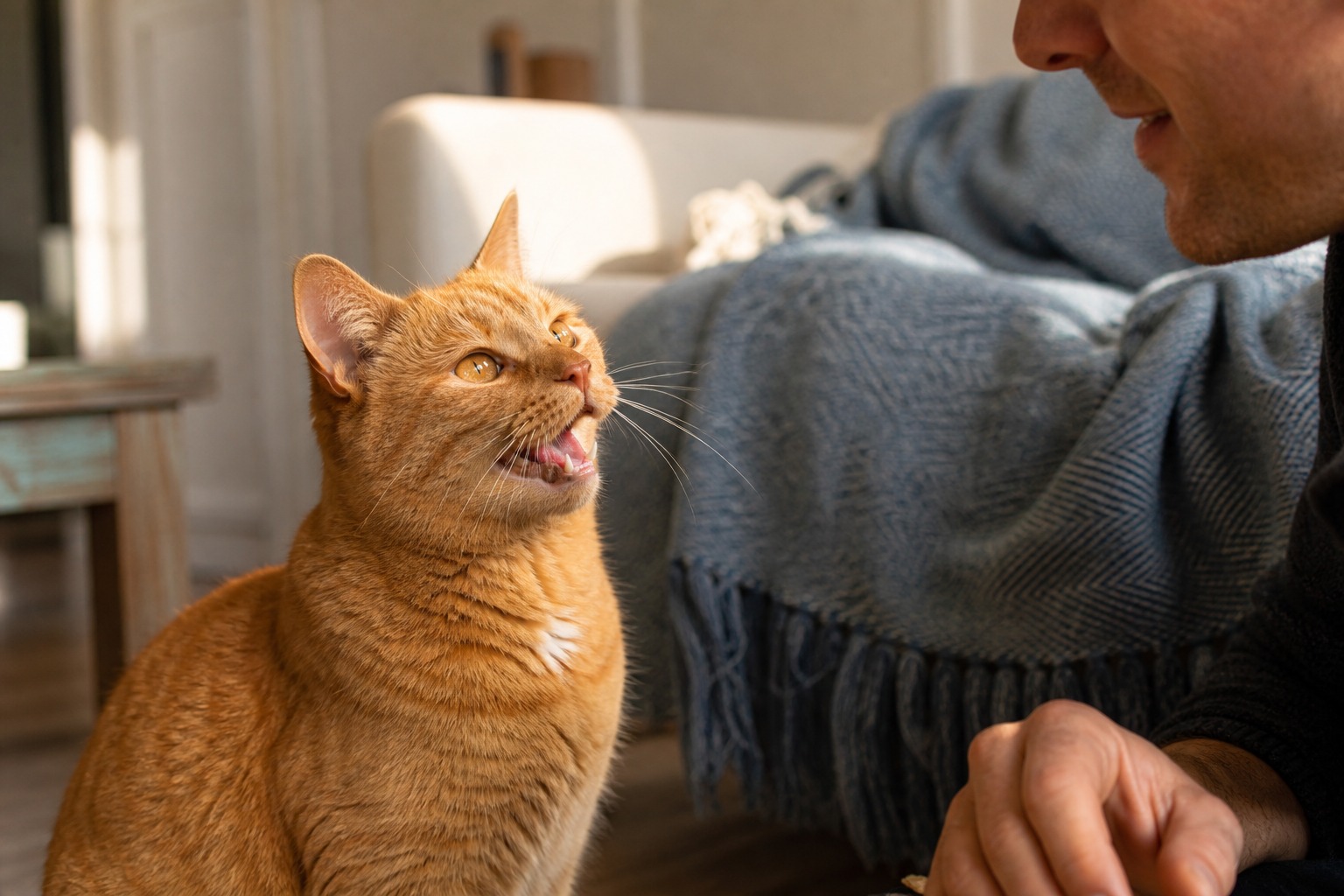
Here is a fact that reframes everything people get told about “cat language.” When researchers play recordings of a cat meowing and ask strangers to guess what it means, the strangers do no better than random chance. When they ask the cat’s own owner, accuracy climbs, but only to about four correct guesses out of ten. In other words, there is no shared feline dictionary that a chart or an app can look words up in. The meow is not a language cats speak to each other. It is a channel each cat builds, over years, with one specific human. You are not bad at reading it. You are the closest thing there is to an expert, and even you are working at four out of ten.
That changes how you should approach the whole subject. Instead of memorizing what a “short meow” universally means, the useful skill is learning to read your particular cat in context. This piece covers why the meow is aimed at you, which sounds actually carry consistent meaning, and a practical method for decoding the animal you live with.
The meow is for humans. The rest of the catalog is for everyone.
Cats have two broad communication tracks, and confusing them is where most misunderstandings start.
Kittens meow to their mothers, but once cats reach adulthood, they largely stop meowing at other cats. Adult-to-adult feline communication runs on scent, body language, and a different set of sounds. The meow survived into adulthood for exactly one audience: us. Adult cats kept and expanded the meow specifically because it works on humans, a genuinely remarkable bit of interspecies adaptation. So when your cat meows, they are almost always addressing you, not narrating to the room.
The other vocalizations, the trills, hisses, growls, and chatters below, are older and more universal. Those a cat will use with people, other cats, and prey, and they carry more consistent meaning across individuals. The meow is the custom-built part. Everything else is closer to standard equipment.
The sounds that mean roughly the same thing in every cat
Because these are not human-directed inventions, they are the closest thing to a reliable dictionary, so start here.
Chatter is the rapid, clicking or squeaking sound, often with a quivering jaw, that a cat makes while locked onto prey through a window.
There are a few competing theories on chatter. One is that the cat is imitating the bird or rodent it is watching. Another is that it is the overflow of excitement that comes with stalking. Plenty of behaviorists read it as simple frustration: the prey is visible and unreachable. The debate is unlikely to be settled soon, and honestly, that mystery is part of what makes the sound so charismatic.
Trills are the sweet ones, a soft rolling “rrrrrr” pitched halfway between purr and meow, with a musical little roll to it. Queens use it with their kittens, and adult cats aim it at people as a friendly hello: at gentle wake-ups, mid ankle-rub, or the moment dinner hits the floor.
Chirps blur with chatter and trills but are the most bird-like of the three, faster and shorter. They generally work as a “come here” or locator call, a way to summon a friend, though a cat may also chirp at prey.
Purrs everyone knows as contentment, but cats also purr to self-soothe through stress, discomfort, or injury. There is research suggesting the vibrations may have a physical healing effect, which would explain purring in pain.
Hisses are often involuntary, triggered automatically by surprise, fear, pain, or perceived danger. The point is to make you, and any threat, take notice.
Growls are a low rumble that plainly means back off, a way to drive danger away before a fight starts. Cats may also growl when in pain.
The one meow that is nearly impossible to ignore
There is a fascinating exception to “there is no universal meow,” and it is worth knowing because your cat may already be using it on you. Researchers studying the “solicitation purr,” the sound cats make when they want to be fed, found that cats embed a high-pitched, cry-like frequency inside that purr, acoustically similar to a human infant’s cry. People consistently rate it as more urgent and harder to tune out than an ordinary purr, even people who have never owned a cat. Your cat did not read the study. They just learned that this particular sound gets you out of bed, and refined it. It is the clearest evidence that cats are not meowing at random. They are running an experiment on you and keeping what works.
How the private language actually forms
The reason there is no universal dictionary is that you and your cat write your own, together, through pattern learning on both sides.
Say your cat gives a soft meow and you respond with a snuggle. Your cat files it: soft meow produces snuggles. You file it too: soft meow means wants snuggles. Another day, a frantic burst of meowing once got the treat jar open, and now both of you remember what that sound is “for.” Neither of you decided this consciously. You negotiated the meaning through repetition. That is why the exact same acoustic meow can mean “feed me” in one household and “let me out” in another, and why a stranger, lacking your shared history, is guessing blind.
This is also the mechanism behind the cat who sounds like they are dying by the ceiling, only to be found blinking serenely by the food bowl. They are not lying. They learned which sound brings you running, and they are using the tool that works.
A method for decoding your own cat
Since the meaning lives in your relationship, not in a chart, here is how to actually read it.
Build a baseline first. Spend a week just noticing your cat’s normal soundtrack: when they typically meow, how often, and what the “everyday” versions sound like. You cannot recognize a meaningful change without knowing the ordinary.
Read the meow together with the body and the situation. A sound alone is four-out-of-ten guessable. A sound plus context, where the cat is standing, what time it is, what their ears and tail are doing, gets you much further. The meow by the empty bowl at breakfast time is not the same message as the identical meow at the front door at night.
Then respond, and watch. If your interpretation was right, the cat stops asking. If they escalate or keep going, you read it wrong, and that feedback is how your personal dictionary gets more accurate over time.
When the meowing is telling you something is wrong
Cats do not only vocalize when happy, and this is where reading your baseline pays off medically. Some common reasons behind a lot of meowing:
Breed plays a role: Siamese, Bengals, Maine Coons, and Sphynx are famously talkative. Boredom drives it too, since an under-stimulated cat will loudly request play, especially after a day alone. Anxiety is a major cause, whether the cat is naturally nervous or reacting to a recent change. And aging can increase vocalizing, including the disoriented night-yowling of feline cognitive decline.
But the reason baseline matters most is pain. Cats are experts at hiding it, so a change in vocalizing is often the only tell. Call your vet if your cat suddenly becomes much more vocal, especially alongside other changes like eating or playing less, or sleeping more or less than usual. And do not overlook the opposite: a reliable chatterbox who suddenly goes quiet is also worth a call. If stress or fear seems to be driving the noise, a certified feline training and behavior consultant can help find the cause and build a plan.
The bottom line
Stop looking for the universal cat translator. It does not exist, because your cat did not build their meow for cats or for the internet. They built it for you, one learned exchange at a time. The reliable sounds, the trills, hisses, growls, and chatters, you can read straight off the list. The meow you have to earn, by learning your own cat’s baseline, reading the sound in context, and paying attention when it changes. Four out of ten is the starting line, and it climbs the longer you listen.
What the research adds
Feline vocal communication has drawn serious scientific attention, and the through-line is that the human relationship is central to a cat’s “language.” Multiple studies find that cats reserve meowing largely for people, that strangers classify unfamiliar cats’ meows at no better than chance, and that even owners correctly read only a minority of their own cat’s calls from sound alone, all of which support the personalized-dictionary idea. The solicitation-purr work adds the striking detail that cats can lace a food-request sound with a cry-like frequency humans find hard to ignore. There is growing interest in whether technology can help decode meows, but for now the best decoder is an attentive owner reading sound plus context plus body language.
Frequently asked questions
Do cats meow to communicate with each other? Mostly no. Kittens meow to their mothers, but adult cats largely stop meowing at other cats and reserve it for humans. Adult-to-adult communication runs more on scent, body language, and other sounds.
Why can’t I always tell what my cat means? Because there is no universal meow. Research shows even owners correctly identify the context of their own cat’s meows only about four times out of ten from sound alone. Reading the sound alongside body language and context improves that a lot.
Is my cat manipulating me with certain meows? In a sense, yes, and it is not sinister. Cats learn which sounds get results and refine them, including a food-solicitation purr with a cry-like frequency that people find especially hard to ignore.
When should meowing prompt a vet visit? Any sudden change from your cat’s normal, more vocal or suddenly silent, especially with changes in eating, play, or sleep. Cats hide pain, so a shift in vocalizing is often the first clue.
References
- Ellis, Sarah L. H., et al. “What’s in a Meow? A Study on Human Classification and Interpretation of Domestic Cat Vocalizations.” Animals, vol. 10, no. 12, 2020. https://pmc.ncbi.nlm.nih.gov/articles/PMC7765146/
- McComb, Karen, et al. “The Cry Embedded within the Purr.” Current Biology, vol. 19, no. 13, 2009. https://www.cell.com/current-biology/fulltext/S0960-9822(09)01168-3
- Tavernier, Chloe, et al. “Feline Vocal Communication.” Journal of Veterinary Science, vol. 21, no. 1, Jan. 2020. https://www.ncbi.nlm.nih.gov/pmc/articles/PMC7000907/
- “Meowing and Yowling.” ASPCA. https://www.aspca.org/pet-care/cat-care/common-cat-behavior-issues/meowing-and-yowling
Tom Hadley writes about training and behavior, helping owners understand what their pets are trying to tell them. His work covers everyday manners, decoding common behaviors, and the small changes at home that make dogs and cats easier to live with.
Meet our experts ↗Keep reading
 TrainingYour Cat's Creepy Stare Is a Sentence. Read the Pupils First.Dr. Nina Kohl · 6 min
 TrainingYour Cat Is Running Surveillance on Your Mood, and Smell Is Just One SensorNina Vasquez · 5 min
 LivingYour Cat Isn't Trying to Cuddle. They're Doing Math.Dr. Nina Kohl · 6 min
 TrainingIt Was Never the Baby Voice. Your Cat Is Listening for YouDr. Priya Nair · 5 min
 TrainingPaper Is the Best Cat Toy in Your House. It's Also a Trap.Dr. Ravi Mehta · 7 min
 TrainingYou Can Tell When Your Cat Is Happy. That's the Problem.Dr. Priya Nair · 7 min