


Your Cat's Creepy Stare Is a Sentence. Read the Pupils First.
A cat locked onto you is not being rude, they are sending data. The pupils, ears, and any sound tell you whether it is love, a demand, or a warning to back off.

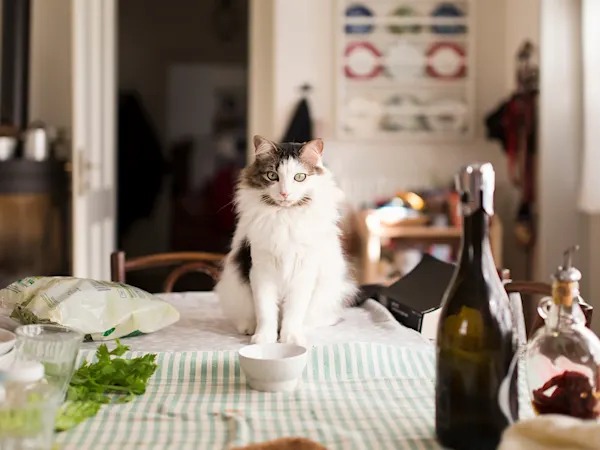
You feel it before you see it: your cat, parked a few feet away, staring at you with the unblinking focus of a tiny prosecutor. It is easy to take personally. It is also the wrong way to read it. A stare is not your cat being rude, and it is rarely nothing. It is a signal with several possible meanings, and the trick is that the stare itself is only half the message. The other half is written in the pupils, the ears, and whatever sound is or is not coming out of your cat. Learn to read all of it together and the glare stops being creepy and starts being useful.
Start with the eyes themselves
Before you decide why your cat is staring, look at how they are staring, beginning with the pupils.
The pupils tell you most of the story. A calm cat tends to have narrow, almond-shaped pupils. When you see them blown wide and round on a cat who is locked onto something, that is a flag for arousal, fear, or stress, and it is your cue to slow down and give space.
One honest caveat: pupil size also tracks light. Wide pupils in a dim room may mean nothing more than dim room. So read the pupils in context, not in isolation, and when you are unsure, treat a hard, wide-eyed stare as a “proceed gently” sign rather than an invitation.
The ears are the next tell. Ears swiveled to the sides or pinned flat back, especially paired with a stare, mean an unhappy cat who wants distance, not attention. And listen. A growl is the serious one, a clear warning that your cat feels unsafe and needs whatever is bothering them to back off. A hiss is a notch below that but still means “give me room.” A stare with either sound attached is not a moment to reach in for a pet.
The reasons behind the glare
Once you have a read on the mood from the eyes, ears, and sound, the situation usually explains the rest. Here are the common reasons cats stare, roughly from most to least benign.
They want something, usually from you. This is the everyday classic. The stare that materializes ten minutes before dinner, then creeps closer and drops lower, is a request. If you fail to produce the food, the next step is often a paw deliberately shoving something off a shelf. Whether it is a meal, a play session, or attention they are after, a demanding stare is your cat managing their staff.
They are showing affection. Some stares are soft, and those are the good ones, especially when they come with a slow blink. A cat who gazes at you while slowly closing and opening their eyes, then glances away and back, is telling you they trust you and feel no threat. That brief look-away is actually the key difference between an affectionate gaze and a tense one. A relaxed cat breaks contact easily; a stressed cat locks on.
They are curious. Cats are nosy, and young or high-energy cats especially will stare simply to figure out what you are doing, what is in your hand, or why you are behaving like that. It is the same impulse that makes them supervise you in the bathroom. No deeper meaning required.
They are afraid. A fearful stare usually travels with a hunched body, a tucked tail, and those dilated, defensive pupils. Here the cat is not sizing you up so much as bracing. If your cat stares at an unfamiliar person or another animal this way, they are evaluating a perceived threat, and crowding them will only raise the stakes.
They are in pain. This is the one owners miss most, because cats are built to hide discomfort. A cat who is hurting may squint, or seem to stare through you into the middle distance, and hold themselves stiffly. If a new, glassy, checked-out staring habit shows up alongside a change in how your cat moves, eats, or carries their body, it belongs on the vet’s radar rather than in the “quirky cat” file.
When a stare is worth acting on
Most staring is harmless, and you do not need to analyze every glance. The situations that deserve a response fall into two buckets: the stare aimed at you that comes with warning signals, and the stare that hints your cat is not okay.
For the first, the rule is simple. A long stare paired with flattened ears, wide pupils, a growl, or a hiss is a request for space. Do not answer it with a staring contest or a reach. Slowly look away and let your cat de-escalate. Cats generally break a stare within a few seconds, so a fixed, prolonged lock-on is itself a reason to pay closer attention.
For the second, watch for staring that comes bundled with signs of pain or illness, or a persistent, out-of-character change in your cat’s gaze and demeanor. That is when a veterinarian or a qualified behavior professional earns their fee, because a stare driven by an aching tooth, high blood pressure, or another medical issue will not resolve until the underlying cause does. Blood pressure problems in particular can affect the eyes, which is one more reason a sudden change in your senior cat’s staring or pupils is worth a check rather than a shrug.
The reframe that helps most: your cat is not staring at you so much as telling you something. Read the whole face, not just the eyes, and you will usually know exactly what.
References
- Humphrey, T., Proops, L., Forman, J., Spooner, R., and McComb, K. “The role of cat eye narrowing movements in cat-human communication.” Scientific Reports, 2020. https://www.nature.com/articles/s41598-020-73426-0
- International Cat Care. “Understanding your cat’s body language.” https://icatcare.org/advice/understanding-your-cats-body-language/
- Cornell Feline Health Center. “Feline Behavior Problems: Aggression.” https://www.vet.cornell.edu/departments-centers-and-institutes/cornell-feline-health-center/health-information/feline-health-topics/feline-behavior-problems-aggression
Common questions
Why does my cat stare at me?
Most often to get your attention, especially around mealtime, or to show quiet affection. Cats also stare out of plain curiosity. Less often, a stare signals fear or pain. The rest of the body, the pupils, ears, posture, and any sound, tells you which one it is.
Is my cat staring at me a sign of affection?
It can be, particularly when the stare is soft and paired with a slow blink. A relaxed cat with almond-shaped pupils who squints and looks away and back is showing trust, not threatening you.
When should I worry about my cat staring?
When the stare drags on far longer than a few seconds and comes with dilated pupils, flattened or sideways ears, a hunched or stiff body, or growling and hissing. A stare paired with signs of pain, like squinting or a tucked, tense posture, is worth a vet call.
Dr. Kohl is a board-certified veterinary dentist with a particular interest in preventive oral care. She reviews all dental health content at The Pet Times and contributes practical guides on home dental routines, professional cleaning, and oral disease prevention.
Meet our experts ↗Keep reading
 TrainingYou Can't Train a Cat Off the Counter. You Can Outbid Her.Dr. Mara Chen · 8 min
 LivingMy Cat Has Never Once Felt Awkward. I'm Taking Notes.Sasha Ford · 5 min
 TrainingYour Cat Knows Its Roommate's Name. It Just Won't Perform for You.Dr. Nina Kohl · 4 min
 TrainingThe Paw on Your Mouth at 4 A.M.? You Trained That.Dr. Amara Solis · 6 min
 TrainingYour Cat Knows When You're Watching. A Study Proved ItDr. Amara Solis · 5 min
 LivingYour Cat Didn't 'Imprint' on You Like a Duckling. What Actually Happened Is BetterDr. Nina Kohl · 7 min