


Your Cat Knows When You're Watching. A Study Proved It
The famous 'cats ask for help' study found something better than a party trick: cats track whether you're paying attention and change their behavior to match. Here's what that means for you.

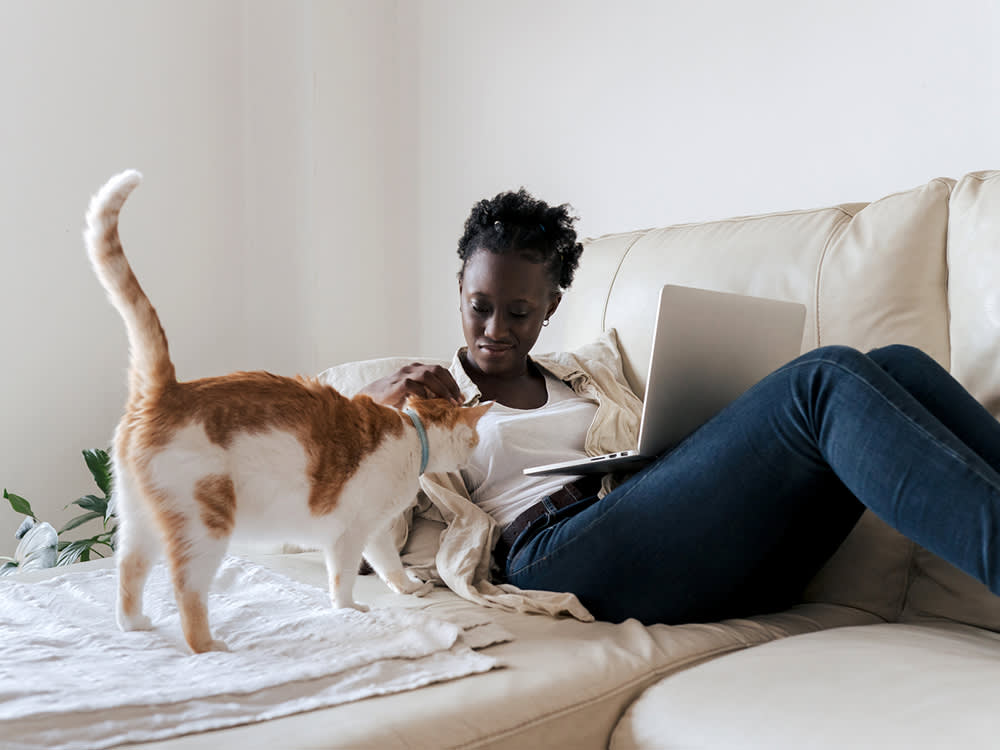
The tired story about cats is that they do not need us. Aloof, self-contained, mildly annoyed by our existence. It is a good line for a coffee mug and a bad description of what actually happens in most homes. And a study out of the University of Adelaide, published in the journal Animal Cognition, put a crack right down the middle of it.
The headline version, the one that made the rounds, was “cats ask humans for help.” True, but it undersells the finding. The more interesting result is that cats keep tabs on whether you are paying attention, and they adjust what they do based on the answer. Your attention is not background noise to a cat. It is a variable they are tracking.
What the researchers actually did
The setup was simple. A cat was given a task in two versions. In the first, a treat sat in a container the cat could open on its own. Solvable. In the second, the lid was closed and the treat was out of reach. Unsolvable, at least without help.
Then the researchers changed one more thing: whether the cat’s person was paying attention or looking away.
Here is what the cats did. With the solvable task, they mostly just got the treat themselves, no drama. With the unsolvable one, they turned to their humans, doing the thing scientists call gaze alternation: looking at the treat, then at the person, then back at the treat. It is the feline version of tapping you on the shoulder and pointing.
The kicker was the attention part. When their person was watching, cats looked over sooner, held the gaze longer, and worked the treat container more. When their person was tuned out, the cats shifted strategy. They were not performing into a void. They were reading the room and spending their effort where it might actually pay off.
That last piece is the one that changes how I think about my own cat. It is not just that she asks for help. It is that she checks whether I am the kind of audience worth asking, and behaves accordingly. That is social awareness, not instinct on autopilot.
Why this matters more than a cute finding
For years the research spotlight was on dogs, whose whole evolutionary deal is reading people. Cats got written off as the standoffish roommates of the animal world. Studies like this one are slowly rewriting that, and the picture that is emerging is a cat who is quietly, constantly gathering information about you.
The practical version is worth sitting with. If your cat seems to “only bother you when you are free,” that may not be a coincidence or your imagination. They may genuinely be timing their asks to your availability, because a look aimed at a person staring at a phone is a wasted look.
It also reframes a lot of behavior people read as demanding or manipulative. A cat staring at you and then at an empty bowl is not being passive-aggressive. It is using the exact communication tool the study documented, pointed at a problem it cannot solve alone.
How to actually answer your cat
Once you know cats track your attention, you can meet them halfway, and it tends to make the relationship smoother.
Notice the gaze-and-glance. When your cat looks at you and then at a door, a bowl, a closed cabinet, or a favorite toy stuck under the couch, that is a request, not a stare-down. Following the look is often all it takes.
Give them an attentive audience sometimes. A few minutes a day where you are genuinely available, not half-watching a screen, gives your cat the window they are looking for. Short and real beats long and distracted.
Respond consistently. Cats learn which of their signals get results. Answering the polite asks (a glance, a soft trill, a paw) teaches your cat they do not need to escalate to knocking things off the counter to be heard.
What newer research adds
The Adelaide study is not a one-off anymore; it sits inside a growing stack of work pointing the same direction. A widely cited study in Scientific Reports found that the slow blink, that lazy half-close of the eyes, functions as a friendly signal between cats and people, and that you can start a “conversation” by slow-blinking first. Other work on social referencing has shown cats will look to their owner’s emotional reaction when they meet something strange, and take cues from it, much the way a toddler checks a parent’s face.
And in 2024, a large survey study of hundreds of cats found that many showed real behavior changes after losing a companion animal, including seeking more attention and eating less. Researchers were careful not to overclaim the emotion behind it, but the behavioral pattern was clear. Put together, the last few years have quietly dismantled the idea of the indifferent cat. The animal that emerges instead is socially tuned in, watching you more closely than the stereotype ever gave them credit for, and adjusting to what they see.
References
- Zhang, L., Needham, K.B., Juma, S., et al. “Feline communication strategies when presented with an unsolvable task: the attentional state of the person matters.” Animal Cognition, vol. 24, 2021, pp. 1109-1119.
- Humphrey, T., Proops, L., Forman, J., et al. “The role of cat eye narrowing movements in cat-human communication.” Scientific Reports, vol. 10, 2020.
- Merola, I., Lazzaroni, M., Marshall-Pescini, S., Prato-Previde, E. “Social referencing and cat-human communication.” Animal Cognition, vol. 18, 2015.
- Greene, B., Delgado, M.M., et al. “Responses of domestic cats to the loss of another companion animal.” Applied Animal Behaviour Science, 2024.
Dr. Solis is a board-certified veterinary dermatologist with over twelve years of clinical experience. She advises on skin conditions, allergies, and grooming practices that affect coat and skin health. All dermatology and allergy content at The Pet Times is reviewed by her team before publication.
Meet our experts ↗Keep reading
 TrainingYour Cat's Tail Isn't Talking to You. It's Talking to Whatever They're Looking At.Dr. Nina Kohl · 7 min
 TrainingThe One Piece of Cat Body Language You Can Speak, Not Just ReadDr. Mara Chen · 5 min
 TrainingYour Cat Isn't Seeing Ghosts. They're Seeing What You Can't.Nina Vasquez · 5 min
 TrainingThat Old Sweater Isn't Comforting Your Cat. It's Just Soft.Dr. Mara Chen · 8 min
 TrainingThat Sneer Is Your Cat Tasting the Air. Here's the Organ Doing ItDr. Amara Solis · 5 min
 First DaysYour Older Cat Doesn't Hate the Kitten. It Hates the Energy.Dr. Priya Nair · 7 min