


Cucumbers Are a Safe, Hydrating Snack for Cats. The Viral Scare Video Is the Real Danger
Yes, cats can eat cucumber, and it's mostly water with a satisfying crunch. The thing to unlearn is the internet trick of scaring cats with one, which does real harm.

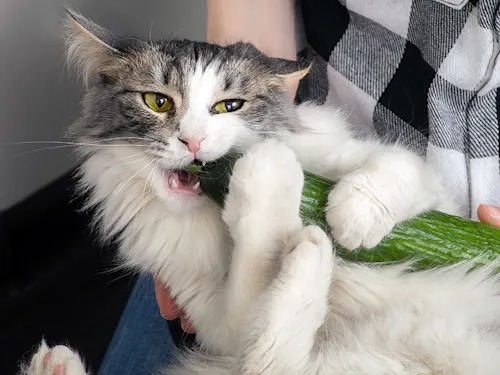
Cucumber is one of the easiest foods on this whole list to clear: it is nontoxic, mostly water, and a perfectly good crunchy snack for a cat who likes it. So instead of spending 1,500 words relitigating whether a cucumber is safe, let’s deal with the thing that actually hurts cats around cucumbers, which is us. The viral “scare your cat with a cucumber” videos are not harmless fun. They are the one genuine cucumber-related risk in most homes, and they are worth understanding before we get to the snack.
The scare video is the real hazard
You have seen the clips: someone quietly sets a cucumber behind a cat that’s eating, the cat turns, sees it, and rockets into the air. It reads as funny. It isn’t. To a cat, a strange object that appears silently at close range, right where a predator might, triggers a hardwired startle-and-flee response. The cat isn’t playing. It is genuinely frightened, and a cat launched into panic can crash into furniture, hurt itself, or, with enough repetition, become chronically anxious in the one place it should feel safest: near its food.
The cucumber trick isn’t a cat quirk, it’s a fear response we’re filming for laughs. You’re teaching your cat that danger can appear out of nowhere while they eat. Do it enough and you get a cat who won’t relax at the bowl. That’s a real behavior problem for a ten-second video.
So the first rule of cats and cucumbers has nothing to do with digestion: don’t ambush your cat with one. If you want to share cucumber, offer it openly, the way you’d offer any treat.
Why cucumber is actually a decent snack
With that out of the way, the food part is genuinely easy. Cucumber is the fruit of Cucumis sativus, and nutritionally it is close to plain water with a crunch. That is exactly what makes it useful:
It is about 95 percent water, which is a quiet win for a species famous for not drinking enough. Many cats run mildly dehydrated, and a hydrating snack is a gentle way to add a little water, especially for cats prone to urinary or kidney issues.
It is very low in sugar and calories, so unlike most fruit, it doesn’t come with a weight-gain asterisk. For a cat who loves to crunch on something, cucumber gives them the texture without the calories.
It has a bit of fiber, mostly in the skin, plus some antioxidants and a compound called cucurbitacin that researchers are studying for anti-inflammatory and anti-cancer properties. None of that is a reason to feed cucumber for its health benefits, but it means the snack isn’t empty either.
How to serve it
Keep it simple. Offer a small, thin, bite-sized piece of plain cucumber. Peeling is optional but genuinely helps for two reasons: the skin holds most of the fiber, so peeling lowers the chance of gas or loose stool, and the skin holds the bitter cucurbitacin, so peeling makes it more appealing to a picky cat. Start with a tiny amount to see how the stomach handles it.
The one hard “no” is pickles and prepared cucumber dishes. The cucumber is fine, but pickling and seasoning bring salt, vinegar, and often garlic or onion, and Allium vegetables are toxic to cats. Plain cucumber only.
And keep the whole thing in proportion. Cats are obligate carnivores; cucumber is a fun extra, not nutrition. All treats together should stay under about 10 percent of daily calories, with a complete cat food doing the real work.
What newer research adds
The science that’s moved most in recent years is on cucurbitacins, the bitter compounds concentrated in cucumber skin and stem. Lab studies continue to explore them for anti-cancer and anti-inflammatory activity, which is why cucumber keeps showing up on “superfood” lists. It’s worth translating that plainly for cat owners: those findings involve isolated compounds in controlled studies, not the sliver of cucumber your cat crunches, and high concentrations of cucurbitacin are actually what make some cucumber parts taste bitter and cause stomach upset. The practical guidance is unchanged and even a touch more cautious: stick to the flesh, go easy on the skin, and don’t read a research headline as a reason to feed more.
The bottom line
Cucumber is a safe, hydrating, low-calorie snack, and a fine thing to share with a curious cat, as long as it’s plain and offered openly. The part to actually change is the ambush. Skip the scare video, hand your cat a slice like you mean it, and let the cucumber be what it is: mostly water, a little crunch, and no drama.
References
- ASPCA Animal Poison Control Center. “People Foods to Avoid Feeding Your Pets.”
- ASPCA Animal Poison Control Center. “Toxic and Non-Toxic Plants: Cucumber.”
- Kaushik, U., et al. “Cucurbitacins – An Insight into Medicinal Leads from Nature.” Pharmacognosy Reviews / International Journal of Health Sciences.
- North Carolina Extension Gardener. “Cucumis sativus.”
Common questions
Why do cats freak out at cucumbers?
It is not the cucumber, it's the surprise. A cucumber placed silently behind a cat mimics a sudden threat and triggers a startle response. It's not a game, and it can genuinely stress your cat.
Should I peel cucumber for my cat?
Peeling is optional but helps. The skin holds most of the fiber and the bitter compounds, so peeling makes it gentler on the stomach and more palatable for picky cats.
Not a substitute for your vet. Our guidance is educational. For urgent symptoms, contact a vet or emergency clinic right away. Editorial standards
Dr. Mehta is a board-certified veterinary nutritionist who evaluates pet food formulations, ingredient quality, and the science behind dietary trends. He writes and reviews all nutrition content at The Pet Times, including our food rankings and feeding guides.
Meet our experts ↗Keep reading
 FoodYour Cat Can Eat Sweet Potato. Your Cat Also Doesn't Care About ItDr. Mara Chen · 6 min
 FoodPeanut Butter Is a Dog Trick. Here's Why It's Riskier for Your CatDr. Mara Chen · 4 min
 FoodShrimp Is the Rare Cat Treat That's Actually Lean, If You Lose the ShellDr. Priya Nair · 6 min
 FoodRaspberries Are Safe for Your Cat. Your Cat Just Doesn't Care.Dr. Priya Nair · 5 min
 FoodCats and Peaches: The Sweet Flesh Is Safe. The Pit Is a Trip to the ERDr. Lena Park · 5 min
 FoodPopcorn Is Safe for Cats. The Stuff We Put on It Is the ProblemDr. Ravi Mehta · 6 min